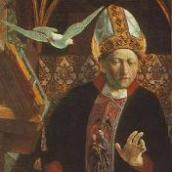
De Spiritu Sancto.
Chapter I
Prefatory remarks on the need of exact investigation of the most
minute portions of theology.
1. Your desire for information, my right well-beloved and most deeply
respected brother Amphilochius, I highly commend, and not less your industrious
energy. I have been exceedingly delighted at the care and watchfulness
shewn in the expression of your opinion that of all the terms concerning
God in every mode of speech, not one ought to be left without exact investigation.
You have turned to good account your reading of the exhortation of the
Lord, "Every one that asketh receiveth, and he that seeketh findeth"1 and
by your diligence in asking might, I ween, stir even the most reluctant
to give you a share of what they possess. And this in you yet further moves
my admiration, that you do not, according to the manners of the most part
of the men of our time, propose your questions by way of mere test, but
with the honest desire to arrive at the actual truth. There is no lack
in these days of captious listeners and questioners; but to find a character
desirous of information, and seeking the truth as a remedy for ignorance,
is very difficult. Just as in the hunters snare, or in the soldier's ambush,
the trick is generally ingeniously concealed, so it is with the inquiries
of the majority of the questioners who advance arguments, not so much with
the view of getting any good out of them, as in order that, in the event
of their failing to elicit answers which chime in with their own desires,
they may seem to have fair ground for controversy.
2. If "To the fool on his asking for wisdom, wisdom shall be reckoned,"2
at how high a price shall we value "the wise hearer" who is quoted by the
Prophet in the same verse with "the admirable counsellor"?3 It is right,
I ween, to hold him worthy of all approbation, and to urge him on to further
progress, sharing his enthusiasm, and in all things toiling at his side
as he presses onwards to perfection. To count the terms used in theology
as of primary importance, and to endeavour to trace out the hidden meaning
in every phrase and in every syllable, is a characteristic wanting in those
who are idle in the pursuit of true religion, but distinguishing all who
get knowledge of "the mark" "of our calling;"4 for what is set before us
is, so far as is possible with human nature, to be made like unto God.
Now without knowledge there can be no making like; and knowledge is not
got without lessons. The beginning of teaching is speech, and syllables
and words are parts of speech. It follows then that to investigate syllables
is not to shoot wide of the mark, nor, because the questions raised are
what might seem to some insignificant, are they on that account to be held
unworthy of heed. Truth is always a quarry hard to hunt, and therefore
we must look everywhere for its tracks. The acquisition of true religion
is just like that of crafts; both grow bit by bit; apprentices must despise
nothing. If a man despise the first elements as small and insignificant,
he will never reach the perfection of wisdom.
Yea and Nay are but two syllables, yet there is often involved in these
little words at once the best of all good things, Truth, and that beyond
which wickedness cannot go, a Lie. But why mention Yea and Nay? Before
now, a martyr bearing witness for Christ has been judged to have paid in
full the claim of true religion by merely nodding his head.5 If, then,
this be so, what term in theology is so small but that the effect of its
weight in the scales according as it be rightly or wrongly used is not
great? Of the law we are told "not one jot nor one tittle shall pass away;"6
how then could it be safe for us to leave even the least unnoticed? The
very points which you yourself have sought to have thoroughly sired by
us are at the same time both small and great. Their use is the matter of
a moment, and peradventure they are therefore made of small account; but,
when we reckon the force of their meaning, they are great. They may be
likened to the mustard plant which, though it be the least of shrub-seeds,
yet when properly cultivated and the forces latent in its germs unfolded,
rises to its own sufficient height.
If any one laughs when he sees our subtilty, to use the Psalmist's7
words, about syllables, let him know that he reaps laughter's fruitless
fruit; and let us, neither giving in to men's reproaches, nor yet vanquished
by their disparagement, continue our investigation. So far, indeed, am
I from feeling ashamed of these things because they are small, that, even
if I could attain to ever so minute a fraction of their dignity, I should
both congratulate myself on having won high honour, and should tell my
brother and fellow-investigator that no small gain had accrued to him therefrom.
While, then, I am aware that the controversy contained in little words
is a very great one, in hope of the prize I do not shrink from toil, with
the conviction that the discussion will both prove profitable to myself,
and that my hearers will be rewarded with no small benefit. Wherefore now
with the help, if I may so say, of the Holy Spirit Himself, I will approach
the exposition of the subject, and, if you will, that I may be put in the
way of the discussion, I will for a moment revert to the origin of the
question before us.3. Lately when praying with the people, and using the
full doxology to God the Father in both forms, at one time "with the Son
together with the Holy Ghost," and at another "through the Son in the Holy
Ghost," I was attacked by some of those present on the ground that I was
introducing novel and at the same time mutually contradictory terms.8 You,
however, chiefly with the view of benefiting them, or, if they are wholly
incurable, for the security of such as may fall in with them, have expressed
the opinion that some clear instruction ought to be published concerning
the force underlying the syllables employed. I will therefore write as
concisely as possible, in the endeavour to lay down some admitted principle
for the discussion.
Chapter II
The origin of the heretics' close observation all syllables.
4. The petty exactitude of these men about syllables and words is not,
as might be supposed, simple and straightforward; nor is the mischief to
which it tends a small one. There is involved a deep and covert design
against true religion· Their pertinacious contention is to show
that the mention of Father, Son, and Holy Ghost is unlike, as though they
will thence find it easy to demonstrate that there is a variation in nature.
They have an old sophism, invented by Aetius, the champion of this heresy,
in one of whose Letters there is a passage to the effect that things naturally
unlike are expressed in unlike terms, and, conversely, that things expressed
in unlike terms are naturally unlike. In proof of this statement he drags
in the words of the Apostle, "One God and Father of whom are all things,
... and one Lord Jesus Christ by whom are all things·"9 "Whatever,
then," he goes on, "is the relation of these terms to one another, such
will be the relation of the natures indicated by them; and as the term
`of whom' is unlike the term `by whom,' so is the Father unlike the Son."10
On this heresy depends the idle subtilty of these men about the phrases
in question. They accordingly assign to God the Father, as though it were
His distinctive portion anti lot, the phrase "of Whom;" to God the Son
they confine the phrase "by Whom;" to the Holy Spirit that of "in Whom,"
and say that this use of the syllables is never interchanged , in order
that. as I have already said, the variation of language may indicate the
variation of nature.11 Verily it is sufficiently obvious that in their
quibbling about the words they are endeavouring to maintain the force of
their impious argument.
By the term "of whom" they wish to indicate the Creator; by the term
"through whom," the subordinate agent12 or instrument;13 by the term "in
whom," or "in which," they mean to shew the time or place. The object of
all this is that the Creator of the universe14 may be regarded as of no
higher dignity than an instrument, and that the Holy Spirit may appear
to be adding to existing things nothing more than the contribution derived
from place or time.
Chapter III.
The systematic discussion of syllables is derived from heathen philosophy.
5. They have, however, been led into this error by their close study
of heathen writers, who have respectively applied the terms "of whom" and
"through whom" to things which are by nature distinct. These writers suppose
that by the term "of whom" or "of which" the matter is indicated, while
the term "through whom" or "through which"15 represents the instrument,
or, generally speaking, subordinate agency? Or rather-for there seems no
reason why we should not take up their whole argument, and briefly expose
at once its incompatibility with the truth and its inconsistency with their
own teaching-the students of vain philosophy, while expounding the manifold
nature of cause and distinguishing its peculiar significations, define
some causes as principal,16 some as cooperative or con-causal, while others
are of the character of "sine qua non," or indispensable?17
For every one of these they have a distinct and peculiar use of terms,
so that the maker is indicated in a different way from the instrument.
For the maker they think the proper expression is "by whom," maintaining
that the bench is produced "by" the carpenter; and for the instrument "through
which," in that it is produced "through" or by means of adze and gimlet
and the rest. Similarly they appropriate "of which" to the material, in
that the tiring made is "of" wood, while "according to which" shews the
design, or pattern put before the craftsman. For he either first makes
a mental sketch, and so brings his fancy to bear upon what he is about,
or else he looks at a pattern previously put before him, and arranges his
work accordingly. The phrase "on account of which" they wish to be confined
to the end or purpose, the bench, as they say, being produced for, or on
account of, the use of man. "In which" is supposed to indicate time and
place. When was it produced? In this time. And where? In this place. And
though place and time contribute nothing to what is being produced, yet
without these the production of anything is impossible, for efficient agents
must have both place and time. It is these careful distinctions, derived
from unpractical philosophy and vain delusion,18 which our opponents have
first studied and admired, and then transferred to the simple and unsophisticated
doctrine of the Spirit, to the belittling of God the Word, and the setting
at naught of the Divine Spirit. Even the phrase set apart by non-Christian
writers for the case of lifeless instruments19 or of manual service of
the meanest kind, I mean the expression "through or by means of which,"
they do not shrink from transferring to the Lord of all, and Christians
feel no shame in applying to the Creator of the universe language belonging
to a hammer or a saw.
Chapter IV.
That there is no distinction in the scriptural use of these syllables.
6. We acknowledge that the word of truth has in many places made use
of these expressions; yet we absolutely deny that the freedom of the Spirit
is in bondage to the pettiness of Paganism. On the contrary, we maintain
that Scripture varies its expressions as occasion requires, according to
the circumstances of the case. For instance, the phrase "of which" does
not always and absolutely, as they suppose, indicate the material,20 but
it is more in accordance with the usage of Scripture to apply this term
in the case of the Supreme Cause, as in the words "One God, of whom are
all things,"21 and again, "All things of God."22 The word of truth has,
however, frequently used this term in the case of the material, as when
it says "Thou shalt make an ark of incorruptible wood;"23 and "Thou shall
make the candlestick of pure gold ;"24 and "The first man is of the earth,
earthy;25 and "Thou art formed out of clay as I am."26 But these men, to
the end, as we have already remarked, that they may establish the difference
of nature, have laid down the law that this phrase befits the Father alone.
This distinction they have originally derived from heathen authorities,
but here they have shewn no faithful accuracy of limitation. To the Son
they have in conformity with the teaching of their masters given the title
of instrument, and to the Spirit that of place, for they say in the Spirit,
and through the Son. But when they apply "of whom" to God they no longer
follow heathen example, but "go over, as they say, to apostolic usage,
as it is said, "But of him are ye in Christ Jesus,"27 and "All things of
God."28 What, then, is the result of this systematic discussion? There
is one nature of Cause; another of Instrument; another of Place. So the
Son is by nature distinct from the Father, as the tool from the craftsman;
and the Spirit is distinct in so far as place or time is distinguished
from the nature of tools or from that of them that handle them.
Chapter V
That "through whom" is said also in the case of the Father, and "of
whom" in the case of the San and of the Spirit.
7. After thus describing the outcome of our adversaries' arguments,
we shall now proceed to shew, as we have proposed, that the Father does
not first take "of whom" and then abandon "through whom" to the Son; and
that there is no truth in these men's ruling that the Son refuses to admit
the Holy Spirit to a share in "of whom" or in "through whom," according
to the limitation of their new-fangled allotment of phrases. "There is
one God and Father of whom are all things, and one Lord Jesus Christ through
whom are all things."29
Yes; but these are the words of a writer not laying down a rule, but
carefully distinguishing the hypostases.30
The object of the apostle in thus writing was not to introduce the diversity
of nature, but to exhibit the notion of Father and of Son as unconfounded.
That the phrases are not opposed to one another and do not, like squadrons
in war marshalled one against another, bring the natures to which they
are applied into mutual conflict, is perfectly, plain from the passage
in question. The blessed Paul brings both phrases to bear upon one and
the same subject, in the words "of him and through him and to him are all
things."31 That this plainly refers to the Lord will be admitted even by
a reader paying but small attention to the meaning of the words. The apostle
has just quoted from the prophecy of Isaiah, "Who hath known the mind of
the Lord, or who hath been his counsellor,32 and then goes on, "For of
him and from him and to him are all things." That the prophet is speaking
about God the Word, the Maker of all creation, may be learnt from what
immediately precedes: "Who hath measured the waters in the hollow of his
hand, and meted out heaven with the span, and comprehended the dust of
the earth in a measure, and weighed the mountains in scales, and the hills
in a balance? Who hath directed the Spirit of the Lord, or being his counsellor
hath taught him?"33 Now the word "who" in this passage does not mean absolute
impossibility, but rarity, as in the passage "Who will rise up for me against
the evil doers?"34 and "What man is he that desireth life?"35 and "Who
shall ascend into the hill of the Lord?"36 So is it in the passage in question,
"Who hath directed [lxx., known] the Spirit of the Lord, or being his counsellor
hath known him?" "For the Father loveth the Son and sheweth him all things."37
This is He who holds the earth, and hath grasped it with His hand. who
brought all things to order and adornment, who poised38 the hills in their
places, and measured the waters, and gave to all things in the universe
their proper rank, who encompasseth the whole of heaven with but a small
portion of His power, which, in a figure, the prophet calls a span. Well
then did the apostle add "Of him and through him and to him are all things."39
For of Him, to all things that are, comes the cause of their being, according
to the will of God the Father. Through Him all things have their continuance40
and constitution,41 for He created all things, and metes out to each severally
what is necessary for its health and preservation. Wherefore to Him all
things are turned, looking with irresistible longing and unspeakable affection
to "the arthur"42 and maintainer" of" their "life," as it is written "The
eyes of all wait upon thee,"43 and again, "These wait all upon thee,"44
and "Thou openest thine hand, and satisfiest the desire of every living
thing."45
8. But if our adversaries oppose this our interpretation, what argument
will save them from being caught in their own trap?
For if they will not grant that the three expressions "of him" and "through
him" and "to him" are spoken of the Lord, they cannot but be applied to
God the Father. Then without question their rule will fall through, for
we find not only "of whom," but also "through whom" applied to the Father.
And if this latter phrase indicates nothing derogatory, why in the world
should it be confined, as though conveying the sense of inferiority, to
the Son? If it always and everywhere implies, ministry, let them tell us
to what superior the God of glory46 and Father of the Christ is subordinate.
They are thus overthrown by their own selves, while our position will
be on both sides made sure. Suppose it proved that the passage refers to
the Son, "of whom" will be found applicable to the Son. Suppose on the
other hand it be insisted that the prophet's words relate to God, then
it will be granted that "through whom" is properly used of God, and both
phrases have equal value, in that both are used with equal force of God.
Under either alternative both terms, being employed of one and the same
Person, will be shewn to be equivalent. But let us revert to our subject.
9. In his Epistle to the Ephesians the apostle says, "But speaking the
truth in love, may grow up into him in all things, which is the head, even
Christ; from whom the whole body filly joined together and compacted by
that which every joint supplieth, according to the effectual working in
the measure of every part, maketh increase of the body."47
And again in the Epistle to the Colossians, to them that have not the
knowledge of the Only Begotten, there is mention of him that holdeth "the
head," that is, Christ, "from which all the body by joints and bands having
nourishment ministered increaseth with the increase of God."48 And that
Christ is the head of the Church we have learned in another passage, when
the apostle says "gave him to be the head over all things to the Church,"49
and "of his fulness have all we received."50 And the Lord Himself says
"He shall take of mine, and shall shew it unto you."51 In a word, the diligent
reader will perceive that "of whom" is used in diverse manners.52 For instance,
the Lord says, "I perceive that virtue is gone out of me."53 Similarly
we have frequently observed "of whom" used of the Spirit. "He that soweth
to the spirit," it is said, "shall of the spirit reap life ever!asting."54
John too writes, "Hereby we know that he abideth in ns by(e0k) the spirit
which he hath given us."55 "That which is conceived in her," says the angel,
"is of the Holy Ghost,"56 and the Lord says "that which is born of the
spirit is spirit."57 Such then is the case so far.
10. It must now be pointed out that the phrase "through whom" is admitted
by cripture in the case of the Father and of the Son and of the Holy Ghost
alike. It would indeed be tedious to bring forward evidence of this in
the case of the Son, not only because it is perfectly well known, but because
this very point is made by our opponents. We now show that "through whom"
is used also in the case of the Father. "God is faithful," it is said,
"by whom (di' ou\) ye were called unto the fellowship of his Son,"58 and
"Paul an apostle of Jesus Christ by (dia/) the will of God;" and again,
"Wherefore thou art no more a servant, but a son; and if a son, then an
heir through God."59 And "like as Christ was raised up from the dead by
(dia/) the glory of God the Father."60 Isaiah, moreover, says, "Woe unto
them that make deep counsel and not through the Lord; "61 and many proofs
of the use of this phrase in the-case of the Spirit might be adduced. "God
hath revealed him to us," it is said, "by (dia/) the spirit;"62 and in
another place, "That good thing which was committed unto thee keep by (dia/)
the Holy Ghost;"63 and again, "To one is given by (dia/) the spirit the
word of wisdom."64
11. In the same manner it may also be said of the word "in," that Scripture
admits its use in the case of God the Father. In the Old Testament it is
said through (e0n) God we shall do valiantly,65 and, "My praise shall be
Continually of (e0n) thee;"66 and again, "In thy name will I rejoice."67
In Paul we read, "In God who created all things,"68 and, I "Paul and Silvanus
and Timotheus unto the church of the Thessalonians in God our Father; "69
and "if now at length I might have a prosperous journey by (e0n) the will
of God to come to you;"70 and, "Thou makest thy boast of God."71 Instances
are indeed too numerous to reckon; but what we want is not so much to exhibit
an abundance of evidence as to prove that the conclusions of our opponents
are unsound. I shall, therefore, omit any proof of this usage in the case
of our Lord and of the Holy Ghost, in that it is notorious. But I cannot
forbear to remark that "the wise hearer" will find sufficient proof of
the proposition before him by following the method of contraries. For if
the difference of language indicates, as we are told, that the nature has
been changed, then let identity of language compel our adversaries to confess
with shame that the essence is unchanged.
12. And it is not only in the case of the theology that the use of the
terms varies,72 but whenever one of the terms takes the meaning of the
other we find them frequently transferred from the one subject to the other.
As, for instance, Adam says, "I have gotten a man through God,"73 meaning
to say the same as from God; and in another passage "Moses commanded ...
Israel through the word of the Lord,"74 and, again, "Is not the interpretation
through God?"75 Joseph, discoursing about dreams to the prisoners, instead
of saying "from God" says plainly "through God." Inversely Paul uses the
term "from whom" instead of "through whom," when he says "made from a woman"
(A.V., "of" instead of "through a woman").76 And this he has plainly distinguished
in another passage, where he says that it is proper to a woman to be made
of the man, and to a man to be made through the woman, in the words "For
as the woman is from [A.V., of] the man, even so is the man also through
[A.V., by] the woman."77 Nevertheless in the passage in question the apostle,
while illustrating the variety of usage, at the same time corrects obiter
the error of those who supposed that the body of the Lord was a spiritual
body,78 and, to shew that the God-bearing79 flesh was formed out of the
common lump80 of human nature, gave precedence to the more emphatic preposition.
The phrase "through a woman" would be likely to give rise to the suspicion
of mere transit in the generation, while the phrase "of the woman" would
satisfactorily indicate that the nature was shared by the mother and the
offspring. The apostle was in no wise contradicting himself, but he shewed
that the words can without difficulty be interchanged. Since, therefore,
the term "from whom" is transferred to the identical subjects in the case
of which "through whom" is decided to be properly used, with what consistency
can these phrases be invariably distinguished one from the other, in order
that fault may be falsely found with true religion?
Chapter VI
Issue joined with those who assert that the Son is not with the Father,
but after the Father. Also concerning the equal glory.
13. Our opponents, while they thus artfully and perversely encounter
our argument, cannot even have recourse to the plea of ignorance. It is
obvious that they are annoyed with us for completing the doxology to the
Only Begotten together with the Father, and for not separating the Holy
Spirit from the Son. On this account they style us innovators, revolutionizers,
phrase-coiners, and every other possible name of insult. But so far am
I from being irritated at their abuse, that, were it not for the fact that
their loss causes me "heaviness and continual sorrow,"81 I could almost
have said that I was grateful to them for the blasphemy, as though they
were agents for providing me with blessing. For "blessed are ye," it is
said, "when men shall revile you for my sake."82 The grounds of their indignation
are these: The Son, according to them, is not together with the Father,
but after the Father. Hence it follows that glory should be ascribed to
the Father "through him," but not "with him;" inasmuch as "with him" expresses
equality of dignity, while "through him" denotes subordination. They further
assert that the Spirit is not to be ranked along with the Father and the
Son, but under the Son and the Father; not coordinated, but subordinated;
not connumerated, but subnumerated.83
With technical terminology of this kind they pervert the simplicity
and artlessness of the faith, and thus by their ingenuity, suffering no
one else to remain in ignorance, they cut off from themselves the plea
that ignorance might demand.
14. Let us first ask them this question: In what sense do they say that
the Son is "after the Father;" later in time, or in order, or in dignity?
But in time no one is so devoid of sense as to assert that the Maker of
the ages84 holds a second place, when no interval intervenes in the natural
conjunction of the Father with the Son.85 And indeed so far as our conception
of human relations goes,86 it is impossible to think of the Son as being
later than the Father, not only from the fact that Father and Son are mutually
conceived of in accordance with the relationship subsisting between them,
but because posteriority in time is predicated of subjects separated by
a less interval from the present, and priority of subjects farther off.
For instance, what happened in Noah's time is prior to what happened to
the men of Sodom, inasmuch as Noah is more remote from our own day; and,
again, the events of the history of the men of Sodom are posterior, because
they seem in a sense to approach nearer to our own day. But, in addition
to its being a breach of true religion, is it not really the extremest
folly to measure the existence of the life which transcends all time and
all the ages by its distance from the present? Is it not as though God
the Father could be compared with, and be made superior to, God the Son,
who exists before the ages, precisely in the same way in which things liable
to beginning and corruption are described as prior to one another?
The superior remoteness of the Father is really inconceivable, in that
thought and intelligence are wholly impotent to go beyond the generation
of the Lord; and St. John has admirably confined the conception within
circumscribed boundaries by two words, "In the beginning was the Word."
For thought cannot travel outside "was," nor imagination87 beyond "beginning."
Let your thought travel ever so far backward you cannot get beyond the
"was," and however you may strain and strive to see what is beyond the
Son, you will find it impossible to get further than the "beginning ".
True religion, therefore, thus teaches us to think of the Son together
with the Father.
15. If they really conceive of a kind of degradation of the Son in relation
to the Father, as though He were in a lower place, so that the Father sits
above, and the Son is thrust off to the next seat below, let them confess
what they mean. We shall have no more to say. A plain statement of the
view will at once expose its absurdity. They who refuse to allow that the
Father pervades all things do not so much as maintain the logical sequence
of thought in their argument. The faith of the sound is that God fills
all things;88 but they who divide their up and down between the Father
and the Son do not remember even the word of the Prophet: "If I climb up
into heaven thou art there; if I go down to hell thou art there also."89
Now, to omit all proof of the ignorance of those who predicate place of
incorporeal things, what excuse can be found for their attack upon Scripture,
shameless as their antagonism is, in the passages "Sit thou on my right
hand "90 and "Sat down on the right hand of the majesty of God"?91 The
expression "right hand" does not, as they contend, indicate the lower place,
but equality of relation; it is not understood physically, in which case
there might be something sinister about God,92 but Scripture puts before
us the magnificence of the dignity of the Son by the use of dignified language
indicating the seat of honour. It is left then for our opponents to allege
that this expression signifies inferiority of rank. Let them learn that
"Christ is the power of God and wisdom of God,"93 and that "He is the image
of the invisible God "94 and "brightness of his glory,"95 and that "Him
hath God the Father sealed,"96 by engraving Himself on Him.97
Now are we to call these passages, and others like them, throughout
the whole of Holy Scripture, proofs of humiliation, or rather public proclamations
of the majesty of the Only Begotten, and of the equality of His glory with
the Father? We ask them to listen to the Lord Himself, distinctly setting
forth the equal dignity of His glory with the Father, in His words, "He
that hath seen me hath seen the Father;"98 and again, "When the Son cometh
in the glory of his Father;"99 that they "should honour the Son even as
they henour the Father;"100 and, "We beheld his glory, the glory as of
the only begotten of the Father;"101 and "the only begotten God which is
in the bosom of the Father."102 Of all these passages they take no account,
and then assign to the Son the place set apart for His foes. A father's
bosom is a fit and becoming seat for a son, but the place of the footstool
is for them that have to be forced to fall.103
We have only touched cursorily on these proofs, because our object is
to pass on to other points. You at your leisure can put together the items
of the evidence, and then contemplate the height of the glory and the preeminence
of the power of the Only Begotten. However, to the well-disposed bearer,
even these are not insignificant, unless the terms "right hand" and "bosom"
be accepted in a physical and derogatory sense, so as at once to circumscribe
God in local limits, and invent form, mould, and bodily position, all of
which are totally distinct from the idea of the absolute, the infinite,
and the incorporeal. There is moreover the fact that what is derogatory
in the idea of it is the same in the case both of the Father and the Son;
so that whoever repeats these arguments does not take away the dignity
of the Son, but does incur the charge of blaspheming the Father; for whatever
audacity a man be guilty of against the Son he cannot but transfer to the
Father. If he assigns to the Father the upper place by way of precedence,
and asserts that the only begotten Son sits below, he will find that to
the creature of his imagination attach all the consequent conditions of
body. And if these are the imaginations of drunken delusion and phrensied
insanity, can it be consistent with true religion for men taught by the
Lord himself that "He that honoureth not the Son honoureth not the Father"104
to refuse to worship and glorify with the Father him who in nature, in
glory, and in dignity is conjoined with him? What shall we say? What just
defence shall we have in the day of the awful universal judgment of all-creation,
if, when the Lord clearly announces that He will come "in the glory of
his Father;"105 when Stephen beheld Jesus standing at the right hand of
God;106 when Paul testified in the spirit concerning Christ "that he is
at the right hand of God;"107 when the Father says, "Sit thou on my right
hand;"108 when the Holy Spirit bears witness that he has sat down on "the
right hand of the majesty"109 of God; we attempt to degrade him who shares
the honour and the throne, from his condition ofequality, to a lower state?110
Standing and sitting, I apprehend, indicate the fixity and entire stability
of the nature, as Baruch, when he wishes to exhibit the immutability and
immobility of the Divine mode of existence, says, "For thou sittest for
ever and we perish utterly."111 Moreover, the place on the right hand indicatesin
my judgmentequality of honour. Rash, then, is the attempt to deprive the
Son of participation in the doxology, as though worthy only to be ranked
in a lower place of honour.
Chapter VII
Against those who assert that it is not proper for "with whom" to be
said of the Son, and that the proper hrase is "through whom."
16. But their contention is that to use the phrase" with him" is altogether
strange and unusual, while "through him" is at once most familiar in Holy
Scripture, and very common in the language of the brotherhood.112 What
is our answer to this? We say, Blessed are the ears that have not heard
you and the hearts that have been kept from the wounds of your words. To
you, on the other hand, who are lovers of Christ,113 I say that the Church
recognizes both uses, and deprecates neither as subversive of the other.
For whenever we are contemplating the majesty of the nature of the Only
Begotten, and the excellence of His dignity, we bear witness that the glory
is with the Father; while on the other hand, whenever we bethink us of
His bestowal114 on us of good gifts, and of oar access115 to, and admission
into, the household of God,116 we confess that this grace is effected for
us through Him and by117 Him.
It follows that the one phrase "with whom" is the proper one to be used
in the ascription of glory, while the other, "through whom," is specially
appropriate in giving of thanks. It is also quite untrue to allege that
the phrase "with whom" is unfamiliar in the usage of the devout. All those
whose soundness of character leads them to hold the dignity of antiquity
to be more honourable than mere new-fangled novelty, and who have preserved
the tradition of their fathers118 unadulterated, alike in town and in country,
have employed this phrase. It is, on the contrary, they who are surfeited
with the familiar and the customary, and arrogantly assail the old as stale,
who welcome innovation, just as in dress your lovers of display always
prefer some utter novelty to what is generally worn. So you may even still
see that the language of country folk preserves the ancient fashion, while
of these, our cunning experts119 in Iogomachy, the language bears the brand
of the new philosophy.
What our fathers said, the same say we, that the glory of the Father
and of the Son is common; wherefore we offer the doxology to the Father
with the Son. But we do not rest only on the fact that such is the tradition
of the Fathers; for they too followed the sense of Scripture, and started
from the evidence which, a few sentences back, I deduced from Scripture
and laid before you. For "the brightness" is always thought of with "the
glory,"120 "the image" with the archetype,121 and the Son always and everywhere
together with the Father; nor does even the close connexion of the names,
much less the nature of the things, admit of separation.
Chapter VIII
In how many ways "Through whom "is used; and in what sense "with whom"
is more suitable. Explanation of how the Son receives a commandment, and
how late is sent.
17. When, then, the apostle "thanks God through Jesus Christ,"122 and
again says that "through Him" we have "received grace and apostleship for
obedience to the faith among all nations,"123 or "through Him have access
unto this grace wherein we stand and rejoice,"124 he sets forth the boons
conferred on us by the Son, at one time making the grace of the good gifts
pass through from the Father to us, and at another bringing us to the Father
through Himself. For by saying "through whom we have received grace and
apostleship,"125 he declares the supply of the good gifts to proceed from
that source; and again in saying "through whom we have had access,"126
he sets forth our acceptance and being made "of the household of God"127
through Christ. Is then the confession of the grace wrought by Him to usward
a detraction from His glory? Is it not truer to say that the recital of
His benefits is a proper argument for glorifying Him? It is on this account
that we have not found Scripture describing the Lord to us by one name,
nor even by such terms alone as are indicative of His godhead and majesty.
At one time it uses terms descriptive of His nature, for it recognises
the "name which is above every name,"128 the name of Son,129 and speaks
of true Son,130 and only begotten God,131 and Power of God,132 and Wisdom,133
and Word.134 Then again, on account of the divers manners135 wherein grace
is given to us, which, because of the riches of His goodness,136 according
to his manifold137 wisdom, he bestows on them that need, Scripture designates
Him by innumerable other titles, calling Him Shepherd,138 King139 Physician,140
Bridegroom,141 Way,142 Door,143 Fountain,144 Bread,145 Axe,146 and Rock.147
And these, titles do not set forth His nature, but, as I have remarked,
the variety of the effectual working which, out of His tender-heartedness
to His own creation, according to the peculiar necessity of each, He bestows
upon them that need. Them that have fled for refuge to His ruling care,
and through patient endurance have mended their wayward ways,148 He calls
"sheep," and confesses Himself to be, to them that hear His voice and refuse
to give heed to strange teaching, a "shepherd." For "my sheep, He says,
"hear my voice." To them that have now reached a higher stage and stand
in need of righteous royalty,149 He is a King. And in that, through the
straight way of His commandments, He leads men to good actions, and again
because He safely shuts in all who through faith in Him betake themselves
for shelter to the blessing of the higher wisdom,150 He is a Door.So He
says, "By me if any man enter in, ... he shall go in and out and shall
find pastare."151 Again, because to the faithful He is a defence strong,
unshaken, and harder to break than any bulwark, He is a Rock. Among these
titles, it is when He is styled Door, or Way, that the phrase "through
Him" is very appropriate and plain. As, however, God and Son, He is glorified
with and together with152 the Father, in that "at, the name of Jesus every
knee should bow, of things in heaven, and things in earth, and things under
the earth; and that every tongue should confess that Jesus Christ is Lord,
to the glory of God the Father."153 Wherefore we use both terms, expressing
by the one His own proper dignity, and by the other His grace to usward.
18. For "through Him" comes every succour to our souls, and it is in
accordance with each kind of care that an appropriate title has been devised.
So when He presents to Himself the blameless soul, not having spot or wrinkle,154
like apure maiden, He is called Bridegroom, but whenever He receives one
in sore plight from the devil's evil strokes, healing it in the heavy infirmity
of its sins, He is named Physician. And shall this His care for us degrade
to meanness oar thoughts of Him? Or, on the contrary, shall it smite us
with amazement at once at the mighty power and love to man155 of the Saviour,
in that He both endured to suffer with us156 in our infirmities, and was
able to come down to our weakness? For not heaven and earth and the great
seas, not the creatures that live in the water and on dry land, not plants,
and stars, and air, and seasons, not the vast variety in the order of the
universe,157 so well sets forth the excellency of His might as that God,
being incomprehensible, should have been able, impassibly, through flesh,
to have come into close conflict with death, to the end that by His own
suffering He might give us the boon of freedom from suffering.158 The apostle,
it is true, says, "In all these things we are more than conquerors through
him that loved us."159 But in a phrase of this kind there is no suggestion
of any lowly and subordinate ministry,160 but rather of the succour rendered
"in the power of his might."161 For He Himself has bound the strong man
and spoiled his goods,162 that is, us men, whom our enemy had abused in
every evil activity, and made "vessels meet for the Master's use "163 us
who have been perfected for every work through the making ready of that
part of us which is in our own control.164 Thus we have had our approach
to the Father through Him, being translated from "the power of darkness
to be partakers of the inheritance of the saints in light."165 We must
not, however, regard the oeconomy166 through the Son as a compulsory and
subordinate ministration resulting from the low estate of a slave, but
rather the voluntary solicitude working effectually for His own creation
in goodness and in pity, according to the will of God the Father. For we
shall be consistent with true religion if in all that was and is from tithe
to time perfected by Him, we both bear witness to the perfection of His
power, and in no case put it asunder from the Father's will. For instance,
whenever the Lord is called the Way, we are carried on to a higher meaning,
and not to that which is derived from the vulgar sense of the word. We
understand by Way that advance167 to perfection which is made stage by
stage, and in regular order, through the works of righteousness and" the
illumination of knowledge;"168 ever longing after what is before, and reaching
forth unto those things which remain,169 until we shall have reached the
blessed end, the knowledge of God, which the Lord through Himself bestows
on them that have trusted in Him. For our Lord is an essentially good Way,
where erring and straying are unknown, to that which is essentially good,
to the Father. For "no one," He says, "cometh to the Father but ["by" A.V.]
through me."170 Such is our way up to God "through the Son."
19. It will follow that we should next in order point out the character
of the provision of blessings bestowed on us by the Father "through him."
Inasmuch as all created nature, both this visible world and all that is
conceived of in the mind, cannot hold together without the care and providence
of God, the Creator Word, the Only begotten God, apportioning His succour
according to the measure of the needs of each, distributes mercies various
and manifold on account of the many kinds and characters of the recipients
of His bounty, but appropriate to the necessities of individual requirements.
Those that are confined in the darkness of ignorance He enlightens: for
this reason He is true Light.171 Portioning requital in accordance with
the desert of deeds, He judges: for this reason He is righteous Judge.172
"For the Father judgeth no man, but hath committed all judgment to the
Son."173 Those that have lapsed from the lofty height of life into sin
He raises from their fall: for this reason He is Resurrection.174 Effectually
working by the much of His power and the will of His goodness He does all
things. He shepherds; He enlightens; He nourishes; He heals; He guides;
He raises up; He calls into being things that were not; He upholds what
has been created. Thus the good things that come from God reach us "through
the Son," who works in each case with greater speed than speech can utter.
For not lightnings, not light's course in air, is so swift; not eyes' sharp
turn, not the movements of our very thought. Navy by the divine energy
is each one of these in speed further surpassed than is the slowest of
all living creatures outdone in motion by birds, or even winds, or the
rush of the heavenly bodies: or, not to mention these, by our very thought
itself. For what extent of time is needed by Him who "upholds all things
by the word of His power, "175 and works not by bodily agency, nor requires
the help of hands to form and fashion, but holds in obedient following
and unforced consent the nature of all things that are? So as Judith says,
"Thou hast thought, and what things thou didst determine were ready at
hand."176 On the other hand, and test we should ever be drawn away by the
greatness of the works wrought to imagine that the Lord is without beginning,177
what saith the Self-Existent?178 "I live through [by, A.V.] the Father,
"179 and the power of God; "The Son hath power [can, A.V.] to do nothing
of himself. "180 And the self-complete Wisdom? I received "a commandment
what I should say and what I should speak."181 Through all these words
He is guiding us to the knowledge of the Father, and referring our wonder
at all that is brought into existence to Him, to the end that "through
Him" we may know the Father. For the Father is not regarded from the difference
of the operations, by the exhibition of a separate and peculiar energy;
for whatsoever things He sees the Father doing, "these also doeth the Son
likewise; "182 but He enjoys our wonder at all that comes to pass out of
the glory which comes to Him from the Only Begotten, rejoicing in the Doer
Himself as well as in the greatness of the deeds, and exalted by all who
acknowledge Him as Father of our Lord Jesus Christ, "through whom [by whom,
A.V.] are all things, and for whom are all things."183 Wherefore, saith
the Lord, "All mine are thine,"184 as though the sovereignty over created
things were conferred on Him, and "Thine are mine," as though the creating
Cause came thence to Him. We are not to suppose that He used assistance
in His action, or yet was entrusted with the ministry of each individual
work by detailed commission, a condition distinctly menial and quite inadequate
to the divine dignity. Rather was the Word full of His Father's excellences;
He shines forth from the Father, and does all things according to the likeness
of Him that begat Him. For if in essence He is without variation, so also
is He without variation in power.185 And of those whose power is equal,
the operation also is in all ways equal. And Christ is the power of God,
and the wisdom of God.186 And so "all things are made through [by, A.V.]
him,"187 and "all things were created through [by, A.V.] him and for him,"188
not in the discharge of any slavish service, but in the fulfilment of the
Father's will as Creator.
20. When then He says, "I have not spoken of myself,"189 and again,
"As the Father said unto me, so I speak,"190 and" The word which ye hear
is not mine. but [the Father's] which sent me,"191 and in another place,
"As the Father gave me commandment, even so I do,"192 it is not because
He lacks deliberate purpose or power of initiation, nor yet because He
has to wait for the preconcerted key-note, that he employs language of
this kind. His object is to make it plain that His own will is connected
in indissoluble union with the Father. Do not then let us understand by
what is called a "commandment" a peremptory mandate delivered by organs
of speech, and giving orders to the Son, as to a subordinate, concerning
what He ought to do. Let us rather, in a sense befitting the Godhead, perceive
a transmission of will, like the reflexion of an object in a mirror, passing
without note of time from Father to Son. "For the Father loveth the Son
and sheweth him all things,"193 so that "all things that the Father hath"
belong to the Son, not gradual accruing to Him little by little, but with
Him all together and at once. Among men, the workman who has been thoroughly
taught his craft, and, through long training, has sure and established
experience in it, is able, in accordance with the scientific methods which
now he has in store, to work for the future by himself. And are we to suppose
that the wisdom of God, the Maker of all creation, He who is eternally
perfect, who is wise, without a teacher, the Power of God, "in whom are
hid all the treasures of wisdom and knowledge,"194 needs piecemeal instruction
to mark out the manner and measure of His operations? I presume that in
the vanity of your calculations, you mean to open a school; you will make
the one take His seat in the teacher's place, and the other stand by in
a scholars ignorance, gradually learning wisdom and advancing to perfection,
by lessons given Him bit by bit. Hence, if you have sense to abide by what
logically follows, you will find the Son being eternally taught, nor yet
ever able to reach the end of perfection, inasmuch as the wisdom of the
Father is infinite, and the end of the infinite is beyond apprehension.
It results that whoever refuses to grant that the Son has all things from
the beginning will never grant that He will reach perfection. But I am
ashamed at the degraded conception to which, by the course of the argument,
I have been brought down. Let us therefore revert to the loftier themes
of our discussion.
21. "He that hath seen me hath seen the Father;195 not the express image,
nor yet the form, for the divine nature does not admit of combination;
but the goodness of the will, which, being concurrent with the essence,
is beheld as like and equal, or rather the same, in the Father as in the
Son.196
What then is meant by "became subject"?197 What by "delivered him up"?198
It is meant that the Son has it of the Father that He works in goodness
on behalf of men. But you must hear too the words, "Christ hath redeemed
us from the curse of the law;"199 and "while we were yet sinners, Christ
died for us."200
Give careful heed, too, to the words of the Lord, and note how, whenever
He instructs us about His Father, He is in the habit of using terms of
personal authority, saying," I will; be thou clean;"201 and "Peace, be
still;"202 and "But I say unto you;"203 and "Thou dumb and deaf spirit,
I charge thee;"204 and all other expressions of the same kind, in order
that by these we may recognise our Master and Maker, and by the former
may be taught the Father of our Master and Creator.205 Thus on all sides
is demonstrated the true doctrine that the fact that the Father creates
through the Son neither constitutes the creation of the Father imperfect
nor exhibits the active energy of the Son as feeble, but indicates the
unity of the will; so the expression "through whom" contains a confession
of an antecedent Cause, and is not adopted in objection to the efficient
Cause.
Chapter IX
Definitive conceptions about the Spirit which conform to the teaching
of the Scriptures.
22. Let us now investigate what are our common conceptions concerning
the Spirit, as well those which have been gathered by us from Holy Scripture
concerning It as those which we have received from the unwritten tradition
of t he Fathers. First of all we ask, who on hearing the titles of the
Spirit is not lifted up in soul, who does not raise his conception to the
supreme nature? It is called "Spirit of God,"206 "Spirit of truth which
proceedeth from the Father,"207 "right Spirit,"208 "a leading Spirit."209
Its210 proper and peculiar title is "Holy Spirit;" which is a name specially
appropriate to everything that is incorporeal, purely immaterial, and indivisible.
So our Lord, when teaching the woman who thought God to be an object of
local worship that the incorporeal is incomprehensible, said "God is a
spirit."211 On our hearing, then, of a spirit, it is impossible to form
the idea of a nature circumscribed, subject to change and variation, or
at all like the creature. We are compelled to advance in our conceptions
to the highest, and to think of an intelligent essence, in power infinite,
in magnitudeunlimited, unmeasured by times or ages, generous of It's good
gifts, to whom turn all things needing sanctification, after whom reach
all things that live in virtue, as being watered by It's inspiration and
helped on toward their natural and proper end; perfecting all other things,
but Itself in nothing lacking; living not as needing restoration, but as
Supplier of life; not growing by additions; but straightway full, self-established,
omnipresent, origin of sanctification, light perceptible to the mind, supplying,
as it were, through Itself, illumination to every faculty in the search
for truth; by nature un-approachable, apprehended by reason of goodness,
filling all things with Its power,212 but communicated only to the worthy;
not shared in one measure, but distributing Its energy according to "the
proportion of faith;"213 in essence simple, in powers various, wholly present
in each and being wholly everywhere; impassively divided, shared without
loss of ceasing to be entire, after the likeness of the sunbeam, whose
kindly light falls on him who enjoys it as though it shone for him alone,
yet illumines land and sea and mingles with the air. So, too, is the Spirit
to every one who receives lt, as though given to him alone, and yet It
sends forth grace sufficient and full for all mankind, and is enjoyed by
all who share It, according to the capacity, not of Its power, but of their
nature.
23. Now the Spirit is not brought into intimate association with the
soul by local approximation. How indeed could there be a corporeal approach
to the incorporeal? This association results from the withdrawal of the
passions which, coming afterwards gradually on the soul from its friendship
to the flesh, have alienated it from its close relationship with God. Only
then after a man is purified from the shame whose stain he took through
his wickedness, and has come back again to his natural beauty, and as it
were cleaning the Royal Image and restoring its ancient form, only thus
is it possible for him to draw near to the Paraclete.214 And He, like the
sun, will by the aid of thy purified eye show thee in Himself the image
of the invisible, and in the blessed spectacle of the image thou shalt
behold the unspeakable beauty of the archetype.215 Through His aid hearts
are lifted up, the weak are held by the hand, and they who are advancing
are brought to perfection.216 Shining upon those that are cleansed from
every spot, He makes them spiritual by fellowship with Himself. Just as
when a sunbeam falls on bright and transparent bodies, they themselves
become brilliant too, and shed forth a fresh brightness from themselves,
so souls wherein the Spirit dwells, illuminated by the Spirit, themselves
become spiritual, and send forth their grace to others. Hence comes foreknowledge
of the future, understanding of mysteries, apprehension of what is hidden,
distribution of good gifts, the heavenly citizenship, a place in the chorus
of angels, joy without end, abiding in God, the being made like to God,
and, highest of all, the being made God.217 Such, then, to instance a few
out of many, are the conceptions concerning the Holy Spirit, which we have
been taught to hold concerning His greatness, His dignity, and His operations,
by the oracles218 of the Spirit themselves.
Chapter X
Against those who say that it is not right to rank the Holy Spirit with
the Father and the Son.
24. But we must proceed to attack our opponents, in the endeavour to
confute those "oppositions" advanced against us which are derived from
"knowledge falsely so-called."219 )
It is not permissible, they assert, for the Holy Spirit to be ranked
with the Father and Son, on account of the difference of His nature and
the inferiority of His dignity. Against them it is right to reply in the
words of the apostles, "We ought to obey God rather than men,"220
For if our Lord, when enjoining the baptism of salvation, charged His
disciples to baptize all nations in the name "of the Father and of the
Son and of the Holy Ghost,"221 not disdaining fellowship with Him, and
these men allege that we must not rank Him with the Father and the Son,
is it not clear that they openly withstand the commandment of God? If they
deny that coordination of this kind is declaratory of any fellowship and
conjunction, let them tell us why it behoves us to hold this opinion, and
what more intimate mode of conjunction222 they have.
If the Lord did not indeed conjoin the Spirit with the Father anti Himself
in baptism, do not223 let them lay the blame of conjunction upon us, for
we neither hold nor say anything different. If on the contrary the Spirit
is there conjoined with the Father and the Son, and no one is so shameless
as to say anything else, then let them not lay blame on us for following
the words of Scripture.
25. But all the apparatus of war has been got ready against us; every
intellectual missile is aimed at us; and now blasphemers' tongues shoot
and hit and hit again, yet harder than Stephen of old was smitten by the
killers of the Christ.224 And do not let them succeed in concealing the
fact that, while an attack on us serves for a pretext for the war, the
real aim of these proceedings is higher. It is against us, they say, that
they are preparing their engines and their snares; against us that they
are shouting to one another, according to each one's strength or cunning,
to come on. But the object of attack is faith. The one aim of the whole
band of opponents and enemies of "sound doctrine"225 is to shake down the
foundation of the faith of Christ by levelling apostolic tradition with
the ground, and utterly destroying it. So like the debtors,-of course bona
fide debtors.-they clamour for written proof, and reject as worthless the
unwritten tradition of the Fathers.226 But we will not slacken in our de
fence of the truth. We will not cowardly abandon the cause. The Lord has
delivered to us as a necessary and saving doctrine that the Holy Spirit
is to be ranked with the Father. Our opponents think differently, and see
fit to divide and rend227 asunder, and relegate Him to the nature of a
ministering spirit. Is it not then indisputable that they make their own
blasphemy more authoritative than the law prescribed by the Lord? Come,
then, set aside mere contention. Let us consider the points before us,
as follows:
26. Whence is it that we are Christians? Through our faith, would be
the universal answer. And in what way are we saved? Plainly because we
were regenerate through the grace given in our baptism. How else could
we be? And after recognising that this salvation is established through
the Father and the Son and the Holy Ghost, shall we fling away "that form
of doctrine"228 which we received? Would it not rather be ground for great
groaning if we are found now further off from our salvation "than when
we first believed,"229 and deny now what we then received? Whether a man
have departed this life without baptism, or have received a baptism lacking
in some of the requirements of the tradition, his loss is equal.230 And
whoever does not always and everywhere keep to and hold fast as a sure
protection the confession which we recorded at our first admission, when,
being delivered "from the idols," we came "to the living Gods"231 constitutes
himself a "stranger" from the "promises"232 of God, fighting against his
own handwriting,233 which he put on record when he professed the faith.
For if to me my baptism was the beginningof life, and that day of regeneration
the first of days, it is plain that the utterance uttered in the grace
of adoption was the most honourable of all. Can I then, perverted by these
men's seductive words, abandon the tradition which guided me to the light,
which bestowed on me the boon of the knowledge of God, whereby I, so long
a foe by reason of sin, was made a child of God? But, for myself, I pray
that with this confession I may depart hence to the Lord, and them I charge
to preserve the faith secure until the day of Christ, and to keep the Spirit
undivided from the Father and the Son, preserving, both in the confession
of faith and in the doxology, the doctrine taught them at their baptism.
Chapter XI
That they who deny the Spirit are transgressors.
27. "Who hath woe? Who bath sorrow?"234 For whom is distress and darkness?
For whom eternal doom? Is it not for the trangressors? For them that deny
the faith? And what is the proof of their denial? Is it not that they have
set at naught their own confessions? And when and what did they confess?
Belief in the Father and in the Son and in the Holy Ghost, when they renounced
the devil and his angels, and uttered those saving words. What fit title
then for them has been discovered, for the children of light to use? Are
they not addressed as transgressors, as having violated the covenant of
their salvation? What am I to call the denial of God? What the denial of
Christ? What but transgressions? And to him who denies the Spirit, what
title do you wish me to apply? Must it not be the same, inasmuch as he
has broken his covenant with God? And when the confession of faith in Him
secures the blessing of true religion. and its denial subjects men to the
doom of godlessness, is it not a fearful thing for them to set the confession
at naught, not through fear of fire, or sword, or cross, or scourge, or
wheel, or rack, but merely led astray by the sophistry and seductions of
the pneumatomachi? I testify to every man who is confessing Christ and
denying God, that Christ will profit him nothing;235 to every man that
calls upon God but rejects the Son, that his faith is vain;236 to every
man that sets aside the Spirit, that his faith in the Father and the Son
will be useless, for he cannot even hold it without the presence of the
Spirit. For he who does not believe the Spirit does not believe in the
Son, and he who has not believed in the Son does not believe in the Father.
For none "can say that Jesus is the Lord but by the Holy Ghost,"237 and
"No man hath seen God at any time, but the only begotten God which is in
the bosom of the Father, he hath declared him."238
Such an one hath neither part nor lot in the true worship; for it is
impossible to worship the Son, save by the Holy Ghost; impossible to call
upon the Father, save by the Spirit of adoption.
Chapter XII
Against those who assert that the baptism in the name of the Father
alone is sufficient.28. Let no one be misled by the fact of the apostle's
frequently omitting the name of the Father and of the Holy Spirit when
making mention of baptism, or on this account imagine that the invocation
of the names is not observed. "As many of you," he says, "as were baptized
into Christ have put on Christ;"239 and again, "As many of you as were
baptized into Christ were baptized into his death."240 For the naming of
Christ is the confession of the whole,241 shewing forth as it does the
God who gave, the Son who received, and the Spirit who is, the unction.242
So we have learned from Peter, in the Acts, of "Jesusof Nazareth whom God
anointed with the Holy Ghost;243 and in Isaiah, "The Spirit of the Lord
is upon me, because the Lord hath anointed me;"244 and the Psalmist, "Therefore
God, even thy God, hath anointed thee with the oil of gladness above thy
fellows."245 Scripture, however, in the case of baptism, sometimes plainly
mentions the Spirit alone.246
"For into one Spirit,"247 it says, "we were. all baptized in248 one
body." And in harmony with this are the passages: "You shaft be baptized
with the Holy Ghost,"249 and "He shall baptize you with the Holy Ghost."250
But no one on this account would be justified in calling that baptism a
perfect baptism wherein only the name of the Spirit was invoked. For the
tradition that has been given us by the quickening grace must remain for
ever inviolate. He who redeemed our life from destruction251 gave us power
of renewal, whereof the cause is ineffable and hidden in mystery, but bringing
great salvation to our souls, so that to add or to take away anything252
involves manifestly a falling away from the life everlasting. If then in
baptism the separation of the Spirit from the Father and the Son is perilous
to the baptizer, and of no advantage to the baptized, how can the rending
asunder of the Spirit from Father and from Son be safe for us?253 Faith
and baptism are two kindred and inseparable ways of salvation: faith is
perfected through baptism, baptism is established through faith, and both
are completed by the same names. For as we believe in the Father and the
Son and the Holy Ghost, so are we also baptized in the name of the Father
and of the Son and of the Holy Ghost; first comes the confession, introducing
us to salvation, and baptism follows, setting the seal upon our assent.
Chapter XIII
Statement of the reason why in the writings of Paul the angels are associated
with the Father and the Son.
29. It is, however, objected that other beings which are enumerated
with the Father and the Son are certainly not always glorified together
with them. The apostle, for instance, in his charge to Timothy, associates
the angels with them in the words, "I charge thee before God and the Lord
Jesus Christ and the elect angels."254 We are not for alienating the angels
from the rest of creation, and yet, it is argued, we do not allow of their
being reckoned with the Father and the Son. To this I reply, although the
argument, so obviously absurd is it, does not really deserve a reply, that
possibly before a mild and gentle judge, and especially before One who
by His leniency to those arraigned before Him demonstrates the unimpeachable
equity of His decisions, one might be willing to offer as witness even
a fellow-slave; but for a slave to be made free and called a son of God
and quickened from death can only be brought about by Him who has acquired
natural kinship with us, and has been changed from the rank of a slave.
For how can we be made kin with God by one who is an alien? How can we
be freed by one who is himself under the yoke of slavery? It follows that
the mention of the Spirit and that of angels are not made under like conditions.
The Spirit is called on as Lord of life, and the angels as allies of their
fellow-slaves and faithful witnesses of the truth. It is customary for
the saints to deliver the commandments of God in the presence of witnesses,
as also the apostle himself says to Timothy, "The things which thou hast
heard of me among many witnesses, the same commit thou to faithful men;"255
and now he calls the angels to witness, for he knows that angels shall
be present with the Lord when He shall come in the glory of His Father
to judge the world in righteousness. For He says, "Whoever shall confess
me before men, him shall the Son of Man also confess before the angels
of God, but he that denieth Me before men shall be denied before the angels
of God;"256 and Paul in another place says," When the Lord Jesus shall
be revealed from heaven with his angels."257 Thus he already testifies
before the angels, preparing good proofs for himself at the great tribunal.
30. And not only Paul, but generally all those to whom is committed
any ministry of the word, never cease from testifying, but call heaven
and earth to witness on the ground that now every deed that is done is
done within them, and that in the examination of all the actions of life
they will be present with the judged. So it is said, "He shall call to
tile heavens above and to earth, that he may judge his people."258 And
so Moses when about to deliver his oracles to the people says, "I call
heaven and earth to witness this day;"259 and again in his song he says,
"Give ear, O ye heavens, and I will speak, and hear, O earth, the words
of my mouth;"260 and Isaiah, "Hear, O heavens. and give ear, O earth;"261
and Jeremiah describes astonishment in heaven at the tidings of the unholy
deeds of the people: "The heaven was astonished at this, and was horribly
afraid, because my people committed two evils."262 And so the apostle,
knowing the angels to be set over men astutors and guardians, calls them
to witness. Moreover, Joshua, the son of Nun, even set up a stone as witness
of his words (already a heap somewhere had been called a witness by Jacob),263
for he says, "Behold this stone shall be a witness unto you this day to
the end of days, when ye lie to tile Lord our God,"264 perhaps believing
that by God's power even the stones would speak to the conviction of the
transgressors; or, if not, that at least each man's conscience would be
wounded by the force of the reminder. In this manner they who have been
entrusted with the stewardship of souls provide witnesses, whatever they
may be, so as to produce them at some future day. But the Spirit is ranked
together with God, not on account of the emergency of the moment, but on
account of the natural fellowship; is not dragged in by us, but invited
by the Lord.
Chapter XIV
Objection that some were baptized unto Moses and believed in him, and
an answer to it; with remarks upon types.
31. But even if some are baptized unto the Spirit, it is not, it is
urged, on this account right for the Spirit to be ranked with God. Some
"were baptized unto Moses in the cloud and in the sea."265 And it is admitted
that faith even before now has been put in men; for "The people believed
God and his servant Moses."266 Why then, it is asked, do we, on account
of faith and of baptism, exalt and magnify the Holy Spirit so far above
creation, when there is evidence that the same things have before now been
said of men? What, then, shall we reply? Our answer is that the faith in
the Spirit is the same as the faith in the Father and the Son; and in like
manner, too, the baptism. But the faith in Moses and in the cloud is, as
it were, in a shadow and type. The nature of the divine is very frequently
represented by the rough and shadowy outlines267 of the types;but because
divine things are prefigured by small and human things, it is obvious that
we must not therefore conclude the divine nature to be small. The type
is an exhibition of things expected, and gives an imitative anticipation
of the future. So Adam was a type of"Him that was to come."268 Typically,
"That rock was Christ;"269 and the water a type of the living power of
the word; as He says, "If any man thirst, let him come unto me and drink."270
The manna is a type of the living bread that came down from heaven;271
and the serpent on the standard,272 of the passion of salvation accomplished
by means of the cross, wherefore they who even looked thereon were preserved.
So in like manner, the history of the exodus of Israel is recorded to shew
forth those who are being saved through baptism. For the firstborn of the
Israelites were preserved, like the bodies of the baptized, by the giving
of grace to them that were marked with blood. For the blood of the sheep
is a type of the blood of Christ; and the firstborn, a type of the first-formed.
And inasmuch as the first-formed of necessity exists in us, and, in sequence
of succession, is transmitted till the end, it follows that "in Adam" we
"all die,"273 and that "death reigned"274 until the fulfilling of the law
and the coming of Christ. And the firstborn were preserved by God from
being touched by the destroyer, to show that we who were made alive in
Christ no longer die in Adam. The sea and the cloud for the time being
led on through amazement to faith, but for the time to come they typically
prefigured the grace to be. "Who is wise and he shall understand these
things?"275 -how the sea is typically a baptism bringing about the departure
of Pharaoh. in like manner as this washing causes the departure of the
tyranny of the devil. The sea slew the enemy in itself: and in baptism
too dies our enmity towards God. From the sea the people came out unharmed:
we too, as it were, alive from the dead, step up from the water "saved"
by the "grace" of Him who called us.276 And the cloud is a shadow of the
gift of the Spirit, who cools the flame of our passions by the "mortification"
of our"members."277
32. What then? Because they were typically baptized unto Moses, is the
grace of baptism therefore small? Were it so, and if we were in each ease
to prejudice the dignity of our privileges by comparing them with their
types, not even one of these privileges could be reckoned great; then not
the love of God, who gave His only begotten Son for our sins, would be
great and extraordinary, because Abraham did not spare his own son;278
then even the passion of the Lord would not be glorious, because a sheep
typified the offering instead of Isaac; then the descent into hell was
not fearful, because Jonah had previously typified the death in three days
and three nights. The same prejudicial comparison is made also in the case
of baptism by all who judge of the reality by the shadow, and, comparing
the typified with the type, attempt by means of Moses and the sea to disparage
at once the whole dispensation of the Gospel. What remission of sins, what
renewal of life, is there in the sea? What spiritual gift is there through
Moses? What dying279 of sins is there? Those men did not die with Christ;
wherefore they were not raised with Him.280 They did not "bear the image
of the heavenly;"281 they did "bear about in the body the dying of Jesus;"282
they did not "put off the old man;" they did not "put on the new man which
is renewed in knowledge after the image of Him which created him."283 Why
then do you compare baptisms which have only the name in common, while
the distinction between the things themselves is as great as might be that
of dream and reality, that of shadow and figures with substantial existence?
33. But belief in Moses not only does not show our belief in the Spirit
to be worthless. but, if we adopt our opponents' line of argument, it rather
weakens our confession in the God of the universe. "The people," it is
written, "believed the Lord and his servant Moses."284 Moses then is joined
with God, not with the Spirit; and he was a type not of the Spirit, but
of Christ. For at that time in the ministry of the law, he by means of
himself typified "the Mediator between God and men."285 Moses, when mediating
for the people in things pertaining to God, was not a minister of the Spirit;
for the law was given, "ordained by angels in the hand of a mediator,"286
namely Moses, in accordance with the summons of the people, "Speak thou
with us, ...but let not God speak with us."287 Thus faith in Moses is referred
to the Lord, the Mediator between God and men, who said, "Had ye believed
Moses, ye would have believed me."288 Is then our faith in the Lord a trifle,
because it was signified beforehand through Moses? So then, even if men
were baptized unto Moses, it does not follow that the grace given of the
Spirit in baptism is small. I may point out, too, that it is usual in Scripture
to say Moses and the law,289 as in the passage, "They have Moses and the
prophets."290 When therefore it is meant to speak of the baptism of the
law, the words are, "They were baptized unto Moses."291 Why then do these
calumniators of the truth, by means of the shadow and the types, endeavour
to bring contempt and ridicule on the "rejoicing" of our "hope,"292 and
the rich gift of our God and Saviour, who through regeneration renews our
youth like the eagle's?293 Surely it is altogether childish, and like a
babe who must needs be fed on milk,294 to be ignorant of the great mystery
of our salvation; inasmuch as, in accordance with the gradual progress
of our education, while being brought to perfection in our training for
godliness,295 we were first taught elementary and easier lessons, suited
to our intelligence, while the Dispenser of our lots was ever leading us
up, by gradually accustoming us, like eyes brought up in the dark, to the
great light of truth. For He spares our weakness, and in the depth of the
riches296 of His wisdom, and the inscrutable judgments of His intelligence,
used this gentle treatment, fitted for our needs, gradually accustoming
us to see first the shadows of objects, and to look at the sun in water,
to save us from dashing against the spectacle of pure unadulterated light,
and being blinded. Just so the Law, having a shadow of things to come,
and the typical teaching of the prophets, which is a dark utterance of
the truth, have been devised means to train the eyes of the heart, in that
hence the transition to the wisdom hidden in mystery297 will be made easy.
Enough so far concerningtypes; nor indeed would it be possible to linger
longer on this topic, or the incidental discussion would become many times
bulkier than the main argument.
Chapter XV
Reply to the suggested objection that we are baptized "into water."
Also concerning baptism.
34. What more? Verily, our opponents are well equipped with arguments.
We arebaptized, they urge, into water, and of course we shall not honour
the water above all creation, or give it a share of the honour of the Father
and of the Son. The arguments of these men are such as might be expected
from angry disputants, leaving no means untried in their attack on him
who has offended them, because their reason is clouded over by their feelings.
We will not, however, shrink from the discussion even of these points.
If we do not teach the ignorant, at least we shall not turn away before
evil doers.But let us for a moment retrace our steps.
35. The dispensation of our God and Saviour concerning man is a recall
from the fall and a return from the alienation caused by disobedience to
close communion with God. This is the mason for the sojourn of Christ in
the flesh, the pattern life described in the Gospels, the sufferings, the
cross, the tomb, the resurrection; so that the man who is being saved through
imitation of Christ receives that old adoption. For perfection of life
the imitation of Christ is necessary, not only in the example of gentleness,298
lowliness, and long suffering set us in His life, but also of His actual
death. So Paul, the imitator of Christ,299 says, "being made conformable
unto his death; if by any means I might attain unto the resurrection of
the dead."300 How then are we made in the likeness of His death?301 In
that we were buried302 with Him by baptism. What then is the manner of
the burial? And what is the advantage resulting from the imitation? First
of all, it is necessary that the continuity of the old life be cut. And
this is impossible less a man be born again, according to the Lord's word;303
for the regeneration, as indeed the name shews, is a beginning of a second
life. So before beginning the second, it is necessary to put an end to
the first. For just as in the case of runners who turn and take the second
course,304 a kind of halt and pause intervenes between the movements in
the opposite direction, so also inmaking a change in lives it seemed necessary
for death to come as mediator between the two, ending all that goes before,
and beginning all that comes after. How then do we achieve the descent
into hell? By imitating, through baptism, the burial of Christ. For the
bodies of the baptized are, as it were, buried in the water. Baptism then
symbolically signifies the putting off of the works of the flesh; as the
apostle says, ye were "circumcised with the circumcision made without hands,
in putting off the body of the sins of the flesh by the circumcision of
Christ; buried with him in baptism." And there is, as it were, a cleansing
of the soul from the filth305 that has grown on it from the carnal mind,306
as it is written, "Thou shalt wash me, and I shall be whiter than snow."307
On this account we do not, as is the fashion of the Jews, wash ourselves
at each defilement, but own the baptism of salvation308 to be one.309 For
there the death on behalf of the world is one, and one the resurrection
of the dead, whereof baptism is a type. For this cause the Lord, who is
the Dispenser of our life, gave us the covenant of baptism, containing
a type of life and death, for the water fulfils the image of death, and
the Spirit gives us the earnest of life. Hence it follows that the answer
to our question why the water was associated with the Spirit310 is clear:
the reason is because in baptism two ends were proposed; on the one hand,
the destroying of the body of sin,311 that it may never bear fruit unto
death;312 on the other hand, our living unto the Spirit,313 and having
our fruit in holiness;314 the water receiving the body as in a tomb figures
death, while the Spirit pours in the quickening power, renewing our souls
from the deadness of sin unto their original life. This then is what it
is to be born again of water and of the Spirit, the being made dead being
effected in the water, while our life is wrought in us through the Spirit.
In three immersions,315 then, and with three invocations, the great mystery
of baptism is performed, to the end that the type of death may be fully
figured, and that by the tradition of the divine knowledge the baptized
may have their souls enlightened. It follows that if there is any grace
in the water, it is not of the nature of the water, but of the presence
of the Spirit. For baptism is "not the putting away of the filth of the
flesh, but the answer of a good conscience towards God."316 So in training
us for the life that follows on the resurrection the Lord sets out all
the manner of life required by the Gospel, laying down for us the law of
gentleness, of endurance of wrong, of freedom from the defilement that
comes of the love of pleasure, and from covetousness, to the end that we
may of set purpose win beforehand and achieve all that the life to come
of its inherent nature possesses. If therefore any one in attempting a
definition were to describe the gospel as a forecast of the life that follows
on the resurrection, he would not seem to me to go beyond what is meet
and right. Let us now return to our main topic.
36. Through the Holy Spirit comes our restoration to paradise, our ascension
into the kingdom of heaven, our return to the adoption of sons, our liberty
to call God our Father, our being made partakers of the grace of Christ,
our being called children of light, our sharing in eternal glory, and,
in a word, our being brought into a state of all "fulness of blessing,"317
both in this world and in the world to come, of all the good gifts that
are in store for us, by promise hereof, through faith, beholding the reflection
of their grace as though they were already present, we await the full enjoyment.
If such is the earnest, what the perfection? If such the first fruits,
what the complete fulfilment? Furthermore, from this too may be apprehended
the difference between the grace that comes from the Spirit and the baptism
by water: in that John indeed baptized with water, but our Lord Jesus Christ
by the Holy Ghost. "I indeed," he says, "baptize you with water unto repentance;
but he that cometh after me is mightier than I, whose shoes I am not worthy
to bear: he shall baptize you with the Holy Ghost and with fire."318 Here
He calls the trial at the judgment the baptism of fire, as the apostle
says, "The fire shall try every man's work, of what sort it is."319 And
again, "The day shall declare it, because it shall be revealed by fire."320
And ere now there have been some who in their championship of true religion
have undergone the death for Christ's sake, not in mere similitude, but
in actual fact, and so have needed none of the outward signs of water for
their salvation, because they were baptized in their own blood.321 Thus
I write not to disparage the baptism by water, but to overthrow the arguments322
of those who exalt themselves against the Spirit; who confound things that
are distinct from one another, and compare those which admit of no comparison.
Chapter XVI
That the Holy Spirit is in every conception separable from the Father
and the Son, alike in the creation of perceptible objects, in the dispensation
of human affairs, and in the judgment to came.
37. Let us then revert to the point raised from the outset, that in
all things the Holy Spirit is inseparable and wholly incapable of being
parted from the Father and the Son. St. Paul, in the passage about the
gift of tongues, writes to the Corinthians, "If ye all prophesy and there
come in one that believeth not, or one unlearned, he is convinced of all,
he is judged of all; and thus are the secrets of the heart made manifest;
and so falling down on his face he will worship God and report that God
is in you of a truth."323 If then God is known to be in the prophets by
the prophesying that is acting according to the distribution of the gifts
of the Spirit, let our adversaries consider what kind of place they will
attribute to the Holy Spirit. Let them say whether it is more proper to
rank Him with God or to thrust Him forth to the place of the creature.
Peter's words to Sapphira, "How is it that ye have agreed together to tempt
the Spirit of the Lord? Ye have not lied unto men, but unto God,"324 show
that sins against the Holy Spirit and against God are the same; and thus
you might learn that in every operation the Spirit is closely conjoined
with, and inseparable from, the Father and the Son. God works the differences
of operations, and the Lord the diversities of administrations, but all
the while the Holy Spirit is present too of His own will, dispensing distribution
of the gifts according to each recipient's worth. For, it is said, "there
are diversities of gifts, but the same Spirit; and differences of administrations,
but the same Lord; and there are diversities of operations, but it is the
same God which worketh all in all."325 "But all these," it is said, "worketh
that one and the self-same Spirit, dividing to every man severally as He
will."326 It must not however be supposed because in this passage the apostle
names in the first place the Spirit, in the second the Son, and in the
third God the Father, that therefore their rank is reversed. The apostle
has only started in accordance with our habits of thought; for when we
receive gifts, the first that occurs to us is the distributer, next we
think of the sender, and then we lift our thoughts to the fountain and
cause of the boons.
38. Moreover, from the things created at the beginning may be learnt
the fellowship of the Spirit with the Father and the Son. The pure, intelligent,
and supermundane powers are and are styled holy, because they have their
holiness of the grace given by the Holy Spirit. Accordingly the mode of
the creation of the heavenly powers is passed over in Silence, for the
historian of the cosmogony has revealed to us only the creation of things
perceptible by sense. But do thou, who hast power from the things that
are seen to form an analogy of the unseen, glorify the Maker by whom all
things were made, visible and invisible, principalities and powers, authorities,
thrones, and dominions, and all other reasonable natures whom we cannot
name.327 And in the creation bethink thee first, I pray thee, of the original
cause of all things that are made, the Father; of the creative cause, the
Son; of the perfecting cause, the Spirit; so that the ministering spirits
subsist by the will of the Father, are brought into being by the operation
of the Son, and perfected by the presence of the Spirit. Moreover, the
perfection of angels is sanctification and continuance in it. And let no
one imagine me either to affirm that there are three original hypostases328
or to allege the operation of the Son to be imperfect. For the first principle
of existing things is One, creating through the Son and perfecting through
the Spirit.329 The operation of the Father who worketh all in all is not
imperfect, neither is the creating work of the Son incomplete if not perfected
by the Spirit. The Father, who creates by His sole will, could not stand
in any need of the Son, but nevertheless He wills through the Son; nor
could the Son, who works according to the likeness of the Father, need
co-operation, but the Son too wills to make perfect through the Spirit.
"For by the word of the Lord were the heavens made, and all the host of
them by the breath [the Spirit] of His mouth."330 The Word then is not
a mere significant impression on the air, borne by the organs of speech;
nor is the Spirit of His mouth a vapour, emitted by the organs of respiration;
but the Word is He who "was with God in the beginning" and "was God,"331
and the Spirit of the mouth of God is "the Spirit of truth which proceedeth
from the Father."332 You are therefore to perceive three, the Lord who
gives the order, the Word who creates,and the Spirit who confirms.333 And
what other thing could confirmation be than the perfecting according to
holiness? This perfectingexpresses the confirmation's firmness,unchangeableness,and
fixity in good. But there is no sanctification without the Spirit. The
powers of the heavens are not holy by nature; were it so there would in
this respect be no difference between them and the Holy Spirit. It is in
proportion to their relative excellence that they have their meed of holiness
from the Spirit. The branding-iron is conceived of together with the fire;
and yet the material and the fire are distinct. Thus too in the case of
the heavenly powers; their substance is, peradventure, an aerial spirit,
or an immaterial fire, as it is written, "Who maketh his angels spirits
and his ministers a flame of fire;"334 wherefore they exist in space and
become visible, and appear in their proper bodily form to them that are
worthy. But their sanctification, being external to their substance, superinduces
their perfection through the communion of the Spirit. They keep their rank
by their abiding in the good and true, and while they retain their freedom
of will, never fall away from their patient attendance on Him who is truly
good. It results that, if by your argument you do away with the Spirit,
the hosts of the angels are disbanded, the dominions of archangels are
destroyed, all is thrown into confusion, and their life loses law, order,
and distinctness. For how are angels to cry "Glory to God in the highest"335
without being empowered by the Spirit? For "No man can say that Jesus is
the Lord but by the Holy Ghost, and no man speaking by the Spirit of God
calleth Jesus accursed;"336 as might be said by wicked and hostile spirits,
whose fall establishes our statement of the freedom of the will of the
invisible powers; being, as they are, in a condition of equipoise between
virtue and vice, and on this account needing the succour of the Spirit.
I indeed maintain that even Gabriel337 in no other way foretells events
to come than by the foreknowledge of the Spirit, by reason of the fact
that one of the boons distributed by the Spirit is prophecy. And whence
did he who was ordained to announce the mysteries of the vision to the
Man of Desires338 derive the wisdom whereby he was enabled to teach hidden
things, if not from the Holy Spirit? The revelation of mysteries is indeed
the peculiar function of the Spirit, as it is written, "God hath revealed
them unto us by His Spirit."339 And how could "thrones, dominions, principalities
and powers"340 live their blessed life, did they not "behold the face of
the Father which is in heaven"?341 But to behold it is impossible without
the Spirit! Just as at night, if you withdraw the light from the house,
the eyes fall blind and their faculties become inactive, and the worth
of objects cannot be discerned, and gold is trodden on in ignorance as
though it were iron, so in the order of the intellectual world it is impossible
for the high life of Law to abide without the Spirit. For it so to abide
were as likely as that an army should maintain its discipline in the absence
of its commander, or a chorus its harmony without the guidance of the coryphaeus.
How could the Seraphim cry"Holy, Holy, Holy,"342 were they not taught by
the Spirit how often true religion requires them to lift their voice in
this ascription of glory? Do "all His angels" and "all His hosts"343 praise
God? It is through the co-operation of the Spirit. Do "thousand thousand"
of angels stand before Him, and"ten thousand times ten thouSand" ministering
spirits?344 They are blamelessly doing their proper work by the power of
the Spirit. All the glorious and unspeakable harmony345 of the highest
heavens both in the service of God, and in the mutual concord of the celestial
powers, can therefore only be preserved by the direction of the Spirit.
Thus with those beings who are not gradually perfected by increase and
advance,346 butare perfect from the moment of the creation, there is in
creation the presence of the Holy Spirit, who confers on them the grace
that flows from Him for the completion and perfection of their essence.347
39. But when we speak of the dispensations made for man by our great
God and Saviour Jesus Christ,348 who will gainsay their having been accomplished
through the grace of the Spirit? Whether you wish to examine ancient evidence;-the
blessings of the partriarchs, the succour given through the legislation,
the types, the prophecies, the valorous feats in war, the signs wrought
through just men;-or on the other hand the things done in the dispensation
of the coming of our Lord in the flesh;-all is through the Spirit. In the
first place He was made an unction, and being inseparably present was with
the very flesh of the Lord, according to that which is written, "Upon whom
thou shall see the Spirit descending and remaining on Him, the same is"349
"my beloved Son;"350 and "Jesus of Nazareth" whom "God anointed with the
Holy Ghost."351 After this every operation was wrought with the co-operation
of the Spirit. He was present when the Lord was being tempted by the devil;
for, it is said, "Jesus was led up of the Spirit into the wilderness to
be tempted."352 He was inseparably with Him while working His wonderful
works;353 for, it is said, "If I by the Spirit of God cast out devils."354
And He did not leave Him when He had risen from the dead; for when renewing
man, and, by breathing on the face of the disciples,355 restoring the grace,
that came of the inbreathing of God, which man had lost, what did the Lord
say.? "Receive ye the Holy Ghost: whose soever sins ye remit, they are
remitted unto them; and whose soever ye retain, they are retained."356
And is it not plain and incontestable that the ordering of the Church is
effected through the Spirit? For He gave, it is said, "in the church, first
Apostles, secondarily prophets, thirdly teachers, after that miracles,
then gifts of healing, helps, governments, diversities of tongues,"357
for this order is ordained in accordance with the division of the girls
that are of the Spirit.358
40. Moreover by any one who carefully uses his reason it will be found
that even at the moment of the expected appearance of the Lord from heaven
the Holy Spirit will not, as some suppose, have no functions to discharge:
on the contrary, even in the day of His revelation, in which the blessed
and only potentate359 will judge the world in righteousness,360 the Holy
Spirit will be present with Him. For who is so ignorant of the good things
prepared by God for them that are worthy. as not to know that the crown
of the righteous is the grace of the Spirit, bestowed in more abundant
and perfect measure in that day, when spiritual glory shall be distributed
to each in proportion as he shall have nobly played the man? For among
the glories of the saints are "many mansions" in the Father's house,361
that is differences of dignities: for as "star differeth from star in glory,
so also is the resurrection of the dead."362 They, then, that were sealed
by the Spirit unto the day of redemption,363 and preserve pure anti undiminished
the first fruits which they received of the Spirit, are they that shall
hear the words"well done thou good and faithful servant; thou hast been
faithful over a few things, I will make thee ruler over many things."364
In like manner they which have grieved the Holy Spirit by the wickedness
of their ways, or have not wrought for Him that gave to them, shall be
deprived of what they have received, their grace being transferred to others;
or, according to one of the evangelists, they shall even be wholly cut
asunder,365 -the cutting asunder meaning complete separation from the Spirit.
The body is not divided, part being delivered to chastisement, and part
let off; for when a whole has sinned it were like the old fables, and unworthy
of a righteous judge, for only the half to suffer chastisement. Nor is
the soul cut in two,-that soul the whole of which possesses the sinful
affection throughout, and works the wickedness in co-operation with the
body. The cutting asunder, as I have observed, is the separation for aye
of the soul from the Spirit. For now, although the Spirit does not suffer
admixture with the unworthy, He nevertheless does seem in a manner to be
present with them that have once been sealed, awaiting the salvation which
follows on their conversion; but then He will be wholly cut off from the
soul that has defiled His grace. For this reason "In Hell there is none
that maketh confession; in death none that remembereth God,"366 because
the succour of the Spirit is no longer present. How then is it possible
to conceive that the judgment is accomplished without the Holy Spirit,
wherein the word points out that He is Himself the prize367 of the righteous,
when instead of the earnest368 is given that which is perfect, and the
first condemnation of sinners, when they are deprived of that which they
seem to have? But the greatest proof of the conjunction of the Spirit with
the Father and the Son is that He is said to have the same relation to
God which the spirit in us has to each of us. "For what man" it is said,
"knoweth the things of a man, save the spirit of man which is in him? even
so the things of God knoweth no man but the Spirit of God."369
On this point I have said enough.
Chapter XVII
Against those who say that the Holy Ghost isnot to be numbered with,
but numbered under, the Father and the Son. Wherein moreover there is a
summary notice of the faith concerning right sub-numeration.
41. What, however, they call sub-numeration,370 and in what sense they
use this word, cannot even be imagined without difficulty. It is well known
that it was imported into our language from the"wisdom of the world;"371
but a point for our present consideration will be whether it has any immediate
relation to the subject under discussion. Those who are adepts in vain
investigations tell us that, while some nouns are common and of widely
extended denotation, others are more specific, and that the force of some
is more limited than that of others. Essence, for instance, is a common
noun, predicable of all things both animate and inanimate; while animal
is more specific, being predicated of fewer subjects than the former, though
of more than those which are considered under it, as it embraces both rational
and irrational nature. Again, human is more specific than animal, and man
than human, and than man the individual Peter, Paul or John.372 Do they
then mean by sub-numerationthe division of the common into its subordinate
parts? But I should hesitate to believe they have reached such a pitch
of infatuation as to assert that the God of the universe, like some common
quality conceivable only by reason and without actual existence in any
hypostasis, is divided into subordinate divisions, and that then this subdivision
is called sub-numeration. This would hardly be said even by men melancholy
mad, for, besides its impiety, they are establishing the very opposite
argument to their own contention. For the subdivisions are of the same
essence as that from which they have been divided. The very obviousness
of the absurdity makes it difficult for us to find arguments to confute
their unreasonableness; so that really their folly looks like an advantage
to them; just as soft and yielding bodies offer no resistance, and therefore
cannot be struck a stout blow. It is impossible to bring a vigorous confutation
to bear on a palpable absurdity. The only course open to us is topass by
their abominable impiety in silence. Yet our love for the brethren and
the importunity of our opponents makes silence impossible.
42. What is it that they maintain? Look at the terms of their imposture.
"We assert that connumeration is appropriate to subjects of equal dignity,
and sub-numeration to those which vary in the direction of inferiority."
"Why," I rejoined, "do you say this? I fail to understand your extraordinary
wisdom. Do you mean that gold is numbered with gold, and that lead is unworthy
of the connumeration, but, because of the cheapness of the material, is
subnumerated to gold? And do you attribute so much importance to number
as that it can either exalt the value of what is cheap, or destroy the
dignity of what is valuable? Therefore, again, you will number gold under
precious stones, and such precious stones as are smaller and without lustre
under those which are larger and brighter in colour. But what will not
be said by men who spend their time in nothing else but either'to tell
or to hear some new thing'?373 Let these supporters of impiety be classed
for the future with Stoics and Epicureans. What sub-numeration is even
possible of things less valuable in relation to things very valuable? How
is a brass obol to be numbered under a golden stater? "Because," they reply,
"we do not speak of possessing two coins, but one and one." But which of
these is subnumerated to the other? Each is similarly mentioned. If then
you number each by itself, you cause an equality value by numbering them
in the same way but, if you join them, you make their value one by numbering
them one with the other. But if the sub-numeration belongs to the one which
is numbered second, then it is in the power of the counter to begin by
counting the brass coin. Let us, however, pass over the confutation of
their ignorance, and turn our argument to the main topic.
43. Do you maintain that the Son is numbered under the Father, and the
Spirit under the Son, or do you confine your sub-numeration to the Spirit
alone? If, on the other hand, you apply this sub-numeration also to the
Son, you revive what is the same impious doctrine, the unlikeness of the
substance, the lowliness of rank, the coming into being in later time,
and once for all, by this one term, you will plainly again set circling
all the blasphemies against the Only-begotten. To controvert these blasphemies
would be a longer task than my present purpose admitsof; and I am the less
bound to undertake it because the impiety has been refuted elsewhere to
the best of my ability.374 If on the other hand they suppose the sub-numeration
to benefit the Spirit alone, they must be taught that the Spirit is spoken
of together with the Lord in precisely the same manner in which the Son
is spoken of with the Father. "The name of the Father and of the Son and
of the Holy Ghost"375 is delivered in like manner, and, according to the
co-ordination of words delivered in baptism, the relation of the Spirit
to the Son is the same as that of the Son to the Father. And if the Spirit
is co-ordinate with the Son, and the Son with the Father, it is obvious
that the Spirit is also co-ordinate with the Father. When then the names
are rankedin one and the same co-ordinate series,376 what room is there
for speaking on the one hand of connumeration, and on the other of sub-numeration?
Nay, without exception, what thing ever lost its own nature by being numbered?
Is it not the fact that things when numbered remain what they naturally
and originally were, while number is adopted among us as a sign indicative
of the plurality of subjects? For some bodies we count, some we measure,
and some we weigh;377 those which are by nature continuous we apprehend
by measure; to those which are divided we apply number (with the exception
of those which on account of their fineness are measured); while heavy
objects are distinguished by the inclination of the balance. It does not
however follow that, because we have invented for our convenience symbols
to help us to arrive at the knowledge of quantity, we have therefore changed
the nature of the things signified. We do not speak of "weighing under"
one another things which are weighed, even though one be gold and the other
tin; nor yet do we "measure under" things that are measured; and so in
the same way we will not "number under" things which are numbered. And
if none of the rest of things admits of sub-numeration how can they allege
that the Spirit ought to be subnumerated? Labouring as they do under heathen
unsoundness, they imagine that things which are inferior, either by grade
of rank or subjection of substance, ought to be subnumerated.
Chapter XVIII
In what manner in the confession of the three hypostases we preserve
the pious dogma of the Monarchia. Wherein also is the refutation of them
that allege that the Spirit is subnumerated.378 44.
In delivering the formula of the Father, the Son, and the Holy Ghost,379
our Lord did not connect the gift with number. He did not say "into First,
Second, and Third,"380 nor yet "into one, two, and three, but He gave us
the boon of the knowledge of the faith which leads to salvation, by means
of holy names. So that what saves us is our faith. Number has been devised
as a symbol indicative of the quantity of objects. But these men, who bring
ruin on themselves from every possible source, have turned even the capacity
for counting against the faith. Nothing else undergoes any change in consequence
of the addition of number, and yet these men in the case of the divine
nature pay reverence to number, lest they should exceed the limits of the
honour due to the Paraclete. But, O wisest sirs, let the unapproachable
be altogether above and beyond number, as the ancient reverence of the
Hebrews wrote the unutterable name of God in peculiar characters, thus
endeavouring to set forth its infinite excellence. Count, if you must;
but you must not by counting do damage to the faith. Either let the ineffable
be honoured by silence; or let holy things be counted consistently with
true religion. There is one God and Father, one Only-begotten, and one
Holy Ghost. We proclaim each of the hypostases singly; and, when count
we must, we do not let an ignorant arithmetic carry us away to the idea
of a plurality of Gods.
45. For we do not count by way of addition, gradually making increase
from unity to multitude, and saying one, two, and three,-nor yet first,
second, and third. For "I," God, "am the first, and I am the last."381
And hitherto we have never, even at the present time, heard of a second
God. Worshipping as we do God of God, we both confess the distinction of
the Persons, and at the same time abide by the Monarchy. We do not fritter
away the theology382 in a divided plurality,because one Form, so to say,
united383 in the invariableness of the Godhead, is beheld in God the Father,
and in God the Only begotten. For the Son is in the Father and the Father
in the Son; since such as is the latter, such is the former, and such as
is the former, such is the latter; and herein is the Unity. So that according
to the distinction of Persons, both are one and one, and according to the
community of Nature, one. How, then, if one and one, are there not two
Gods? Because we speak of a king, and of the king's image, and not of two
kings. The majesty is not cloven in two, nor the glory divided. The sovereignty
and authority over us is one, and so the doxology ascribed by us is not
plural but one;384 because the honour paid to the image passes on to the
prototype. Now what in the one case the image is by reason of imitation,
that in the other case the Son is by nature; and as in works of art the
likeness is dependent on the form, so in the case or the divine and uncompounded
nature the union consists in the communion of the Godhead.385 One, moreover,
is the Holy Spirit, and we speak of Him singly, conjoined as He is to the
one Father through the one Son, and through Himself completing the adorable
and blessed Trinity. Of Him the intimate relationship to the Father and
the Son is sufficiently declared by the fact of His not being ranked in
the plurality of the creation, but being spoken of singly; for he is not
one of many, but One. For as there is one Father and one Son, so is there
one Holy Ghost. He is consequently as far removed from created Nature as
reason requires the singular to be removed from compound and plural bodies;
and He is in such wise united to the Father and to the Son as unit has
affinity with unit.
46. And it is not from this source alone that our proofs of the natural
communion are derived, but from the fact that He is moreover said to be
"of God;"386 not indeed in the sense in which "all things are of God,"387
but in the sense of proceeding out of God, not by generation, like the
Son, but as Breath of His mouth. But in no way is the "mouth" a member,
nor the Spirit breath that is dissolved; but the word "mouth" is used so
far as it can be appropriate to God, and the Spirit is a Substance having
life, gifted with supreme power of sanctification. Thus the dose relation
is made plain, while the mode of the ineffable existence is safeguarded.
He is moreover styled `Spirit of Christ,' as being by nature closely related
to Him. Wherefore "If any man have not the Spirit of Christ, he is none
of His."388 Hence He alone worthily glorifies the Lord, for, it is said,"He
shall glorify me,"389 not as the creature, but as "Spirit of truth,"390
dearly shewing forth the truth in Himself, and, as Spirit of wisdom, in
His own greatness revealing "Christ the Power of God and the wisdom of
God."391 And as Paraclete392 He expresses in Himself the goodness of the
Paraclete who sent Him, and in His own dignity manifests the majesty of
Him from whom He proceeded. There is then on the one hand a natural glory,
as light is the glory of the sun; and on the other a glory bestowed judicially
and of free will `ab extra' on them that are worthy. The latter is twofold.
"A son," it is said, "honoureth his father, and a servant his master."393
Of these two the one, the servile, is given by the creature; the other,
which may be called the intimate, is fulfilled by the Spirit. For, as our
Lord said of Himself, "I have glorified Thee on the earth: I have finished
the work which thou gavest me to do;"394 so of the Paraclete He says "He
shall glorify me: for He shall receive of mine, and shall show it unto
you."395 And as the Son is glorified of the Father when He says "I have
both glorified it and will glorify it396 again,"397 so is the Spirit glorified
through His communion with both Father and Son, and through the testimony
of the Only-begotten when He says "All manner of sin and blasphemy shall
be forgiven unto men: but the blasphemy against the Holy Ghost shall not
be forgiven unto men."398
47. And when, by means of the power that enlightens us, we fix our eyes
on the beauty of the image of the invisible God, and through the image
are led up to the supreme beauty of the spectacle of the archetype, then,
I ween, is with us inseparably the Spirit of knowledge, in Himself bestowing
on them time love the vision of the truth the power of beholding the Image,
not making the exhibition from without, but in Himself leading on to the
full knowledge. "No man knoweth the Father save the Son."399 And so "no
man can say that Jesusis the Lord but by th Holy Ghost."400 For it is not
said through the Spirit, but by the Spirit, and "God is a spirit, and they
that worship Him must worship Him in spirit and in truth,"401 as it is
written "in thy light shall we see light,"402 namely by the illumination
of the Spirit, "the true light which lighteth every man that cometh into
the world."403 It results that in Himself He shows the glory of the Only
begotten, and on true worshippers He in Himself bestows the knowledge of
God. Thus the way of the knowledge of God lies from One Spirit through
the One Son to the One Father, and conversely the natural Goodness and
the inherent Holiness and the royal Dignity extend from the Father through
the Only-begotten to the Spirit. Thus there is both acknowledgment of the
hypostases and the true dogma of the Monarchy is not lost.404 They on the
other hand who support their sub-numeration by talking of first and second
and third ought to be informed that into the undefiled theology of Christians
they are importing the polytheism of heathen error. No other result can
be achieved by the fell device of sub-numeration than the confession of
a first, a second, and a third God. For us is sufficient the order prescribed
by the Lord. He who confuses this order will be no less guilty of transgressing
the law than are the impious heathen.
Enough has been now said to prove, in contravention of their error,
that the communion of Nature is in no wise dissolved by the manner of sub-numeration.
Let us, however, make a concession to our contentious and feeble minded
adversary, and grant that what is second to anything is spoken of in sub-numeration
to it. Now let us see what follows. "The first man "it is said "is of the
earth earthy, the second man is the Lord from heaven."405 Again "that was
not first which is spiritual but that which is natural and afterward that
which is spiritual."406 If then the second is subnumerated to the first,
and the subnumerated is inferior in dignity to that to which it was subnumerated,
according to you the spiritual is inferior in honour to the natural, and
the heavenly man to the earthy.
Chapter XIX
Against those who assert that the Spirit ought not to beglorified.
48. "BE it so," it is rejoined, "but glory is by no means so absolutely
due to the Spirit as to require His exaltation by us in doxologies." Whence
then could we get demonstrationsof the dignity of theour Spirit, "passing
all understanding,"407 if His communion with the Father and the Son were
not reckoned by our opponents as good for testimony of His rank? It is,
at all events, possible for us to arrive to a certain extent at intelligent
apprehension of the sublimity of His nature and of His unapproachable power,
by looking at the meaning of His title, and at the magnitude of His operations,
and by His good gifts bestowed on us or rather on all creation. He is called
Spirit, as "God is a Spirit,"408 and "the breath of our nostrils, the anointed
of the Lord."409 He is called holy,410 as the Father is holy, and the Son
is holy, for to the creature holiness was brought in from without, but
to the Spirit holiness is the fulfilment of nature, and it is for this
reason that He is described not as being sanctified, but as sanctifying.
He is called good,411 as the Father is good, and He who was begotten of
the Good is good, and to the Spirit His goodness is essence. He is called
upright,412 as "the Lord is upright,"413 in that He is Himself truth,414
and is Himself Righteousness,415 having no divergence nor leaning to one
side or to the other, on account of the immutability of His substance.
He is called Paraclete, like the Only begotten, as He Himself says," I
will ask the Father, and He will give you another comforter."416 Thus names
are borne by the Spirit in common with the Father and the Son, and He gets
these titles from His natural and close relationship. From what other source
could they be derived? Again He is called royal,417 Spirit of truth,418
and Spirit of wisdom.419 "The Spirit of God," it is said "hath made me,"420
and God filled Bezaleel with "the divine Spirit of wisdom and understanding
and knowledge."421 Such names as these are super-eminent and mighty, but
they do not transcend His glory.
49. And His operations, what are they? For majesty ineffable, and for
numbers innumerable. How shall we form a conception of what extends beyond
the ages? What were His operations before that creation whereof we can
conceive? How great the grace which He conferred on creation? What the
power exercised by Him over the ages to come? He existed; He pre-existed;
He co-existed with the Father and the Son before the ages. It follows that,
even if you can conceive of anything beyond the ages, you will find the
Spirit yet further above and beyond. And if you think of the creation,
the powers of the heavens were established by the Spirit,422 the establishment
being understood to refer to disability to fall away from good. For it
is from the Spirit that the powers derive their close relationship to God,
their inability to change to evil, and their continuance in blessedness.
Is it Christ's advent? The Spirit is forerunner. Is there the incarnate
presence? The Spirit is inseparable. Working of miracles, and gifts of
healing are through the Holy Spirit. Demons were driven out by the Spirit
of God. The devil was brought to naught by the presence of the Spirit.
Remission of Sins was by the gift of the Spirit, for "ye were washed, ye
were sanctified, ... in the name of the Lord Jesus Christ, and in the holy
Spirit of our God."423 There is close relationship with God through the
Spirit, for "God hath sent forth the Spirit of His Son into your hearts,
crying Abba, Father."424 The resurrection from the dead is effected by
the operation of the Spirit, for "Thou sendest forth thy spirit, they are
created; and Thou renewest the face of the earth."425 If here creation
may be taken to mean the bringing of the departed to life again, how mighty
is not the operation of the Spirit, Who is to us the dispenser of the life
that follows on the resurrection, and attunes our souls to the spiritual
life beyond? Or if here by creation is meant the change to a better condition
of those who in this life have fallen into sin, (for it is so understood
according to the usage of Scripture, as in the words of Paul "if any man
be in Christ he is a new creature"426 ), the renewal which takes place
in this life, and the transmutation from our earthly and sensuous life
to the heavenly conversation which takes place in us through the Spirit,
then our souls are exalted to the highest pitch of admiration. With these
thoughts before us are we to be afraid of going beyond due bounds in the
extravagance of the honour we pay? Shall we not rather fear lest, even
though we seem to give Him the highest names which the thoughts of man
can conceive or man's tongue utter, we let our thoughts about Him fall
too low?
It is the Spirit which says, as the Lord says, "Get thee down, and go
with them, doubting nothing: for I have sent them."427 Are these the words
of an inferior, or of one in dread? "Separate me Barnabas and Saul for
the work whereunto I have called them."428 Does a slave speak thus? And
Isaiah,"The Lord God and His Spirit hath sent me,"429 and "the Spirit came
down from the Lord and guided them."430 And pray do not again understand
by this guidance some humble service, for the Word witnesses that it was
the work of God;-"Thou leddest thy people," it is said "like a flock,"431
and "Thou that leadest Joseph like a flock,"432 and "He led them on safely,
so that they feared not."433 Thus when yon hear that when the Comforter
is come, He will put you in remembrance, and "guide you into all truth."434
do not misrepresent the meaning.
50. But, it is said that "He maketh intercession for us."435 It follows
then that, as the suppliant is inferior to the benefactor, so far is the
Spirit inferior in dignity to God. But have you never heard concerning
the Only-begotten that He "is at the right hand of God, who also maketh
intercession for us"?436 Do not, then, because the Spirit is in you,-if
indeed He is at all in you,-nor yet because He teaches us who were blinded,
and guides us to the choice of what profits us,-do not for this reason
allow yourself to be deprived of the right and holy opinion concerning
Him. For to make the loving kindness of your benefactor a ground of ingratitude
were indeed a very extravagance of unfairness. "Grieve not the Holy Spirit;"437
hear the words of Stephen, the first fruits of the martyrs, when he reproaches
the people for their rebellion and disobedience; "you do always," he says,"resist
the Holy Ghost;"438 and again Isaiah,-"They vexed His Holy Spirit, therefore
He was turned to be their enemy;"439 and in another passage, "the house
of Jacob angered the Spirit of the Lord."440 Are not these passages indicative
of authoritative power? I leave it to the judgment of my readers to determine
what opinions we ought to hold when we hear these passages; whether we
are to regard the Spirit as an instrument, a subject, of equal rank with
the creature, and a fellow servant of ourselves, or whether, on the contrary,
to the ears of the pious the mere whisper of this blasphemy is not most
grievous. Do you call the Spirit a servant? But, it is said, "the servant
knoweth not what his Lord doeth,"441 and yet the Spirit knoweth the things
of God, as "the spirit of man that is in him."442 Chapter XX.
Against those who maintain that the Spirit is in the rank neither of
a servant nor of a master, but in that of the free.
51. HE is not a slave, it is said; not a master, but free. Oh the terrible
insensibility, the pitiable audacity, of them that maintain this! Shall
I rather lament in them their ignorance or their blasphemy? They try to
insult the doctrines that concern the divine nature443 by comparing them
with the human, and endeavour to apply to the ineffable nature of God that
common custom of human life whereby the difference of degrees is variable,
not perceiving that among men no one is a slave by nature. For men are
either brought under a yoke of slavery by conquest, as when prisoners are
taken in war; or they are enslaved on account of poverty, as the Egyptians
were oppressed by Pharaoh; or, by a wise and mysterious dispensation, the
worst children are by their fathers' order condemned to serve the wiser
and the better;444 and this any righteous enquirer into the circumstances
would declare to be not a sentence of condemnation but a benefit. For it
is more profitable that the man who, through lack of intelligence, has
no natural principle of rule within himself, should become the chattel
of another, to the end that, being guided by the reason of his master,
he may be like a chariot with a charioteer, or a boat with a steersman
seated at the tiller. For this reason Jacob by his father's blessing became
lord of Esau,445 in order that the foolish son, who had not intelligence,
his proper guardian, might, even though he wished it not, be benefited
by his prudent brother. So Canaan shall be "a servant unto his brethren"446
because, since his father Ham was unwise, he was uninstructed in virtue.
In this world, then, it is thus that men are made slaves, but they who
have escaped poverty or war, or do not require the tutelage of others,
are free. It follows that even though one man be called master and another
servant, nevertheless, both in view of our mutual equality of rank and
as chattels of our Creator, we are all fellow slaves. But in that other
world what can yon bring out of bondage? For no sooner were they created
than bondage was commenced. The heavenly bodies exercise no rule over one
another, for they are unmoved by ambition, but all bow down to God, and
render to Him alike the awe which is due to Him as Master and the glower
which fails to Him as Creator. For "a son honoureth his father and a servant
his master,"447 and from all God asks one of these two things; for "if
I then be a Father where is my honour? and if I be a Master where is my
fear?"448 Otherwise the life of all men, if it were not under the oversight
of a master, would be most pitiable; as is the condition of the apostate
powers who, because they stiffen their neck against God Almighty, fling
off the reins of their bondage,-not that their natural constitution is
different; but the cause is in their disobedient disposition to their Creator.
Whom then do you call free? Him who has no King? Him who has neither power
to rule another nor willingness to be ruled? Among all existent beings
no such nature is to be found. To entertain such a conception of the Spirit
is obvious blasphemy. If He is a creature of course He serves with all
the rest, for "all things," it is said "are thy servants,"449 but if He
is above Creation, then He shares in royalty.450
Chapter XXI
Proof from Scripture that the Spirit is called Lord.
52. But why get an unfair victory for our argument by fighting over
these undignified questions, when it is within our power to prove that
the excellence of the glory is beyond dispute by adducing more lofty considerations?
If, indeed, we retreat what we have been taught by Scripture, every one
of the Pneumatomachi will peradventure raise a loud and vehement outcry,
stop their ears, pick up stones or anything else that comes to hand for
a weapon, and charge against us. But our own security must not be regarded
by us before the truth. We have learnt from the Apostle, "the Lord direct
your hearts into the love of God and into the patient waiting for Christ"451
for our tribulations. Who is the Lord that directs into the love of God
and into the patient waiting for Christ for tribulations? Let those men
answer us who are for making a slave of the Holy Spirit. For if the argument
had been about God the Father, it would certainly have said, `the Lord
direct you into His own love,' or if about the Son, it would have added
`into His own patience.' Let them then seek what other Person there is
who is worthy to be honoured with the title of Lord. And parallel with
this is that other passage, "and the Lord make you to increase and abound
in love one toward another, and toward all men, even as we do towards you;
to the end He may establish your hearts unblamable in holiness before God,
even our Father, at the coming of our Lord Jesus Christ with all His saints."452
Now what Lord does he entreat to stablish the hearts of the faithful at
Thessalonica, unblamable in holiness before God even our Father, at the
coming of our Lord? Let those answer who place the Holy Ghost among the
ministering spirits that are sent forth on service. They cannot. Wherefore
let them hear yet another testimony which distinctly calls the Spirit Lord.
"The Lord," it is said, "is that Spirit;" and again "even as from the Lord
the Spirit."453 But to leave no ground for objection, I will quote the
actual words of the Apostle;-"For even unto this day remaineth the same
veil untaken away in the reading of the Old Testament, which yell is done
away in Christ. ... Nevertheless, when it shall turn to the Lord, the veil
shall be taken away. Now the Lord is that Spirit."454 Why does he speak
thus? Because he who abides in the bare sense of the letter, and in it
busies himself with the observances of the Law, has, as it were, got his
own heart enveloped in the Jewish acceptance of the letter, like a veil;
and this be-falls him because of his ignorance that the bodily observance
of the Law is done away by the presence of Christ, in that for the future
the types are transferred to the reality. Lamps are made needless by the
advent of the sun; and, on the appearance of the truth, the occupation
of the Law is gone, and prophecy is hushed into silence. He, on the contrary,
who has been empowered to look down into the depth of the meaning of the
Law, and, after passing through the obscurity of the letter, as through
a veil, to arrive within things unspeakable, is like Moses taking off the
veil when he spoke with God. He, too, turns from the letter to the Spirit.
So with the veil on the face of Moses corresponds the obscurity of the
teaching of the Law, and spiritual contemplation with the turning to the
Lord. He, then, who in the reading of the Law takes away the letter and
turns to the Lord,-and the Lord is now called the Spirit,-becomes moreover
like Moses, who had his face glorified by the manifestation of God. For
just as objects which lie near brilliant colours are themselves tinted
by the brightness which is shed around, so is be who fixes his gaze firmly
on the Spirit by the Spirit's glory somehow transfigured into greater splendour,
having his heart lighted up, as it were, by some light streaming from the
truth of the Spirit.455 And, this is "being changed from456 the glory of
the Spirit "into" His own "glory," not in niggard degree, nor dimly and
indistinctly, but as we might expect any one to be who is enlightened by457
the Spirit. Do you not, O man, fear the Apostle when he says"Ye are the
temple of God, and the Spirit of God dwelleth in you"?458 Could he ever
have! brooked to honour with the title of "temple" the quarters of a slave?
How can he who calls Scripture "God-inspired,"459 because it was written
through the inspiration of the Spirit, use the language of one who insults
and belittles Him?
Chapter XXII
Establishment of the natural communion of theSpirit from His being,
equally with the Father and the Son, unapproachable in thought.460
53. Moreover the surpassing excellence of the nature of the Spirit is
to be learned not only from His having the same title as the Father and
the Son, and sharing in their operations, but also from His being, like
the Father and the Son, unapproachable in thought. For what our Lord says
of the Father as being above and beyond human conception, and what He says
of the Son, this same language He uses also of the Holy Ghost. "O righteous
Father," He says, "the world hath not known Thee,"461 meaning here by the
world not the complex whole compounded of heaven and earth, but this life
of ours subject to death,462 and exposed to innumerable vicissitudes. And
when discoursing of Himself He says, "Yet a little while and the world
seeth me no more, but ye see me;"463 again in this passage, applying the
word world to those who being bound down by this material and carnal life,
and beholding464 the truth by material sight alone,465 were ordained, through
their unbelief in the resurrection, to see our Lord no more with the eyes
of the heart. And He said the same concerning the Spirit. "The Spirit of
truth," He says, "whom the world cannot receive, because it seeth Him not,
neither knoweth Him: but ye know Him, for He dwelleth with you."466 For
the carnal man, who has never trained his mind to contemplation,467 but
rather keeps it buried deep in lust of the flesh,468 as in mud, is powerless
to look up to the spiritual light of the truth. And so the world, that
is life enslaved by the affections of the flesh, can no more receive the
grace of the Spirit than a weak eye the light of a sunbeam. But the Lord,
who by His teaching bore witness to purity of life, gives to His disciples
the power of now beth beholding and contemplating the Spirit. For "now,"
He says, "Ye are clean through the word which I have spoken unto you,"469
wherefore "the world cannot receive Him, because it seeth Him not, ...
but ye know Him; for he dwelleth with you."470 And so says Isaiah;-"He
that spread forth the earth and that which cometh out of it; he that giveth
breath unto the people upon it, and Spirit to them that trample on it"471
; for they that trample clown earthly things and rise above them are borne
witness to as worthy of the gift of the Holy Ghost. What then ought to
be thought of Him whom the world cannot receive, and Whom saints alone
can contemplate through pureness of heart? What kind of honours can be
deemed adequate to Him?
Chapter XXIII
The glorifying of the enumeration of His attributes.
54.472 Now of the rest of the Powers each is believed to be in a circumscribed
place. The angel who stood by Cornelius473 was not at one and the same
moment with Philip;474 nor yet did the angel who spoke with Zacharias from
the altar at the same time occupy his own pose in heaven. But the Spirit
is believed to have been operating at the saint time in Habakkuk and in
Daniel at Babylon,475 and to have been at the prison with Jeremiah,476
and with Ezekiel at the Chebar.477 For the Spirit of the Lord filleth the
world,478 and "whither shall I go from thy spirit? or whither shall I flee
from thy presence?"479 And, in the words of the Prophet, "For I am with
you, saith the Lord ... and my spirit remaineth among you."480 But what
nature is it becoming to assign to Him who is omnipresent, and exists together
with God? The nature which is all-embracing, or one which is confined to
particular places, like that which our argument shews the nature of angels
to be? No one would so say. Shall we not then highly exalt Him who is in
His nature divine, in His greatness infinite, in His operations powerful,
in the blessings He confers, good? Shall we not give Him glory? And I understand
glory to mean nothing else than the enumeration of the wonders which are
His own. It follows then that either we are forbidden by our antagonists
even to mention the good things which flow to us from Him. or on the other
hand that the mere recapitulation of His attributes is the fullest possible
attribution of glory. For not even in the case of the God and Father of
our Lord Jesus Christ and of the Only begotten Son, are we capable of giving
Them glory otherwise than by recounting, to the extent of our powers, all
the wonders that belong to Them.
Chapter XXIV
Proof of the absurdity of the refusal to glorify the Spirit, from the
comparison of things glorified in creation.
55.Furthermore man crowned with glory and honour,"481 and "glory, honour
and peace" are laid up by promise "to every man that worketh good."482
There is moreover a special and peculiar glory for Israelites "to whom,"
it is said "pertaineth the adoption and the glory ... and the service,"483
and the Psalmist speaks of a certain glory of his own,"that my glory may
sing praise to Thee484 ;" and again "Awake up my glory"485 and according
to the Apostle there is a certain glory of sun and moon and stars,486 and
"the ministration of condemnation is glorious."487 While then so many things
are glorified, do you wish the Spirit alone of all things to be unglorified?
Yet the Apostle says "the ministration of the Spirit is glorious."488 How
then can He Himself be unworthy of glory? How according to the Psalmist
can the glory of the just man be great489 and according to you the glory
of the Spirit none? How is there not a plain peril from such arguments
of our bringing on ourselves the sin from which there is no escape? If
the man who is being saved by works of righteousness glorifies even them
that fear the Lord490 much less would be deprive the Spirit of the glory
which is His due.
Grant, they say, that He is to be glorified, but not with the Father
and the Son. But what reason is there in giving up the place appointed
by the Lord for the Spirit, and inventing some other? What reason is there
for robbing of His share of glory Him Who is everywhere associated with
the Godhead; in the confession of the Faith, in the baptism of redemption,
in the working of miracles, in the indwelling of the saints, in the graces
bestowed on obedience? For there is not even one single gift which reaches
creation without the Holy Ghost;491 when not even a single word can be
spoken in defence of Christ except by them that are aided by the Spirit,
as we have learnt in the Gospels from our Lord and Saviour.492 And I know
not whether any one who has been par-taker of the Holy Spirit will consent
that we should overlook all this, forget His fellowship in all things,
and tear the Spirit asunder from the Father and the Son. Where then are
we to take Him and rank Him? With the creature? Yet all the creature is
in bondage, but the Spirit maketh free. "And where the Spirit of the Lord
is, there is liberty."493 Many arguments might be adduced to them that
it is unseemly to coordinate the Holy Spirit with created nature, but for
the present I will pass them by. Were I indeed to bring forward, in a manner
befitting the dignity of the discussion, all the proofs always available
on our side, and so overthrow the objections of our opponents, a lengthy
dissertation would be required, and my readers might be worn out by my
prolixity. I therefore propose to reserve this matter for a special treatise,494
and to apply thyself to the points now more immediately before us.
56. Let us then examine the points one by one. He is good by nature,
in the same way as the Father is good, and the Son is good; the creature
on the other hand shares in goodness by choosing the good. He knows "The
deep things of God;"495 the creature receives the manifestation of ineffable
things through the Spirit. He quickens together with God, who produces
and preserves all things alive,496 and together with the Son, who gives
life. "He that raised up Christ from the dead," it is said, "shall also
quicken your mortal bodies by the spirit that dwelleth in you;"497 and
again "my sheep hear my voice, ... and I give unto them eternal life;"498
but Spirit" also, it is said, "giveth life,"499 and again "the Spirit,"
it is said, "is life, because of righteousness."500 And the Lord bears
witness that "it is the Spirit that quickeneth; the flesh profiteth nothing."501
How then shall we alienate the Spirit from His quickening power, and make
Him belong to lifeless nature? Who is so contentious, who is so utterly
without the heavenly gift,502 and unfed by God's good words, who is so
devoid of part and lot in eternal hopes, as to sever the Spirit from the
Godhead and rank Him with the creature?
57. Now it is urged that the Spirit is in us as a gift from God, and
that the gift is not reverenced with the same honour as that which is attributed
to the giver. The Spirit is a gift of God, but a gift of life, for the
law of "the Spirit of life," it is said,"hath made" us "free;"503 and a
gift of power, for "ye shall receive power after that the Holy Ghost is
come upon you."504 Is He on this account to be lightly esteemed? Did not
God also bestow His Son as a free gift to mankind? "He that spared not
His own Son," it is said, "but delivered Him up for us all, how shall He
not with Him also freely give us all things?"505 And in another place,"that
we might truly know the things that are freely given us of God,"506 in
reference to the mystery of the Incarnation. It follows then that the maintainers
of such arguments, in making the greatness of God's loving kindness an
occasion of blasphemy, have really surpassed the ingratitude of the Jews.
They find fault with the Spirit because He gives us freedom to call God
our Father. "For God hath sent forth the Spirit of His Son into" our "hearts
crying Abba, Father,"507 that the voice of the Spirit may become the very
voice of them that have received him.
Chapter XXV
That Scripture uses the words "in" or "by," e0n, cf. note on p. 3, in
place of "with." Wherein also it is proved that the word "and" has the
same force as "with."
58. IT is, however, asked by our opponents, how it is that Scripture
nowhere describes the Spirit as glorified together with the Father and
the Son, but carefully avoids the use of the expression "with the Spirit,"
while it everywhere prefers to ascribe glory "in Him" as being the fitter
phrase. I should, for my own part, deny that the word in [or by] implies
lower dignity than the word "with;" I should main-pain on the contrary
that, rightly understood, it leads us up to the highest possible meaning.
This is the case where, as we have observed, it often stands instead of
with; as for instance, "I will go into thy house in burnt offerings,"508
instead of with burnt offerings and"he brought them forth also by silver
and gold,"509 that is to say with silver and gold and "thou goest not forth
in our armies"510 instead of with our armies, and innumerable similar passages.
In short I should very much like to learn from this newfangled philosophy
what kind of glory the Apostle ascribed by the word in, according to the
interpretation which our opponents proffer as derived from Scripture, for
I have nowhere found the formula "To Thee, O Father, be honour and glory,
through Thy only begotten Son, by [or in] the Holy Ghost,"-a form which
to our opponents comes, so to say, as naturally as the air they breathe.
You may indeed find each of these clauses separately,511 but they will
nowhere be able to show them to us arranged in this conjunction. If, then,
they want exact conformity to what is written, let them give us exact references.
If, on the other hand, they make concession to custom, they must not make
us an exception to such a privilege.
59. As we find both expressions in use among the faithful, we use both;
in the belief that full glory is equally given to the Spirit by both. The
mouths, how, ever, of revilers of the truth may best be stopped by the
preposition which, while it has the same meaning as that of the Scriptures,
is not so wieldy a weapon for our opponents,(indeed it is now an object
of their attack) and is used instead of the conjunction and. For to say
"Paul and Silvanus and Timothy"512 is precisely the same thing as to say
Paul with Timothy and Silvanus; for the connexion of the names is, preserved
by either mode of expression. The Lord says "The Father, the Son and the
Holy Ghost."513 If I say the Father and the Son with the Holy Ghost shall
I make, any difference in the sense? Of the connexion of names by means
of the conjunction and the instances are many. We read "The grace of our
Lord Jesus Christ and the love of God and the fellowship of the Holy Ghost,"514
and again "I beseech you for the Lord Jesus Christ's sake, and for the
love of the Spirit."515 Now if we wish to use with instead of and, what
difference shall we have made? I do not see; unless any one according to
hard and fast grammatical rules might prefer the conjunction as copulative
and making the union stronger, and reject the preposition as of inferior
force. But if we had to defend ourselves on these points I do not suppose
we should require a defence of many words. As it is, their argument is
not about syllables nor yet about this or that sound of a word, but about
things differing. most widely in power and in truth. It is for this reason
that, while the use of the syllables is really a matter of no importance
whatever, our opponents are making the endeavour to authorise some syllables,
and bunt out others from the Church. For my own part, although the usefulness
of the word is obvious as soon as it is heard, I will nevertheless set
forth the arguments which led our fathers to adopt the reasonable coarse
of employing the preposition "with."516 It does indeed equally well with
the preposition "and," confute the mischief of Sabellius;517 and it sets
forth quite as well as "and" the distinction of the hypostases, as in the
words "I and my Father will come,"518 and "I and my Father are one."519
In addition to this the proof it contains of the eternal fellowship and
uninterrupted conjunction is excellent. For to say that the Son is with
the Father is to exhibit at once the distinction of the hypostases, and
the inseparability of the fellowship. The same thing is observable even
in mere human matters, for the conjunction "and" intimates that there is
a common element in an action, while the preposition "with" declares in
some sense as well the communion in action. As, for instance;-Paul and
Timothy sailed to MaCedonia, but both Tychicus and Onesimus were sent to
the Colossians. Hence we learn that they did the same thing. But suppose
we are told that they sailed with, and were sent with? Then we are informed
in addition that they carried out the action in company with one another.
Thus while the word "with" upsets the error of Sabellius as no other word
can, it routs also sinners who err in the very opposite direction; those,
I mean, who separate the Son from the Father and the Spirit from the Son,
by intervals of time.520
60. As compared with"in," there is this difference, that while "with"
sets forth the mutual conjunction of the parties associated, -as, for example,
of those who sail with, or dwell with, or do anything else in common, "in"
shews their relation to that matter in which they happen to be acting.
For we no sooner hear the words "sail in" or "dwell in" than we form the
idea of the boat or the house. Such is the distinction between these words
in ordinary usage; and laborious investigation might discover further.
illustrations. I have no time to examine into the nature of the syllables.
Since then it has been shewn that "with" most clearly gives the sense of
conjunction, let it be declared, if you will, to be under safe-conduct,
and cease to wage your savage and truceless war against it. Nevertheless,
though the word is naturally thus auspicious, yet if any one likes, in
the ascription of praise, to couple the names by the syllable "and," and
to give glory, as we have taught in the Gospel, in the formula of baptism,
Father and Son and Holy Ghost,521 be it so: no one will make any objection.
On these conditions, if you will, let us come to terms. But our foes would
rather surrender their tongues than accept this word. It is this that rouses
against us their implacable and truceless war. We must offer the ascription
of glory to God, it is contended, in the Holy Ghost, and not and to the
Holy Ghost, and they passionately cling to this word in, as though it lowered
the Spirit. It will therefore be not unprofitable to speak at greater length
about it; and I shall be astonished if they do not: when they have heard
what we have to urge, reject the in as itself a traitor to their cause,
and a deserter to the side of tile glory of tile Spirit.
Chapter XXVI
That the word "in," in as many senses as it bears, is understood of
the Spirit.
61. Now, short and simple as this utter-ante is, it appears to me, as
I consider it that its meanings are many and various. For of the senses
in which "in" is used, we find that all help our conceptions of the Spirit.
Form is said to be in Matter; Power to be in what is capable of it; Habit
to be in him who is affected by it; and so on.522 Therefore, inasmuch as
the Holy Spirit perfects rational beings, completing their excellence,
He is analogous to Form. For he, who no longer "lives after the flesh,"523
but, being"led by the Spirit of God,"524 is called a Son of God, being"conformed
to tile image of the Son of God,"525 is described as spiritual. And as
is the power of seeing in the healthy eye, so is the operation of the Spirit
in the purified soul. Wherefore also Paul prays for the Ephesians that
they may have their"eyes enlightened" by "the Spirit of wisdom."526 And
as the art in him who has acquired it, so is the grace of the Spirit in
the recipient ever present, though not continuously in operation. For as
the art is potentially in the artist, but only in operation when he is
working in accordance with it, so also the Spirit is ever present with
those that are worthy, but works, as need requires, in prophecies, or in
healings, or in some other actual carrying into effect of His potential
action.527 Furthermore as in our bodies is health, or heat, or, generally,
their variable conditions, so, very frequently is the Spirit in the soul;
since He does not abide with those who, on account of the instability of
their will, easily reject the grace which they have received. An instance
of this is seen in Saul,528 and the seventy elders of the children of Israel,
except Eldad and Medad, with whom alone the Spirit appears to have remained,529
and, generally, any one similar to these in character. And like reason
in the soul, which is at one time the thought in the heart, and at another
speech uttered by the tongue,530 so is the Holy Spirit, as when He"beareth
witness with our spirit,"531 and when lie "cries in our hearts, Abba, Father,"532
or when He speaks on our behalf, as it is said, "It is not ye that speak,
but the Spirit of our Father which speaketh in you."533 Again, the Spirit
is conceived of, in relation to the distribution of gifts, as a whole in
parts. For we all are "members one of another, having girls differing according
to the grace that is given us."534 Wherefore "the eye cannot say to the
hand, I have no need of thee; nor again the head to the feet, I have no
need of you,"535 but all together complete the Body of Christ in the Unity
of the Spirit, and render to one another the needful aid that comes of
the gifts. "But God hath set the members in the body, every one of them,
as it hath pleased Him."536 But "the members have the same care for one
another,"537 according to the inborn spiritual communion of their sympathy.
Wherefore, "whether one member suffer, all the members suffer with it;
or one member be honoured, all the members rejoice with it."538 And as
parts in the whole so are we individually in the Spirit, because we all
"were baptized in one body into one spirit."539
62. It is an extraordinary statement, but it is none the less true,
that the Spirit is frequently spoken of as the place of them that are being
sanctified, and it will become evident that even by this figure the Spirit,
so far from being degraded, is rather glorified. For words applicable to
the body are, for the sake of clearness, frequently transferred in scripture
to spiritual conceptions. Accordingly we find the Psalmist, even in reference
to God, saying "Be Thou to me a champion God and a strong place to save
me"540 and concerning the Spirit "behold there is place by me, and stand
upon a rock."541 Plainly meaning the place or contemplation in the Spirit
wherein, after Moses had entered thither, he was able to see God intelligibly
manifested to him. This is the special and peculiar place of true worship;
for it is said "Take heed to thyself that thou offer not thy burnt offerings
in every place . . . but in the place the Lord thy God shall choose."542
Now what is a spiritual burnt offering? "The sacrifice of praise."543 And
in what place do we offer it? In the Holy Spirit. Where have we learnt
this? From the Lord himself in the words "The true worshippers shall worship
the Father in spirit and in truth."544 This place Jacob saw and said "The
Lord is in this place."545 It follows that the Spirit is verily the place
of the saints and the saint is the proper place forthe Spirit, offering
himself as he does for the indwelling of God, and called God's Temple.546
So Paul speaks in Christ, saying "In the sight of God we speak in Christ,"547
and Christ in Paul, as he himself says "Since ye seek a proof ne Christ
speaking in me."548 So also in the Spirit he speaketh mysteries,549 and
again the Spirit speaks in him.550
63. In relation to the originate,551 then, the Spirit is said to be
in them"in divers portions and in divers manners,"552 while in relation
to the Father and the Son it is more consistent with true religion to assert
Him not to be in but to be with. For the grace flowing from Him when He
dwells in those that are worthy, and carries out His own operations, is
well described as existing in those that are able to receive Him. On the
other hand His essential existence before the ages, and His ceaseless abiding
with Son and Father, cannot be contemplated without requiring titles expressive
of eternal conjunction. For absolute and real co-existence is predicated
in the case of things which are mutually inseparable. We say, for instance,
that beat exists in the hot iron, but in the case of the actual fire it
co-exists; and, similarly, that health exists in the body, but that life
co-exists with the soul. It follows that wherever the fellowship is intimate,
congenital,553 and inseparable, the word with is more expressive, suggesting,
as it does, the idea of inseparable fellowship. Where on the other hand
the grace flowing from the Spirit naturally comes and goes, it is properly
and truly said to exist in, even if on account of the firmness of the recipients'
disposition to good the grace abides with them continually. Thus whenever
we have in mind the Spirit's proper rank, we contemplate Him as being with
the Father and the Son, but when we think of the grace that flows from
Him operating on those who participate in it, we say that the Spirit is
in us. And the doxology which we offer "in the Spirit" is not an acknowledgment
of His rank; it is rather a confession of our own weakness, while we shew
that we are not sufficient to glorify Him of ourselves, but our sufficiency554
is in the Holy Spirit. Enabled in, [or by,] Him we render thanks to our
God for the benefits we have received, according to the measure of our
purification from evil, as we receive one a larger and another a smaller
share of the aid of the Spirit, that we may offer "the sacrifice of praise
to God."555 According to one use, then, it is thus that we offer our thanksgiving,
asthe true religion requires, in the Spirit; although it is not quite unobjectionable
that any one should testify of himself "the Spirit of God is in me, and
I offer glory after being made wise through the grace that flows from Him."
For to a Paul it is becoming to say "I think also that I have the Spirit
of God,"556 and again, "that good thing which was committed to thee keep
by the Holy Ghost which dwelleth in us."557 And of Daniel it is fitting
to say that "the Holy Spirit of God is in him,"558 and similarly of men
who are like these in virtue.
64. Another sense may however be given to the phrase, that just as the
Father is seen in the Son, so is the Son in the Spirit. The "worship in
the Spirit" suggests the idea of the operation of our intelligence being
carried on in the light, as may be learned from the words spoken to the
woman of Samaria. Deceived as she was by the customs of her country into
the belief that worship was local, our Lord, with the object of giving
her better instruction, said that worship ought to be offered "in Spirit
and in Truth,"559 plainly meaning by the Truth, Himself. As then we speak
of the worship offered in the Image of God the Father as worship in the
Son, so too do we speak of worship in the Spirit as shewing in Himself
the Godhead of the Lord. Wherefore even in our worship the Holy Spirit
is inseparable from the Father and the Son. If you remain outside the Spirit
you will not be able even to worship at all; and on your becoming in Him
you will in no wise be able to dissever Him from God;-any more than you
will divorce light from visible objects. For it is impossible to behold
the Image of the invisible God except by the enlightenment of the Spirit,
and impracticable for him to fix his gaze on the Image to dissever the
light from the Image, because the cause of vision is of necessity seen
at the same time as the visible objects. Thus fitly and consistently do
we behold the "Brightness of the glory" of God by means of the illumination
of the Spirit, and by means of the "Express Image" we are led up to Him
of whom He is the Express Image and Seal, graven to the like.560
Chapter XXVII
Of the origin of the word "with," and what force it has. Also concerning
the unwritten laws of the church.
65. The word "in" say our opponents, "is exactly appropriate to the
Spirit, and sufficient for every thought concerning Him. Why then, they
ask, have we introduced this new phrase, saying, "with the Spirit" instead
of "in the Holy Spirit," thus employing an expression which is quite unnecessary,
and sanctioned by no usage in the churches? Now it has been asserted in
the previous portion of this treatise that the word "in" has not been specially
allotted to the Holy Spirit, but is common to the Father and the Son. It
has also been, in my opinion, sufficiently demonstrated that, so far from
detracting anything from the dignity of the Spirit, it leads all, but those
whose thoughts are wholly perverted, to the sublimest height. It remains
for me to trace the origin of the word "with;" to explain what force it
has, and to shew that it is in harmony with Scripture.
66.561 Of the beliefs and practices whether generally accepted or publicly
enjoined which are preserved in the Church562 some we possess derived from
written teaching; others we have received delivered to us "in a mystery"563
by the tradition of the apostles; and both of these in relation to true
religion have the same force. And these no one will gainsay;-no one, at
all events, who is even moderately versed in the institutions of the Church.
For were we to attempt to reject such customs as have no written authority,
on the ground that the importance they possess is small, we should unintentionally
injure the Gospel in its very vitals; or, rather, should make our public
definition a mere phrase and nothing more.564 For instance, to take the
first and most general example, who is thence who has taught us in writing
to sign with the sign of the cross those who have trusted in the name of
our Lord Jesus Christ? What writing has taught us to turn to the East at
the prayer? Which of the saints has left us in writing the words of tim
invocation at the displaying565 of the bread of the Eucharist and the cup
of blessing? For we are not, as is well known, content with what the apostle
or the Gospel has recorded, but both in preface and conclusion we add other
words as being of great importance to the validity of the ministry, and
these we derive from unwritten teaching. Moreover we bless the water of
baptism andthe oil of the chrism, and besides this the catechumen who is
being baptized. On what written authority do we do this? Is not our authority
silent and mystical tradition? Nay, by what written word is the anointing
of oil566 itself taught? And whence comes the custom of baptizing thrice?567
And as to the other customs of baptism from what Scripture do we derive
the renunciation of Satan and his angels? Does not this come from that
unpublished and secret teaching which oar fathers guarded in a silence
out of the reach of curious meddling and inquisitive investigation? Well
had they learnt the lesson that the awful dignity of the mysteries is best
preserved by silence. What the uninitiated are not even allowed: to look
at was hardly likely to be publiclyparaded about in written documents.
What was the meaning of the mighty Moses in not making all the parts of
the tabernacle open to every one? The profane he stationed without the
sacred barriers; the first courts he conceded to the purer; the Levites
alone he judged worthy of being servants of the Deity; sacrifices and burnt
offerings and the rest of the priestly functions he allotted to the priests;
one chosen out of all he admitted to the shrine, and even this one not
always but on only one day in the year, and of this one day a time was
fixed for his entry so that he might gaze on the Holy of Holies amazed
at the strangeness and novelty of the sight. Moses was wise enough to know
that contempt stretches to the trite and to the obvious, while a keen interest
is naturally associated with the unusual and the unfamiliar. In the same
manner the Apostles and Fathers who laid down laws for the Church from
the beginning thus guarded the awful dignity of the mysteries in secrecy
and silence, for what is bruited abroad random among the common folk is
no mystery at all. This is the reason for our tradition of unwritten precepts
and practices, that the knowledge of our dogmas may not become neglected
and contemned by the multitude through familiarity. "Dogma" and "Kerugma"
are two distinct things; the former is observed in silence; the latter
is proclaimed to all the world. One form of this silence is the obscurity
employed in Scripture, which makes the meaning of "dogmas" difficult to
be understood for the very advantage of the reader: Thus we all look to
the East568 at our prayers, but few of us know that we are seeking our
own old country,569 Paradise, which God planted in Eden in the East.570
We pray standing,571 on the first day of the week, but we do not all know
the reason. On the day of the resurrection (or "standing again" Grk. a0na/stasij
we remind ourselves of the grace given to us by standing at prayer, not
only because we rose with Christ,572 and are bound to "seek those things
which are above,"573 but because the day seems to us to be in some sense
an image of the age which we expect, wherefore, though it is the beginning
of days, it is not called by Moses first, but one.574 For he says "There
was evening, and therewas morning, one day," as though the same day often
recurred. Now "one and "eighth" are the same, in itself distinctly indicating
that really "one" and "eighth" of which the Psalmist makes mention in certain
titles of the Psalms, the state which follows after this present time,
the day which knows no waning or eventide, and no successor, that age which
endeth not or groweth old.575 Of necessity, then, the church teaches her
own foster children to offer their prayers on that day standing, to the
end that through continual reminder of the endless life we may not neglect
to make provision for our removal thither. Moreover all Pentecost is a
reminder of the resurrection expected in the age to come. For that one
and first day, if seven times multiplied by seven, completes the seven
weeks of the holy Pentecost; for, beginning at the first, Pentecost ends
with the same, making fifty revolutions through the like intervening days.
And so it is a likeness of eternity, beginning as it does and ending, as
in a circling course, at the same point. On this day the rules of the church
have educated us to prefer the upright attitude of prayer, for by their
plain reminder they, as It were, make our mind to dwell no longer in the
present but in the future. Moreover every time we fall upon our knees and
rise from off them we shew by the very deed that by our sin we fell down
to earth, and by the loving kindness of our Creator were called hack to
heaven.
67. Time will fail me if I attempt to recount the unwritten mysteries
of the Church. Of the rest I say nothing; but of the very confession of
our faith in Father, Son, and Holy Ghost, what is the written source? If
it be granted that, as we are baptized, so also under the obligation to
believe, we make our confession in like terms as our baptism, in accordance
with the tradition of our baptism and in conformity with the principles
of true religion, let our opponents grant us too the right to be as consistent
in our ascription of glory as in our confession of faith. If they deprecate
our doxology on the ground that it lacks written authority, let them give
us the written evidence for theconfession of our faith and the other matters
which we have enumerated. While the unwritten traditions are so many, and
their bearing on "the mystery of godliness576 is so important, can they
refuse to allow us a single word which has come down to us from the Fathers;-which
we found, derived from untutored custom, abiding in unperverted churches;-a
word for which the arguments are strong, and which contributes in no small
degree to the completeness of the force of the mystery?
68. The force of both expressions has now been explained. I will proceed
to state once more wherein they agree and wherein they differ from one
another;-not that they are opposed in mutual antagonism, but that each
contributes its own meaning to true religion. The preposition "in" states
the truth rather relatively to ourselves; while "with" proclaims the fellowship
of the Spirit with God. Wherefore we use both words, by the one expressing
the dignity of the Spirit; by the other announcing the grace that is with
us. Thus we ascribe glory to God both "in" the Spirit, and "with" the Spirit;
and herein it is not our word that we use, but we follow the teaching of
the Lord as we might a fixed rule, and transfer His word to things connected
and closely related, and of which the conjunction in the mysteries is necessary.
We have deemed ourselves under a necessary obligation to combine in our
confession of the faith Him who is numbered with Them at Baptism, and we
have treated the confession of the faith as the origin and parent of the
doxology. What, then, is to be done? They must now instruct us either not
to baptize as we have received, or not to believe as we were baptized,
or not to ascribe glory as we have believed. Let any man prove if he can
that the relation of sequence in these acts is not necessary and unbroken;
or let any man deny if he can that innovation here must mean ruin everywhere.
Yet they never stop dinning in our ears that the ascription of glory "with"
the Holy Spirit is unauthorized and unscriptural and the like. We have
stated that so far as the sense goes it is the same to say "glory be to
the Father and to the Son and to the Holy Ghost," and glory be to the Father
and to the Son with the Holy Ghost." It is impossible for any one to reject
or cancel the syllable "and," which is derived from the very words of our
Lord, and there is nothing to hinder the acceptance of its equivalent.
What amount of difference and similarity there is between the two we have
already shewn. And our argument is confirmed by the fact that the Apostle
uses either word indifferently,-saying at one time "in the name of the
Lord Jesus and by the Spirit of our God ;"577 at another "when ye are gathered
together, and my Spirit, with the power of our Lord Jesus,"578 with no
idea that it makes any difference to the connexion of the names whether
he use the conjunction or the preposition.
Chapter XXVIII
That our opponents refuse to concede in the case of the Spirit the terms
which Scripture uses in the case of men, as reigning together with Christ.
69. But let us see if we can bethink us of any defence of this usage
of our fathers; for they who first originated the expression are more open
to blame than we ourselves. Paul in his Letter to the Colossians says,
"And you, being dead in your sins and the uncircumcision ... hath He quickened
together with"579 Christ. Did then God give to a whole people and to the
Church the boon of the life with Christ, and yet the life with Christ does
not belong to the Holy Spirit? But if this is impious even to think of,
is it not rightly reverent so to make our confession, as They are by nature
in close conjunction? Furthermore what boundless lack of sensibility does
it not shew in these men to confess that the Saints are with Christ,(if,
as we know is the case, Paul, on becoming absent from the body, is present
with the Lord,580 and, after departing, is with Christ581 ) and, so far
as lies in their power, to refuse to allow to the Spirit to be with Christ
even to the same extent as men? And Paul calls himself a "labourer together
with God"582 in the dispensation of the Gospel; will they bring an indictment
for impiety against us, if we apply the term "fellow-labourer" to the Holy
Spirit, through whom in every creature under heaven the Gospel bringeth
forth fruit?583 The life of them that have trusted in the Lord "is hidden,"
it would seem, "with Christ in God, and when Christ, who is our life, shall
appear, then shall" they themselves also "appear with Him in glory;"584
and is the Spirit of life Himself, "Who made us free from the law of sin,"585
not with Christ, both in the secret and hidden life with Him, and in the
manifestation of the glory which we expect to be manifested in the saints?
We are "heirs of God and joint heirs with Christ,"586 and is the Spirit
without part or lot in the fellowship of God and of His Christ? "The Spirit
itself beareth witness with our spirit that we are the children of God;"587
and are we not to allow to the Spirit even that testimony of His fellowship
with God which we have learnt from the Lord? For the height of folly is
reached if we through the faith in Christ which is in the Spirit588 hope
that we shall be raised together with Him and sit together in heavenly
places,589 whenever He shall change our vile body from the natural to the
spiritual,590 and yet refuse to assign to the Spirit any share in the sitting
together, or in the glory, or anything else which we have received from
Him. Of all the boons of which, in accordance with the indefeasible grant
of Him who has promised them, we have believed ourselves worthy, are we
to allow none to the Holy Spirit, as though they were all above His dignity?
It is yours according to your merit to be "ever with the Lords" and you
expect to be caught up" in the clouds to meet the Lord in the air and to
be ever with the Lord."591 You declare the man who numbers and ranks the
Spirit with the Father and the Son to be guilty of intolerable impiety.
Can you really now deny that the Spirit is with Christ?
70. I am ashamed to add the rest. You expect to be glorified together
with Christ; ("if so be that we suffer with him that we may be also glorified
together;"592 ) but you do not glorify the "Spirit of holiness"593 together
with Christ, as though He were not worthy to receive equal honour even
with you. You hope to "reign with"594 Christ; but you" do despite unto
the Spirit of grace"595 by assigning Him the rank of a slave and a subordinate.
And I say this not to demonstrate that so much is due to the Spirit in
the ascription of glory, but to prove the unfairness of those who will
not ever give so much as this, and shrink from the fellowship of the Spirit
with Son and Father as from impiety. Who could touch on these things without
a sigh?596 Is it not so plain as to be within the perception even of a
child that this presentstate of things preludes the threatened eclipseof
the faith? The undeniable has become the uncertain. We profess belief in
the Spirit, and then we quarrel with our own confessions. We are baptized,
and begin to fight again. We call upon Him as the Prince of Life, and then
despise Him as a slave like ourselves. We received Him with the Father
and the Son, and we dishonour Him as a part of creation. Those who "know
not what they ought to pray for,"597 even though they be induced to utter
a word of the Spirit with awe, as though coming near His dignity, yet prune
down all that exceeds the exact proportion of their speech.They ought rather
to bewail their weakness, in that we are powerless to express in words
our gratitude for the benefits which we are actually receiving; for He
"passes all understanding,"598 and convicts speech of its natural inability
even to approach His dignity in the least degree; as it is written in the
Book of Wisdom,599 "Exalt Him as much as you can, for even yet will He
far exceed; and when you exalt Him put forth all your strength, and be
not weary, for you can never go far enough." Verily terrible is the account
to be given for words of this kind by you who have heard from God who cannot
lie that for blasphemy against the Holy Ghost there is no forgiveness.600
Chapter XXIX
Enumeration of the illustrious men in the Church who in their writings
have used the word "with."
71. Is answer to the objection that the doxology in the form "with the
Spirit" has no written authority, we maintain that if there is no other
instance of that which is unwritten, then this must not be received. But
if the greater number of our mysteries are admitted into our constitution
without written authority, then, in company with the many others, let us
receive this one. For I hold it apostolic to abide also by the unwritten
traditions. "I praise you," it is said, "that ye remember me in all things,
andkeep the ordinances as I delivered them to you;"601 and "Hold fast the
traditions which ye have been taught whether by word, or our Epistle."602
One of these traditions is the practice which is now before us, which they
who ordained from the beginning, rooted firmly in the churches, delivering
it to their successors, and its use through long custom advances pace by
pace with time. If, as in a Court of Law, we were at a loss for documentary
evidence, but were able to bring before you a large number of witnesses,
would you not give your vote for our acquittal? I think so; for "at the
mouth of two or three witnesses shall the matter be established."603 And
if we could prove clearly to you that a long period of time was in our
favour, should we not have seemed to you to urge with reason that this
suit ought not to be brought into court against us? For ancient dogmas
inspire a certain sense of awe, venerable as they are with a hoary antiquity.
I will therefore give you a list of the supporters of the word (and the
time too must be taken into account in relation towhat passes unquestioned).
For it did not originate with us. How could it? We, in comparison with
the time during which this word has been in vogue, are, to use the words
of Job, "but of yesterday."604 I myself, if I must speak of what concerns
me individually, cherish this phrase as a legacy left me by my fathers.
It was delivered to me by one605 who spent a long life in the service of
God, and by him I was both baptized, and admitted to the ministry of the
church. While examining, so far as I could, if any of the blessed men of
old used the words to which objection is now made, I found many worthy
of credit both on account of their early date, and also a characteristic
in which they are unlike the men of to-day-because of the exactness of
their knowledge. Of these some coupled the word in the doxology by the
preposition, others by the conjunction, but were in no case supposed to
be acting divergently,-at least so far as the right sense of true religion
is concerned.
72. There is the famous Irenaeus,606 and Clement of Rome;607 Dionysius
of Rome,608 and, strange to say, Dionysius of Alexandria, in his second
Letter to his namesake, on "Conviction and Defence," so concludes. I will
give you his very words. "Following all these, we, too, since we have received
from the presbyters who were before us a form and rule, offering thanksgiving
in the same terms with them, thus conclude our Letter to you. To God the
Father and the Son our Lord Jesus Christ, with the Holy Ghost, glory and
might for ever and ever; amen." And no one can say that this passage has
been altered. He would not have so persistently stated that he had received
a form and rule if he had said "in the Spirit." For of this phrase the
use is abundant: it was the use of "with" which required defence. Dionysius
moreover in the middle of his treatise thus writes in opposition to the
Sabellians, "If by the hypostases being three they say that they are divided,
there are three, though they like it not. Else let them destroy the divine
Trinity altogether." And again: "most divine on this account after the
Unity is the Trinity."609 Clement, in more primitive fashion, writes, "God
lives, and the Lord Jesus Christ, and the Holy Ghost."610 And now let us
bear how Irenaeus, who lived near the times of the Apostles, mentions the
Spirit in his work "Against the Heresies."611 "The Apostle rightly calls
carnal them that are unbridled and carried away to their own desires, having
no desire for the Holy Spirit,"612 and in another passage Irenaeus says,
"The Apostle exclaimed that flesh and blood cannot inherit the kingdom
of the heavens lest we, being without share in the divine Spirit, fall
short of the kingdom of the heavens." If any one thinks Eusebius of Palestine613
worthy of credit on account of his wide experience, I point further to
the very words he uses in discussing questions concerning the polygamy
of the ancients. Stirring up himself to his work, he writes "invoking the
holy God of the Prophets, the Author of light, through our Saviour Jesus
Christ, with the Holy Spirit."73. Origen, too, in many of his expositions
of the Psalms, we find using the form of doxology "with the Holy Ghost.
The opinions which he held concerning the Spirit were not always and everywhere
sound; nevertheless in many passages even he himself reverently recognises
the force of established usage, and expresses himself concerning the Spirit
in terms consistent with true religion. It is, if I am not mistaken, in
the Sixth614 Book of his Commentary on the Gospel of St. John that he distinctly
makes the Spirit an object of worship. His words are:-"The washing or water
is a symbol of the cleaning of the soul which is washed clean of all filth
that comes of wickedness;615 but none the less is it also by itself, to
him who yields himself to the God-head of the adorable Trinity, through
the power of the invocations, the origin and source of blessings." And
again, in his Exposition of the Epistle to the Romans "the holy powers,"
he says"are able to receive the Only-begotten, and the Godhead of the Holy
Spirit." Thus I apprehend, the powerful influence of traditionfrequently
impels men to express themselves in terms contradictory to their own opinions.616
Moreover this form of the doxology was not unknowneven to Africanus the
historian. In the Fifth Book of his Epitome of the Times he says "we who
know the weight of those terms, and are not ignorant of the grace of faith,
render thanks to the Father, who bestowed on us His own creatures, Jesus
Christ, the Saviour of the world and our Lord, to whom be glory and majesty
with the Holy Ghost, for ever."617 The rest of the passages may peradventure
be viewed with suspicion; or may really have been altered, and the fact
of their having been tampered with will be difficult to detect because
the difference consists in a single syllable. Those however which I have
quoted at length are out of the reach of any dishonest manipulation, and
can easily be verified from the actual works.
I will now adduce another piece of evidence which might perhaps seem
insignificant, but because of its antiquity must in nowise be omitted by
a defendant who is indicted on a charge of innovation. It seemed fitting
to our fathers not to receive the gift of the light at eventide in silence,
but, on its appearing, immediately to give thanks. Who was the author of
these words of thanksgiving at the lighting of the lamps, we are not able
to say. The people, however, utter the ancient form, and no one has ever
reckoned guilty of impiety those who say "We praise Father, Son, and God's
Holy Spirit."618 And if any one knows the Hymn of Athenogenes,619 which,
as he was hurrying on to his perfecting by fire, he left as a kind of farewell
gift620 to his friends, he knows the mind of the martyrs as to the Spirit.
On this head I shall say no more.
74. But where shall I rank the great Gregory,621 and the words uttered
by him? Shall we not place among Apostles and Prophets a man who walked
by the same Spirit as they;622 who never through all his days diverged
from the footprints of the saints; who maintained, as long as he lived,
the exact principles of evangelical citizenship? I am sure that we shall
do the truth a wrong if we refuse to number that soul with the people of
God, shining as it did like a beacon in the Church of God; for by the fellow-working
of the Spirit the power which he had over demons was tremendous, and so
gifted was he with the grace of the word "for obedience to the faith among
...the nations,"623 that, although only seventeen Christians were handed
over to him, hebrought the whole people alike in town and country through
knowledge to God. He too by Christ's mighty name commanded even rivers
to change their course,624 and caused a lake, which afforded a ground of
quarrel to some covetous brethren, to dry up.625 Moreover his predictions
of things to come were such as in no wise to fall short of those of the
great prophets. To recount all his wonderful works in detail would be too
long a task. By the superabundance of gifts, wrought in him by the Spirit
in all power and in signs and in marvels, he was styled a second Moses
by the very enemies of the Church. Thus in all that he through grace accomplished,
alike byword and deed, a light seemed ever to be shining, token of the
heavenly power from the unseen which followed him. To this day he is a
great object of admiration to the people of his own neighbourhood, and
his memory, established in the churches ever fresh and green, is not dulled
by length of time. Thus not a practice, not a word, not a mystic rite has
been added to the Church besides what he bequeathed to it. Hence truly
on account of the antiquity of their institution many of their ceremonies
appear to be defective.626 For his successors in the administration of
the Churches could not endure to accept any subsequent discovery in addition
to what had had his sanction. Now one of the institutions of Gregory is
the very form of the doxology to which objection is now made, preserved
by the Church on the authority of his tradition; a statement which may
be verified without much trouble by any one who likes to make a short journey.
That our Firmilian held this belief is testified by the writings which
he has left.627 The contemporaries also of the illustrious Meletius say
that he was of this opinion. But why quote ancient authorities? Now in
the East are not the maintainers of true religion known chiefly by this
one term, and separated from their adversaries as by a watchword? I have
heard from a certain Mesopotamian, a man at once well skilled in the language
and of unperverted opinions, that by the usage of his country it is impossible
for any one, even though he may wish to do so, to express himself in any
other way, and that they are compelled by the idiom of their mother tongue
to offer the doxology by the syllable "and," or, I should more accurately
say, by their equivalent expressions. We Cappadocians, too, so speak in
the dialect of our country, the Spirit having so early. as the division
of tongues foreseen the utility of the phrase. And what of the whole West,
almost from Illyricum to the boundaries of our world? Does it not support
this word?
75. How then can I be an innovator and creator of new terms, when I
adduce as originators and champions of the word whole nations, cities,
custom going back beyond the memory of man, men who were pillars of the
church and conspicuous for all knowledge and spiritual power? For this
cause this banded array of foes is set in motion against me, and town and
village and remotest regions are full of my calumniators. Sad and painful
are these things to them that seek for peace, but great is the reward of
patience for sufferings endured for the Faith's sake. So besides these
let sword flash, let axe be whetted, let fire burn fiercer than that of
Babylon, let every instrument of torture be set in motion against me. To
me nothing is more fearful than failure to fear the threats which the Lord
has directed against them that blaspheme the Spirit.628 Kindly readers
will find a satisfactory defence in what I have said, that I accept a phrase
so dear and so familiar to the saints, and confirmed by usage so long,
inasmuch as, from the day when the Gospel was first preached up to our
own time, it is shewn to have been admitted to all full rights within the
churches, and, what is of greatest moment, to have been accepted as bearing
a sense in accordance with holiness and true religion. But before the great
tribunal what have I prepared to say in my defence? This; that I was in
the first place led to the glory of the Spirit by the honour conferred
by the Lord in associating Him with Himself and with His Father at baptism;629
and secondly by the introduction of each of us to the knowledge of God
by such an initiation; and above all by the fear of the threatened punishment
shutting out the thought of all indignity and unworthy conception. But
our opponents, what will they say? After shewing neither reverence for
the Lord's honour630 nor fear of His threats, what kind of defence will
they have for their blasphemy? It is for them to make up their mind about
their own action or even now to change it. For my own part I would pray
most earnestly that the good God will make His peace rule in the hearts
of all,631 so that these men who are swollen with pride and set in battle
array against us may be calmed by the Spirit of meekness and of love; and
that if they have become utterly savage, and are in an untamable state,
He will grant to us at least to bear with long suffering all that we have
to bear at their hands. In short "to them that have in themselves the sentence
of death,"632 it is not suffering for the sake of the Faith which is painful;
what is hard to bear is to fail to fight its battle. The athlete does not
so much complain of being wounded in the struggle as of not being able
even to secure admission into the stadium. Or perhaps this was the time
for silence spoken of by Solomon the wise.633 For, when life is buffeted
by so fierce a storm that all the intelligence of those who are instructed
in the word is filled with the deceit of false reasoning and confounded,
like an eye filled with dust, when men are stunned by strange and awful
noises, when all the world is shaken and everything tottering to its fall,
what profits it to cry, as I am really crying, to the wind?
Chapter XXX
Exposition of the present state of the Churches.
76. To what then shall I liken our present condition? It may be compared,
I think, to some naval battle which has arisen out of time old quarrels,
and is fought by men who cherish a deadly hate against one another, of
long experience in naval warfare, and eager for the fight. Look, I beg
you, at the picture thus raised before your eyes. See the rival fleets
rushing in dread array to the attack. With a burst of uncontrollable fury
they engage and fight it out. Fancy, if you like, the ships driven to and
fro by a raging tempest, while thick darkness falls from the clouds and
blackens all the scenes so that watchwords are indistinguishable in the
confusion, and all distinction between friend and foe is lost. To fill
up the details of the imaginary picture, suppose the sea swollen with billows
and whirled up from the deep, while a vehement torrent of rain pours down
from the clouds and the terrible waves rise high. From every quarter of
heaven the winds beat upon one point, where boththe fleets are dashed one
against the other. Of the combatants some are turning traitors; some are
deserting in the very thick of the fight; some have at one and the same
moment to urge on their boats, all beaten by the gale, and to advance against
their assailants. Jealousy of authority and the lust of individual mastery
splits the sailors into parties which deal mutual death to one another.
Think, besides all this, of the confused and unmeaning roar sounding over
all the sea, from howling winds, from crashing vessels, from boiling surf,
from the yells of the combatants as they express their varying emotions
in every kind of noise, so that not a word from admiral or pilot can be
heard. The disorder and confusion is tremendous, for the extremity of misfortune,
when life is despaired of, gives men license for every kind of wickedness.
Suppose, too, that the men are all smitten with the incurable plague of
mad love of glory, so that they do not cease from their struggle each to
get the better of the other, while their ship is actually settling down
into the deep.
77. Turn now I beg you from this figurative description to the unhappy
reality. Did it not at one time634 appear that the Arian schism, after
its separation into a sect opposed to the Church of God, stood itself alone
in hostile array? But when the attitude of our foes against us was changed
from one of long standing and bitter strife to one of open warfare, then,
as is well known, the war was split up in more ways than I can tell into
many subdivisions, so that all men were stirred to a state of inveterate
hatred alike by common party spirit and individual suspicion.635 But what
storm at sea was ever so fierce and wild as this tempest of the Churches?
In it every landmark of the Fathers has been moved; every foundation. every
bulwark of opinion has been shaken: everything buoyed up on the unsound
is dashed about and shaken down. We attack one another. We are overthrown
by one another. If our enemy is not the first to strike us, we are wounded
by the comrade at our side. If a foeman is stricken and falls, his fellow
soldier tramples him down. There is at least this bond of union between
us that we hate our common foes, but no sooner have the enemy gone by than
we find enemies in one another. And who could make a complete list of all
the wrecks? Some have gone to the bottom on the attack of the enemy, some
through the unsuspected treachery, of their allies, some from the blundering
of their own officers. We see, as it were, whole churches, crews and all,
dashed and shattered upon the sunken reefs of disingenuous heresy, while
others of the enemies of the Spirit636 of Salvation have seized the helm
and made shipwreck of the faith.637 And then the disturbances wrought by
the princes of the world638 have caused the downfall of the people with
a violence unmatched by that of hurricane or whirlwind. The luminaries
of the world, which God set to give light to the souls of the people, have
been driven from their homes, and a darkness verily gloomy and disheartening
has settled on the Churches.639 The terror of universal ruin is already
imminent, and yet their mutual rivalry is so unbounded as to blunt all
sense of danger. Individual hatred is of more importance than the general
and common warfare, for men by whom the immediate gratification of ambition
is esteemed more highly than the rewards that await us in a time to come,
prefer the glory of getting the better of their opponents to securing the
common welfare of mankind. So all men alike, each as best he can, lift
the hand of murder against one another. Harsh rises the cry of the combatants
encountering one another in dispute; already all the Church is almost full
of the inarticulate screams, the unintelligible noises, rising from the
ceaseless agitations that divert the right rule of the doctrine of true
religion, now in the direction of excess, now in that of defect. On the
one hand are they who confound the Persons and are carried away into Judaism;640
on the other hand are they that, through the opposition of the natures,
pass into heathenism.641 Between these opposite parties inspired Scripture
is powerless to mediate; the traditions of the apostles cannot suggest
terms of arbitration. Plain speaking is fatal to friendship, and disagreement
in opinion all the ground that is wanted for a quarrel. No oaths of confederacy
are so efficacious in keeping men true to sedition as their likeness in
error. Every one is a theologue though he have his soul branded with more
spots than can be counted. The result is that innovators find a plentiful
supply of men ripe for faction, while self-appointed scions of the house
of place-hunters642 reject the government643 of the Holy Spirit and divide
the chief dignities of the Churches. The institutions of the Gospel have
now everywhere been thrown into confusion by want of discipline; there
is an indescribable pushing for the chief places while every self-advertiser
tries to force himself into high office. The result of this lust for ordering
is that our people are in a state of wild confusion for lack of being ordered;644
the exhortations of those in authority are rendered wholly purposeless
and void, because there is not a man but, out of his ignorant impudence,
thinks that it is just as much his duty to give orders to other people,
as it is to obey any one else.
73. So, since no human voice is strong enough to be heard in such a
disturbance, I reckon silence more profitable than speech, for if there
is any truth in the words of the Preacher, "The words of wise men are heard
in quiet,"645 in the present condition of things any discussion of them
must be anything but becoming. I am moreover restrained by the Prophet's
saying, "Therefore the prudent shall keep silence in that time, for it
is an evil time,"646 a time when some trip up their neighbours' heels,
some stamp on a man when he is down, and others clap their hands with joy,
but there is not one to feel for the fallen and hold out a helping hand,
although according to the ancient law he is not uncondemned, who passes
by even his enemy's beast of burden fallen under his load.647 This is not
the state of things now. Why not? The love of many has waxed cold;648 brotherly
concord is destroyed, the very name of unity is ignored, brotherly admonitions
are heard no more, nowhere is there Christian pity, nowhere falls the tear
of sympathy. Now there is no one to receive "the weak in faith,"649 but
mutual hatred has blazed so high among fellow clansmen that they are more
delighted at a neighbour's fall than at their own success. Just as in a
plague, men of the most regular lives suffer from the same sickness as
the rest, because they catch the disease by communication with the infected,
so nowadays by the evil rivalry which possesses our souls we are carried
away to an emulation in wickedness, and are all of us each as bad as the
others. Hence merciless and sour sit the judges of the erring; unfeeling
and hostile are the critics of the well disposed. And to such a depth is
this evil rooted among us that we have become more brutish than the brutes;
they do at least herd with their fellows, but our most savage warfare is
with our own people.
79. For all these reasons I ought to have kept silence, but I was drawn
in the other direction by love, which "seeketh not her own,"650 and desires
to overcome every difficulty put in her way by time and circumstance. I
was taught too by the children at Babylon,651 that, when there is no one
to sopport the cause of true religion, we ought alone and all unaided to
do our duty. They from out of the midst of the flame lifted up their voices
in hymns and praise to God, reeking not of the host that set the truth
at naught, but sufficient, three only that they were, with one another.
Wherefore we too are undismayed at the cloud of our enemies, and, resting
our hope on the aid of the Spirit, have, with all boldness, proclaimed
the truth. Had I not so done, it would truly have been terrible that the
blasphemers of the Spirit should so easily be emboldened in their attack
upon true religion, and that we, with so mighty an ally and supporter at
our side, should shrink from the service of that doctrine, which by the
tradition of the Fathers has been preserved by an unbroken sequence of
memory to our own day. A further powerful incentive to my undertaking was
the warm fervour of your "love unfeigned,"652 a and the seriousness and
taciturnity of your disposition; a guarantee that you would not publish
what I was about to say to all the world,-not because it would not be worth
making known, but to avoid casting pearls before swine,653 My task is now
done. If you find what I have said satisfactory, let this make an end to
our discussion of these matters. If you think any point requires further
elucidation, pray do not hesitate to pursue the investigation with all
diligence, and to add to your information by putting any uncontroversial
question. Either through me or through others the Lord will grant full
explanation on matters which have yet to be made clear, according to the
knowledge supplied to the worthy by the Holy Spirit. Amen.
CLICK HERE FOR FOOTNOTES