A Sermon for Trinity Sunday
Fr. Robert Crouse
[Reprinted with permission from
The Anglican Free Press
Summer 2002]
"Behold a door was
opened in heaven."
Revelation 4:1
For six months now, in the course
of the Church's calendar, we have been remembering and celebrating the
Incarnation and the redeeming works of Christ our Saviour--all of it
culminating in his glorious Ascension and the sending of the Holy Spirit.
And the end of all this, the point of it all, is that we should come to know
and love the living God, and thus fulfill our spiritual destiny, as sons.
The Incarnation is the revelation of the life of God: his being, his eternal
wisdom and his Love. "No man hath seen God at any time; but the
only-begotten Son hath revealed him." "Behold a door was opened
in heaven." The Divine Spirit enables us to grasp that revelation,
and to conform our lives to it, that we may attain the end of our
redemption.
It is fitting, then, that our celebration of
Christ's redeeming work would be summed up with the celebration of what is
the whole point of it--the divine life of God himself, in which we are
called to share: adoptive sons, by grace, "heirs of God, and joint-heirs
with Christ."
The scripture lessons for today have,
therefore, a prophetic character: they speak to us of heavenly things.
For the Epistle lesson, we have St. John's thrilling vision of the heavenly
throne. The angelic trumpet calls: "Come up hither, and I will show
thee things which must be hereafter." And in the Gospel lesson,
Jesus calls Nicodemus from earthly to heavenly things. You must have a
new standpoint, he tells him, "You must be born again," and see with
spiritual vision.
So today we who are born of the Spirit
celebrate heavenly things. And that is no easy matter. The
language of earth does not well suit the glories of heaven. We use the
language of images and similies, and stretch imagination to the breaking
point. St. John is dazzled by his vision: "He that sat
[upon the throne] was to look upon like a jasper and a sardius stone: and
... a rainbow round about the throne, in sight like unto an emerald."
It is the language of imagination, the language of the earthly celebration
of heavenly things, the language of poet and of prophet.
But when we
seek to explain the language of poetry and prophecy, we talk theology; and
thus we speak of God the Holy Trinity. The doctrine of the Trinity is
the central doctrine of the Christian faith. "The Catholic faith is
this," says the Athanasian Creed, "that we worship one God in Trinity, and
the Trinity in unity." It is in that doctrine that Christian
revelation brings all the speculations of religion to a certain clarity and
completeness.
If you recall
something of the early history of the Church, perhaps you know with what
difficulty the doctrine of the Trinity was clarified. Perhaps you
recall St. Athanasius, exiled five times from his diocese of Alexandria in
his struggles against the Arians, who denied the doctrine. At one
point it seemed to be "Athanasius conra mundum"--Athanasius against the
world. All through the Fourth Century the Christian Empire was divided
by an "iota"--the Greek letter "i"--the difference between "homoousios" and
"homoiousios", the technical terms whereby the orthodox said that the Son is
of the same substance as the Father, very God, while the Arians said the Son
is of like substance, not the same. That is why we say, in the Nicene
Creed, "being of one substance with the Father," "very God of very God."
These are phrases which pass glibly off our tongues, but they are phrases
which were shouted by multitudes in processions through the streets of
ancient Rome and Constantinople. The Arian solution--that Jesus is
God-like, not very God, would have meant a very different Christianity.
If he is not really God, he is not our Saviour.
Perhaps to many
modern Christians these seem mere technicalities, unnecessary details remote
from the real business of Christianity--merely theological quibbles about a
mystery which we can never penetrate. Yet how can we be satisfied with
less than the truth reveals, and how can we be content to leave unconsidered
the nature of the God we worship?
"We worship one
God in Trinity, and the Trinity in unity," says the Creed of St. Athanasius.
"Three Persons and One God." But what does that mean, beyond sheer
mystification? There are certainly many homely images employed in an
effort to explain. There is the venerable image of the shamrock--three
leaves, and yet one leaf. There is the image of the man who has three
characters--Father to his children, husband to his wife, worker in his
profession. Perhaps such illustrations help, but they certainly do not
come very close to what we want to say; and often they are misleading, and
even downright heretical--Arian, or worse!
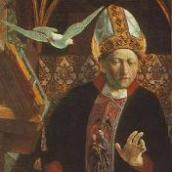
St. Augustine
does better. He asks us to consider the life of the human soul, God's
image. The soul remembers, it knows, it loves. These are three
activities, and yet they are the activity of one soul. In us, these
personal activities are an imperfect unity--our reason and our love do not
simply coincide. God is the perfect unity of personal activity: He is,
He knows, He loves; and with Him, these three are one. Father, Word
and Spirit, three persons and one God: all equally divine, all absolutely
God, one substance, one reality. God is not three beings, three
"personalities:" God is one. Yet His unity is not a dead and static
thing--He is the living God. His is the unity of personal activity: He
is, He knows, he loves, eternally; and with God these personal activities,
these "persons", have a unity and equality towards which we can only strive.
Our life is ever an imitation of that perfect life in which we are called to
share as sons.
To us, God's
life remains a mystery. But that does not mean that we understand
nothing, that we "ignorantly worship." It means that we understand
imperfectly a truth which exceeds our comprehension; and our knowing ends in
the worship of a glory which remains always beyond it. And thus we
return to the language of poetry and prophecy. "Behold a door is
opened in heaven", and we catch a glimpse of the majesty of God.
Cherubin and seraphim
Veil their faces with their wings;
Eyes of angels are too dim
To behold the king of kings,
While they sing eternally
To the Blessed Trinity.
+