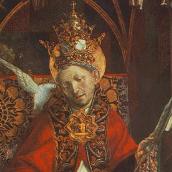
He explains the
ninth Chapter, together with the whole of the tenth.
[i]
[HISTORICAL INTERPRETATION]
1.
BAD minds, if they have once broken out into the eagerness of opposition,
whether what they hear from those that withstand them be right or wrong,
assail it with contradictory replies; for whereas the speaker is unwelcome
from being in opposition, not even what is right is welcome when he utters
it. But, on the other hand, the hearts of the good, whose dislike rises not
at the speaker but at the offence, in such sort pass sentence on what is
amiss, as to adopt still any right things that are said. For they sit the
most even umpires in deciding the sense of their opponents’ words, and they
so reject what is put forth amiss, that notwithstanding they set the seal
upon what they recognise to be delivered in truth. For among a wilderness
of thorns the ear [spica] is generally to be found growing up from
seed good for fruit. Therefore it must be managed with care by the hand of
the tiller, that, whilst the thorn [spina] is removed, the ear be
cherished, so that he, who is eager to root up what pricks, may have sense
to preserve what gives nourishment. Hence in that Bildad the Shuhite had
said well in enquiry, Doth God pervert judgment, or doth the Almighty
pervert justice? in that he had delivered true and forcible sentiments
against hypocrites, blessed Job, seeing that they were delivered against the
wicked in general, admirably treads under foot the prosecution of his own
defence, and at once sanctions the truths he had heard, saying,
Ver.
2. I know it is so of a truth, and that man put with God is not
justified.
[ii]
2.
For man being put under God receives righteousness; being put with God he
loses it: for everyone that compares himself with the Author of all good
things, bereaves himself of the good which he had received. For he that
ascribes to himself blessings vouchsafed to him, is fighting against God
with His own gifts. Therefore by whatsoever means he being in contempt is
lifted up, it is meet that being so set up he be brought to the ground by
the same. Now because he sees that all the worth of our goodness is evil if
it be strictly accounted of by the Judge of the interior, the holy man
lightly subjoins;
Ver.
8. If thou wilt contend with Him, thou shalt not be able to answer Him
one of a thousand.
[iii]
3.
In Holy Scripture, the number a thousand is wont to be taken for totality.
Hence the Psalmist saith, The word which He commanded to a thousand
generations; when it is sufficiently plain that from the very beginning
of the world up to the coming of our Lord no more than seventy-seven
generations are reckoned up by the Evangelist. What then is represented in
the number a thousand, save, until the bringing forth of the new offspring,
the complete whole of the race foreseen. Hence it is said by John, And
shall reign with Him a thousand years [Rev. 20, 6]; for that the reign
of Holy Church is made complete by being perfected in entireness. Now
forasmuch as a unit being multiplied is brought to ten, and ten being taken
into itself is expanded to one hundred, which again being multiplied by ten
is extended to a thousand, since we set out with one to get to one thousand,
what is here denoted by the designation of ‘one’ but the commencement of
good living? what by the fulness of the number ‘a thousand,’ but the
perfection of that good life? Now to contend with God is not to ascribe to
Him but to take to one's self the glory of one's goodness. But let the holy
man consider that the man who has already received even the chiefest gifts,
if he is lifted up for what has been vouchsafed him, parts with all that he
had received, and let him say, If he will contend with Him, he cannot
answer Him one of a thousand. For he, that ‘contends’ with his Maker,
is unable to ‘answer Him one of a thousand,’ in that the man that sets
himself up on the score of perfection, proves that be lacks the very
beginning of good living. For we cannot ‘answer Him one of a thousand,’
since when we are lifted up for perfection of good life, we shew that we
have not so much as begun this. Now we are then more really moved by our
weakness, when by reflection, we are led to form an estimate how infinite is
the power of the Judge.
Ver.
4. He is wise in heart, and mighty in strength.
[iv]
4.
What wonder is it, if we call the Maker of the wise, ‘wise,’ Whom we know to
be Wisdom itself? and what wonder is it that he describes Him to be
‘mighty,’ Whom there is none that doth not know to be this very Mightiness
itself? But the holy man, by the two words set forth in praise of the
Creator, conveys a meaning to us, whereby to recall us in trembling to the
knowledge of ourselves. For God is called ‘wise,’ in that He exactly knows
our secret hearts, and it is added that He is ‘mighty,’ in that He smites
them forcibly, so known. And so He can neither be deceived by us, because
He is wise, nor be escaped, because He is strong. Now, as wise, He beholds
all things, Himself unseen, then, as strong, without let or hindrance, He
punishes those whom He condemns. Who ordains this likewise here with
mightiness of wisdom, that when the human mind exalts itself against the
Creator, it should confound itself by that very self-exaltation. And hence
it is added,
Who
hath resisted Him, and had peace?
[v]
5.
For He that creates all things marvellously, Himself regulates them, that
after having been created, they should agree with themselves; and thus
whereinsoever there is resistance made to the Creator, that agreement in
peace is broken up, in that those things can never be well regulated, which
lose the management of regulation above. For whatsoever things if subjected
to God might have continued at peace, being left to themselves by their own
act work their own confusion, in that they do not find in themselves that
peace, which coming from above they contend against in the Creator. Thus
that highest Angelical Spirit, who being in subjection to God might have
stood at the height, being banished, has to bear the burthen of himself, in
that he roams abroad in disquietude in his own nature. Thus the first
parent of the human race, in that he went against the precept of his
Creator, was thereupon exposed to the insolence of the flesh, and because he
would not be subject to His Maker in obedience, being laid low beneath
himself, even the peace of the body was forthwith lost to him. Thus it is
well said, Who hath resisted Him, and had peace? In that by the same
act, whereby the froward mind lifts itself against its Maker, it works its
own confusion in itself. Now we are said to resist God, when we try to
oppose His dispensations. Not that our frailty does resist His unchangeable
decree, but what it has not the power to accomplish, it yet attempts. For
often human weakness knows in secret the power of His dispensation, and yet
aims, if it might be able, to reverse it. It sets to work to resist, but
shivers itself to pieces by the very sword of its opposition. It struggles
against the interior disposition of things, but, being overcome by its own
efforts, is bound fast. Therefore to have peace whilst resisting can never
be; for whereas confusion follows after pride, that which is foolishly done
in sin is marvellously disposed to the punishment of the doer; but the holy
Man, being filled with the influence of the Spirit of prophecy, while he
regards in general the confounding of human pride, thereupon directs the eye
of the mind to the special fate of the Jewish people, and shews by the ruin
of a single people the punishment that awaits all that are lifted up. For
he immediately adds in these words,
Ver.
5. Which removed the mountains, and they knew not whom He overturned in
His anger.
[vi]
[ALLEGORICAL INTERPRETATION]
6.
Oftentimes in Holy Writ by the title of ‘mountains,’ the loftiness of
Preachers is set forth. Of whom it is said by the Psalmist, The
mountains shall receive peace for Thy people. [Ps. 72, 3] For the Elect
Preachers of the eternal Land are not unjustly called ‘mountains,’ in that
by the loftiness of their lives they leave the low bottoms of earthly
regions, and are brought near to heaven. Now ‘Truth’ ‘removed the
mountains’ when He withdrew the holy Preachers from the stubbornness of
Judaea. Whence too it is rightly said by the Psalmist, The mountains
shall be carried into the heart of the sea. [Ps. 46, 2] For ‘the
mountains were removed into the heart of the sea,’ when the Apostles in
their preaching, thrust off by the faithlessness of Judaea, came to the
understanding of the Gentiles. Hence they themselves say in their Acts,
It was necessary that the word should first have been spoken to you but
seeing ye put it from you and Judge yourselves unworthy of everlasting life,
lo, we turn to the Gentiles. [Acts 13, 46] Now this same ‘removing of
the mountains’ they themselves ‘knew nothing of, who were overthrown in the
wrath of the Lord;’ for when the Hebrew people drove the Apostles from their
coasts, they supposed that they had made gain, in that they had parted with
the light of preaching, since as their deserts demanded, being struck with a
just visitation, they were blinded by so great a delusion of the
understanding, that their losing the light they accounted to be joy; but
upon the rejection of the Apostles, Judaea is at once brought to destruction
by the hands of the Roman Emperor Titus, and she is dispersed and scattered
abroad among all nations. And hence it is rightly added to the removing of
the mountains,
Ver.
6. Which shaketh the earth out of her place and the pillars thereof
shall tremble.
[vii]
7.
For ‘the earth was shaken out of her place,’ when the Israelitish people,
rooted out of the borders of Judaea, submitted the neck to the Gentiles,
because she would not be subjected to the Creator. Which same earth had
pillars, in that the erection of her stubborness, which was to be destroyed,
rose upon the Priests and Rulers, the Teachers of the Law and the Pharisees.
For in these she held in her the edifice of the letter, and in her season
of peace, carried the burthen of carnal sacrifices like a fabric overlaid.
But when ‘the mountains were removed,’ the ‘pillars were shaken,’ in that
when the Apostles were withdrawn from Judaea, they were no more themselves
allowed to live therein, who drove out from thence the proclaimers of life.
For it was meet that they being brought into subjection should lose that
earthly country, for the love of which they had not been afraid to assail
the soldiers of the heavenly country. But upon the holy Teachers being
drawn out, Judaea waxed altogether gross, and by the righteous inquest of
Him That judgeth, she shut the eyes of the mind in the darkness of her
delusion. Hence it is yet further continued;
Ver.
7. Which commandeth the sun, and it riseth not, and shutteth up the
stars as under a seal.
[viii]
8.
Now sometimes in Holy Writ by the title of ‘sun,’ we have the brightness of
the Preachers represented, as it is said by John, And the sun became
black as sackcloth of hair. [Rev. 6, 12] For at the end of time the sun
is exhibited ‘like sackcloth of hair,’ in that the shining life of them that
preach is set forth before the eyes of the lost as hard and contemptible.
And they are represented by the brightness of stars also, in that whilst
they preach right doctrines to sinners, they enlighten the darkness of our
night. And hence upon the removal of the Preachers it is said by the
Prophet, The stars [a] of the rain are withholden. Now
whereas the sun shines in the day time, the stars illumine the shades of
night. And very often in Holy Writ by the designation of day is
denoted the eternal Country, and by the name of night, the present
life. Holy preachers become like the sun to our eyes, inasmuch as they open
to us the view of the true light; and they shine like stars in the dark,
when for the purpose of helping our necessities they manage earthly things
in an active life. They, as it were, shine as the sun in the day, whilst
they raise the eye of our mind to contemplate the land of interior
brightness, and they glitter like stars in the night, in that even whilst
they are engaged in earthly action, they guide the foot of our practice,
every moment on the point of stumbling, by the example of their own
uprightness. But because when the Preachers were driven out, there was none
who might either shew the brightness of contemplation, or disclose the light
of an active life to the Jewish people continuing in the night of their
unbelief, (for the Truth, which being cast off abandoned them, when the
light of preaching was removed, blinded them in reward of their wickedness,)
it is rightly said, Which commandeth the sun, and it riseth not, and
shutteth up the stars as under a seal. For He would not let the sun
rise to that people, from whom He turned away the heart of the Preachers,
and He ‘shut up the stars as under a seal,’ in that while He kept His
Preachers to themselves in silence, He hid the heavenly light from the
darkened perceptions of the wicked.
9.
But it is to be considered, that we shut up any thing under seal with this
view, that when the time suits, we may bring it out to the light. And we
have learnt by the testimony of Holy Writ, that Judaea, which is now left
desolate, shall be gathered into the bosom of the Faith at the end. Hence
it is declared by Isaiah, For though thy people Israel be as the sand of
the sea, yet a remnant of them shall be saved. [Is. 10, 22] Hence Paul
saith, Until the fulness of the Gentiles should come in, and so all
Israel should be saved. [Rom. 11, 25. 26.] Therefore He That removes
His Preachers now from the eyes of Judaea, and afterwards exhibits them, has
as it were ‘shut up the stars under a seal,’ that the rays of the spiritual
stars being first hidden and afterwards beaming forth, she both being now
cast off may not see the night of her misbelief, and then by being
enlightened may find it out. It is hence that those two illustrious
Preachers were removed, but their death delayed, that they might be brought
back in the end for the purpose of preaching; of whom it is said by John,
These are the two olive trees and the two candlesticks standing before the
Lord of the earth. [Rev. 11, 4] One of whom ‘Truth’ by His own lips
gives promise of in the Gospel, saying, Elias truly shall first come, and
restore all things. [b] [Matt. 17, 11] They then are as if the ‘stars’
were ‘shut up under a seal,’ who both at this present are concealed that
they appear not, and hereafter shall appear that they may stand Him in good
stead. Yet the Israelitish people, which shall be gathered in full measure
in the end, in the immediate infancy of Holy Church is pitilessly hardened.
For it rejected the Preachers of the Truth, it spurned the message of
succour. Yet this is effected by the marvellous contrivance of the Creator
with this view, that the glory of the persons preaching, which if received
might have lain hid in one people, being rejected might be spread abroad
among all the nations. Hence too it is fitly added immediately afterwards ;
Ver.
8. Which alone spreadeth out the heavens.
[ix]
10.
For what is denoted by the name of ‘the heavens,’ but this very heavenly
life of the persons preaching, of whom it is said by the Psalmist, The
heavens declare the glory of God. Thus the same persons are recorded to be
the heavens, and the same to be the sun; the heavens indeed, in that by
interposing [intercedendo] they shield; the sun, in that by preaching
they display the power of light. And so, upon the ‘earth being shaken’ ‘the
heavens were spread out,’ in that when Judaea ravened in the violence of
persecution, the Lord spread wide the life of the Apostles, for all the
Gentiles to acquaint themselves withal. And whilst she in judgment being
made captive is scattered over the world, they by grace are every where
amplified in honour. For ‘the heavens’ were of small compass, so long as
one people contained so many mighty preachers. For to which of the Gentiles
would Peter have been known, if he had continued in the preaching to the
Jewish people alone? Who would have known of Paul’s virtues, unless Judaea
by persecuting him had transmitted him to our knowledge? See how already
they, that were thrust off with scourges and with insults by the Israelitish
people, are held in honour throughout the length and breadth of the world.
The Lord alone then ‘has spread out the heavens,’ Who, by the wondrous
ordering of His secret counsel, from the very cause, that He let His
Preachers be persecuted in one people, caused them to spread out even to the
comers of the world. But yet neither did this Gentile folk itself, which
was devoted to the present world, when the tongues of the Apostles rebuked
its iniquities, gladly welcome the words of life. For it forthwith swelled
up in the pride of opposition, and roused itself to the cruelty of
persecution. But she that sets herself to gainsay the words of preaching,
is speedily subdued in wonderment at miraculous signs. Hence too the words
are fitly added in praise of the Creator,
And
treadeth upon the wave of the sea.
[x]
11.
For what is denoted by the title of ‘the sea,’ but this world's bitterness
raging in the destruction of the righteous? Concerning which it is said by
the Psalmist too, He gathereth the waters of the sea together as in a
skin. [Ps. 33, 7. Vulg.] For the Lord ‘gathereth the waters of the sea
together as in a skin,’ when, disposing all things with a wonderful
governance, He restrains the threats of the carnal pent up in their hearts.
Thus ‘the Lord treadeth upon the waves of the sea.’ For when the storms of
persecution lift up themselves, they are dashed in pieces in astonishment at
His miracles. Since He that brings down the swellings of man's madness, as
it were treads the waters standing up in a heap. Thus when the Gentile
world saw that her form and fashion was undone through the preaching of the
Apostles, when the rich sons of this world beheld poor men's deeds arrayed
against their arrogance, when the wise men of this generation marked that
the words of unlettered men were set in opposition to them, they swelled
thereupon in a storm of persecution. Yet they who, being moved by the
opposition of words, burst out in storms of persecution, are calmed, as we
have said, by wonder at the miraculous signs. So the Lord set as many steps
upon these waves, as He exhibited miracles to the persecutors in their
pride. Whence it is well said again by the Psalmist, Marvellously the
floods lift up their waves; marvellous is the Lord on high. [Ps. 93, 3.
4.] For against the life of the Elect the world has lifted itself
wonderfully in waves of persecution, but the Creator of things above has
still more marvellously put these down in the exaltation of the Preachers’
power; for He shewed that His ministers prevailed more in miracles above all
that the powers of the earth had swelled unto in anger. Which the Lord
moreover well delivered by the lips of Jeremiah, while relating outward
things, telling of inward ones; I have placed the sand for the bound of
the sea, by a perpetual decree that it cannot pass it; and though the waves
thereof toss themselves, yet can they not prevail: though they roar,
yet can they not pass over it. [Jer. 5, 22] For ‘the Lord has placed
the sand for the bound of the sea;’ in that He has made choice of the
despised and poor to dash in pieces the glory of the world. ‘The waves of
which same sea toss themselves,’ when the powers of the world leap forth in
the uproar of persecution. Yet they cannot pass over the sand, in that they
are broken in pieces by the miracles and the humility of the despised and
scorned. But whilst the sea rages, while it is lifted up in the waves of
its madness, yet whereas it is trodden upon by the manifestation of interior
Power, Holy Church makes way, and by the accessions of time she rises to the
station of her own rank [or ‘the establishing of her own order’] Hence it
is rightly added immediately afterwards,
Ver.9. Which maketh Arcturus, Orion, and Hyades, and the chambers of the
south.
[xi]
12.
The word of Truth never follows the vain fables of Hesiod, Aratus, or
Callimachus, that in naming Arcturus it should take the last of the seven
stars for the tail of the bear, or as if Orion were holding a sword as a mad
lover; for these names of the stars were invented by the votaries of carnal
wisdom, but Holy Scripture for this reason makes use of these words, that
the things which it aims to convey instruction about, may be represented by
the customariness of their usual designation. For if he had spoken of any
stars he might wish by names unknown to us, man, for whom this very
Scripture was made, would assuredly have known nothing what he heard. Thus
in Holy Writ the wise ones of God derive their speech from the wise ones of
the world, in like sort as therein God the very Creator of man, for man's
benefit, takes in Himself the tones of human passion, i.e. so as to say,
It repenteth Me that I have made man upon the earth [Gen. 6, 6. 7.];
whereas it is plain and undoubted that He, Who beholds all things before
they come, after He has done any thing, never repents by feeling regret.
What wonder is it, then, if spiritual men use the words of carnal men, when
the Ineffable Spirit Himself, Which is the Creator of all things, in order
to draw the flesh to the understanding of Him, in His own case frames His
speech of the flesh? Thus in Holy Writ, when we hear the familiar names of
the stars, we learn what stars the discourse runs on. And after we have
well weighed what stars are described, it remains that from their motions we
be led to raise ourselves to the mysteries of the spiritual meaning. For
not even after the letter is there any thing strange, in that it is said
that God created Arcturus, and the Orions, and the Hyades, concerning Whom
it is an acknowledged truth, that there is nothing of any sort in the world
but He Himself made it. But the holy man declares that the Lord made these,
by which he means properly to denote things that are done in a spiritual
way.
13.
For what is represented by the name of Arcturus, which being set in the
polar region of the heavens shines bright with the rays of seven stars,
except the Church universal, which is represented in the Apocalypse of John
by the seven Churches and the seven candlesticks? Which same, while She
contains in Herself the gifts of seven-fold grace, beaming with the
brightness of highest virtue, as it were gives light from the polar region
of Truth. And it is furthermore to be considered, that Arcturus is ever
turned about, and never sunk from sight, in that Holy Church ever undergoes
the persecutions of the wicked without ceasing, and yet endures without
failing ‘even unto the end of the world.’ For oftentimes because the sons
of perdition have persecuted her even to the death, they have been persuaded
that they had as it were utterly extinguished her, but she returned with
manifold increase to the rearing of her full growth, in proportion as she
travailed in dying amidst the hands of Her persecutors. Thus while Arcturus
is turned about, he is set on high, for Holy Church is then more strongly
reinvigorated in the Truth, when she spends herself more fervently for the
Truth.
14.
Hence too after Arcturus he immediately subjoins the ‘Oriones’ with
propriety. For they arise in the very heaviest of the winter season, and
they stir up storms by their rising, and put sea and land in commotion.
What then is denoted by ‘the Oriones,’ after ‘Arcturus,’ saving the
Martyrs? who, while Holy Church is set on high to take her stand of
preaching, destined to undergo the weight of the persecutors and harassing
treatment, came into the face of heaven, as it were, in the winter season.
For when they were born, the sea and the land were troubled, in that when
the Gentile world grieved that its method of life was undone, on their
courage appearing, it set up for their destruction not only the fiery and
turbulent, but the mild among men also. And thus the winter lowered in ‘the
Oriones,’ in that when the constancy of the Saints shone out, the frozen
soul of the unbelievers lashed itself into a tempest of persecution. And so
‘the heavens’ gave forth the Oriones, when Holy Church sent out her Martyrs,
who whilst they had boldness to speak what is right to the uninstructed,
brought upon themselves every thing most heavy from the adverse bitterness
of cold.
15.
Now he justly subjoins the Hyades directly, which, when the springtide is
waxing, go forth into the face of heaven, and, when the sun is now putting
out the power of his heat, are given to sight. For they are attached to the
beginnings of that sign, which the wise of this world call ‘the Bull,’ at
which the sun begins to increase, and arises with more fervent heat, to
lengthen out the periods of the day. Who, then, after ‘the Oriones,’ are
denoted by the title of ‘the Hyades,’ saving the Doctors of Holy Church,
who; when the Martyrs were taken away, came at that period to the world's
knowledge, when faith now shines forth the brighter, and the winter of
infidelity being forced back, the sun of truth flows deeper through the
hearts of the faithful. These, when the storm of persecution was overpast,
and the nights of long infidelity consummated, then arose to Holy Church,
when the year now opens brighter in the vernal season of belief. Nor are
the holy Doctors improperly denoted by the designation of ‘Hyades,’ for in
the Greek tongue rain is called ‘Hyetus;’ and the ‘Hyades’ have received
their name from the rains, surely because at their rising they bring
showers. Thus they are well represented by the title of ‘the Hyades,’ who,
brought out in the settled frame of Holy Church, as it were into the face of
heaven, upon the parched earth of the human heart poured down the showers of
holy preaching. For if the word of preaching were not rain, Moses would
never have said, Let my doctrine be waited for as the rain. [Deut.
32, 2] ‘Truth’ would never have said by the lips of Isaiah, I will also
command the clouds that they rain no rain upon it; [Is. 5, 6] and that
which we brought forward a little above, Therefore the stars [d]
of the showers are withholden. [Jer. 3, 3] Thus while the Hyades come
bringing showers, the sun is led on to the higher regions of heaven; in
that, when the knowledge of the Doctors appears, while our minds drink in
the showers of preaching, the heat of faith increases. And the earth being
irrigated is rendered productive in fruit, when the light of the sky is
fired; in that we yield the fruit of good works the more plentifully, the
brighter we burn within our breasts through the flame of sacred
instruction. And while heavenly lore is displayed to view by them more and
more day by day, it is as if the springtide of interior light were opened
upon us, that the new Sun may glow brightly in our souls, and being by their
words made known to us, may daily surpass itself in brilliancy. For the end
of the world being close at hand, the knowledge from above advances, and
waxes bigger with the progress of time. For hence it is said by Daniel,
Many shall run to and fro, and knowledge shall be increased. [Dan. 12,
4] Hence the Angel saith to John in the former part of the Revelation,
Seal up those things, which the seven thunders uttered; [Rev. 10, 4] and
yet at the end of that Revelation he bids him, saying, Seal not the
sayings of the prophecy of this book. [Ib. 22, 10] For the first part
of the Revelation is commanded to be sealed, but the end not to be sealed;
for whatever was hidden in the beginnings of Holy Church, the end clears up
day by day. But some imagine that ‘the Hyades’ are named from the Greek
letter which is rendered by ‘y;’
which, if it be so, is not opposed to the sense which we have given: the
Doctors are not unsuitably represented by those stars which have their name
from letters; but, though ‘the Hyades’ are not unlike the look of that
letter, yet it is a fact that a shower is called ‘Hyetus,’ and that those at
their rising bring with them rain.
16.
Therefore let the holy man, viewing the order of our redemption, feel
wonder, and wondering let him cry out, in the words, Which alone
spreadeth out the heavens, and treadeth upon the waves of the sea. Which
maketh Arcturus, the Oriones, and Hyades. For, when the heavens were
spread out, the Lord made ‘Arcturus,’ in that, when the Apostles were
brought to honour, He stablished the Church in heavenly conversation, and
when Arcturus was made, He framed ‘the Oriones,’ in that the faith of the
Church Universal being established, He launched forth the Martyrs against
the storms of the world. And when ‘the Oriones’ were launched in heaven, He
set forth ‘the Hyades,’ in that when the Martyrs proved strong against
adversities, He vouchsafed the teaching of Masters, to water the drought of
human hearts. These then are the ranks of the spiritual stars, which while
they stand out conspicuous by the highest virtues, are ever shining from
above.
17.
But what remains after these things, saving that Holy Church, receiving the
fruit of her toils, should attain to behold the inner depths of the Country
above? And hence, whereas he had said, Which maketh Arcturus, the
Oriones, and the Hyades; he rightly added directly, and the chambers
of the South. For what is here denoted by the name of ‘the South,’
saving the fervour of the Holy Spirit? with which he that is replenished,
kindles to the love of the spiritual Country. And hence it is said by the
voice of the Spouse in the Song of Solomon, Arise, O north wind, and come
thou south, blow upon my garden, that the spices thereof may flow out.
For upon the ‘south wind’ coming, the ‘north wind’ arising departs, when our
old enemy, who had bound up our soul in inactivity, being expelled by the
coming of the Holy Spirit, takes himself away. And ‘the south wind blows
upon the garden’ of the Spouse, that ‘the spices thereof may flow down;’ in
that, whensoever the Spirit of Truth has filled Holy Church with the
excellences of His gifts, He scatters far and wide from her the odours of
good works. And thus ‘the chambers of the South’ are those unseen orders of
the Angels, and those unfathomed depths of the heavenly Country, which are
filled with the heat of the Holy Spirit. For thither are brought the souls
of the Saints, both at this present time divested of the body, and hereafter
restored to the same anew, and like stars they are concealed in hidden
depths. There all the day, as at midday, the fire of the sun burns with a
brighter lustre, in that the brightness of our Creator, which is now
overlaid with the mists of our mortal state, is rendered more clearly
visible; and the beam of the orb seems to raise itself to higher regions, in
that ‘Truth’ from Its own Self enlightens us more completely through and
through. There the light of interior contemplation is seen without the
intervening shadow of mutability; there is the heat of supreme Light without
any dimness from the body; there the unseen bands of Angels glitter like
stars in hidden realms, which cannot now be seen by men, in proportion as
they are deeper bathed in the flame of the true Light. Thus it is
altogether marvellous that, in the sending of the Apostles, the Lord
stretched out the Heavens; that, in moderating the swellings of persecution
He trode the waves of the sea, and kept them down; that in the stablishing
of the Church, He set ‘Arcturus’ in his place; that in making the Martyrs
proof against afflictions, He sent forth ‘the Oriones;’ that in the Doctors
being replenished in peace, He gave forth ‘the Hyades;’ but after these it
is beyond all comparison marvellous, that He should have provided for us the
haven of the heavenly Land, as ‘the chambers of the South.'
18.
All this is beautiful, that is seen as it were in the face of heaven of
God's ordering; but infinitely and incomparably more beautiful is that, to
which we are brought without its being able to be seen. Hence the Spouse
justly repeats a second time in the commendation of His Bride; Behold
thou art fair, my love; behold thou art fair: thou hast doves’ eyes, besides
that which lieth hidden within. [Cant. 4, 1] He describes her ‘fair,’
and says again ‘fair,’ in that there is one sort of beauty of life and
conduct, wherein she is now seen, and another beauty of rewards, wherein she
will then be lifted up in the likeness of her Creator; and because her
members, which are all the Elect, go about all things with simplicity, her
eyes are called ‘doves’ eyes;’ which shine with extraordinary light, for
that they glitter even with the signs of miraculous power. But how great is
all this marvel, which is able to be seen! That marvel relating to things
of the interior is more wonderful, which is not now able to be seen,
concerning which it is fitly added in that place, Besides that which
lieth hidden within. For the glory of the visible world is great, but
the glory of the secret recompensing far beyond comparison. That, then,
which is denoted by the name of ‘stars’ by blessed Job, is in the words of
Solomon represented by the title of ‘eyes;’ and what is described by
Solomon, Besides that which lieth within, blessed Job conveys to us,
when he extols ‘the chambers of the South.’ But see; the holy man in
admiring things without, and contemplating those of the interior, telling of
things manifest, and diving into things secret, aims to describe all that is
done both within and without; but when shall the tongue of flesh unfold the
works of the Supreme Greatness? And hence with just propriety directly
afterwards, by giving up the attempt, he measures the compass of these same
works the more effectually, saying,
Ver.l0. Which doeth great things past finding out; yea, and wonders
without number.
[xii]
19.
For then we more thoroughly compass the deeds of Divine Might, when we
acknowledge that we can never compass them; we then speak with greater
eloquence, when we are silent on these, being struck dumb with
astonishment. Since for the describing of God's works our insufficiency
finds in itself how it may put forth its tongue sufficiently, that what it
cannot suitably understand, it may suitably extol by being dumb. Whence it
is well said by the Psalmist, Praise Him in His mighty acts; praise Him
according to His excellent greatness. [Ps. 150, 2] For He ‘praises God
according to His excellent greatness,’ who sees that he breaks down in the
fulfilling of His praise. Therefore let him say, Which doeth great
things past finding out; yea, and wonders without number: viz. ‘great,’
in power, ‘past finding out,’ in reason, ‘without number,’ in multitude.
Therefore the works of God which he could not compass by speaking, he more
eloquently defined by proving deficient. But in the review of things, why
are we carried so far without ourselves, considering that we know nothing of
the very thing that is done to our own selves? Hence it is fitly added,
Ver.
11. Lo, if He come to me, I see Him not: if He passeth on, I perceive
him not.
[xiii]
20.
For the human race being shut out from the interior joys, in due of sin,
lost the eyes of the mind; and whither it is going with the steps of its
deserts, it cannot tell. Thus, often that is the gift of grace which it
takes to be wrath, and often that is the wrath of God's severity, which it
supposes to be grace. For very commonly it reckons gifts of virtue as
grace, and yet being uplifted by those gifts is brought to the ground; and
very often it dreads the opposition of temptations as wrath, and yet being
bowed down by those temptations, arises the more solicitous to the safe
keeping of its virtuous attainments. For who would not reckon himself to be
nigh to God, when he sees that he is magnified with gifts from on high, when
either the gift of prophecy or the mastership of teaching is vouchsafed him,
or when he is empowered to exercise the grace of healing? Yet it often
happens that whilst the mind is made to sit loose by self-security in its
virtues, from the adversary plotting against it, it is pierced ‘with the
weapon of unexpected sin, and is for ever put far away from God by the very
means whereby for a time it was brought near to Him without the caution of
heedfulness. And who would not look upon himself as now abandoned by Divine
grace, when after experiencing purity, he sees that he is sorely pressed by
the temptations of the flesh, that things unbefitting crowd on the mind, and
before the eyes of fancy there pass things disgraceful and impure? Yet,
when such things as these harass but not subdue, they do not slaughter by
the effect of corrupting, but preserve by their effect of humbling, that the
mind, finding itself weak under temptation, may wholly betake itself to the
assistance of the Divine Being, and completely give over all confidence in
itself; and thus it is brought to pass, that it attaches itself to God the
deeper by the same thing, by which it was made to lament its having fallen
away the lower from God. Therefore the coming and going of God are not at
all discoverable by our faculties, so long as the issue of alternating
states is hidden from our eyes; in that there is no certainty concerning the
trial, whether it be a test of virtue or an instrument of our destruction;
and concerning gifts we never find out whether they are the reward here of
such as are given up, or whether they are a support on the road to bring men
to their native Country. Thus let man, once banished from the interior
joys, view the doors of the secret place of the Spirit shut against him, and
cast forth to himself without, let him groan in the flesh, and seeing the
losses which his blindness entails upon him, exclaim, Lo, if He come to
me, I see Him not; if He passeth on, I perceive Him not. As if he
lamented openly, saying, ‘Since I have once lost my eyes by my own act and
deed, as I am bearing the darkness of a self-sought night, now I neither
know the rising nor the setting of the sun.’ Yet man, who is pressed down by
the infliction of infirmity, and heavy laden with the darkness of his blind
estate, is going forward to the Judgment of the Light above, that he may
render an account of his actions. And hence it is added immediately
afterwards,
Ver.
12. If He question on a sudden, who will answer Him?
[xiv]
21.
God ‘questions suddenly’ when He calls us unexpectedly to the strict
searching of His scrutiny. But man cannot answer to His questioning, for
that, if he be then sifted, all pity laid aside, even the life of the
righteous sinks under the scrutiny. Or, surely, He questions, when He deals
us hard blows, that, when the mind entertains great thoughts of itself in
peace and quiet, it may find itself out in trouble, what sort it really is
of. And very commonly because it is smitten, it utters groans; but it is
unable to make answer, because the very distastefulness of his stroke is
displeasing to him, yet looking to himself man holds his peace, and dreads
to scrutinize the Divine decrees, because he knows himself to be but dust.
Hence it is said by Paul, Nay, but, O man, who art thou that repliest
against God? [Rom. 9, 20] He that is called by the name of ‘man’ (homo)
is proved to be unable to ‘reply against God.’ For by this circumstance,
that he was taken from the dust of the earth [e], he is not worthy to
scrutinize the judgments of the Most High. Hence too it is fitly subjoined
here,
Or,
who will say unto Him, What doest Thou?
[xv]
22.
The acts of our Maker ought always to be reverenced without examining, for
they can never be unjust. For to seek a reason for His secret counsel is
nothing else than to erect one's self in pride against His counsel. So when
the motive of His acts cannot be discovered, it remains that we be silent
under those acts in humility, for the fleshly sense is not equal that it
should penetrate the secrets of His Majesty. He then who sees no reason in
the acts of God, on considering his own weakness does see reason wherefore
he sees none. Hence also it is added by Paul afterwards, Shall the thing
formed say to Him that formed it, Why hast Thou made me so? For in
proportion as it sees itself to be ‘a thing formed’ by God's workmanship, it
rebukes itself so as not to kick back against the hand of Him that wrought
it; for He, Who in loving-kindness exalted what was not, never in injustice
abandons that which is. So let the mind be brought to itself under the
stroke, and what it cannot comprehend, let it cease to require, lest if the
cause of God's wrath be searched out, It be called forth in larger measure
for being searched out, and lest wrath, which humility might have pacified,
pride kindle to an unextinguishable height. Hence it is moreover fitly
added concerning this same Wrath,
Ver.
13. God, Whose wrath none can resist, and under Whom they that bear the
world are bowed down.
[xvi]
23.
It is very strange that it is declared that none can resist God's wrath,
seeing that the divine Oracles witness that many have withstood the
wrathfulness of the visitation of Heaven. Did not Moses resist God's wrath,
when standing up for the fallen people, He restrained the very impulse of
the stroke from above, by the oblation of his own death, saying, Yet now
if Thou wilt forgive their sin:—and if not, blot me, I pray Thee, out of the
book, which Thou hast written? [Exod. 32, 32] Did not Aaron resist
God's wrath, when between the living and the dead he took a censer, and
assuaged the fire of visitation with the fumes of incense? [Numb. 16, 47.
&c.] Did not Phinees resist God's wrath, when slaughtering them that went a
whoring with strange women in the very act, he offered his zeal to the
Divine wrath, and pacified fury with the sword? [Ib. 25, 11] Did not David
resist God's wrath, who by presenting himself to the Angel, as he dealt
destruction, won the grace of propitiation, even before the appointed time?
[2 Sam. 24, 25] Did not Elijah resist God's wrath, who when the earth was
now for long dried up, brought back by a word the showers withdrawn from the
heavens? [1 Kings 18, 44] In what sense then was it said that none can
resist the wrath of God, when it is proved by existing examples that numbers
have resisted it? However, if we minutely consider both these words of
blessed Job, and the deeds of those persons, we both find it to be true that
there is no resisting the Divine Wrath, and also true that many have often
resisted it. For all Saints that encounter the wrath of God, obtain it from
Himself, that they should be thus set in the way to meet the force of His
stroke; and so to say having Him with them, they lift up themselves against
Him, and the Divine Power arms them in alliance with Itself against Itself.
Since in that which they achieve against the wrath of Him dealing cruelly
without, the grace of Him so angered encourages them within, and He bears up
those serving Him inwardly, whom He submits to resisting Him outwardly.
Thus He bears the supplicant's contradiction which He inspires, and that is
forced upon Him as though He were unwilling, which is by Himself commanded
to be done. For He saith to Moses, Now therefore let Me alone, that My
wrath may wax hot against them, and that I may consume them, and I will make
of thee a great nation. [Ex. 32, 10] What is it to say to His servant,
Let Me alone; but to give him boldness to supplicate? As if He said
in plain words, ‘Consider how thou prevailest with Me, and know that thou
mayest obtain whatsoever thou beseechest for the People.’ And that the
thing is done with this mind, is witnessed by the pardon which is
immediately subjoined. But when the Wrath above moveth Itself, so to say,
from the heart's core, human opposition cannot stay It; and no man's
entreaty presents itself to any purpose, when once God ordains any thing
whilst angered from His inward Deep. For it is hence that Moses, who
blotted out by his entreaties the guilt of the whole People in God's sight,
and whilst he offered himself in the way, appeased the force of the Divine
indignation, when he came to the rock Horeb, and for the bringing forth the
water gave way to distrust, could never enter the Land of Promise from the
Lord being wroth. And oftentimes he is distressed on this score, often he
is troubled by his regret making itself felt, and yet he could never remove
from himself the anger of an ordained retribution, who by God's good
pleasure removed it even from the very people. Hence David, who afterwards
by prayer held back the sword of the Angel from the fallen People, first
fled from his son with bare feet howling and lamenting, and until he
received to the full the cup of vengeance for the transgression he had done,
he could never abate the wrath of the Lord for himself. [2 Sam. 24, 10]
Hence Elijah, that as a mortal man he might as it were feel some little of
God's visitation, he, who opened the heavens with a word, fled in terror
through the wilderness from a woman's indignation; and he proves weak for
himself in his dismay, who appeases God's fury for others through his
intercession. Thus there is both a possibility of resisting the wrath of
God, when He, That is wroth Himself, vouchsafes aid; and there is no
possibility at all of resisting it, when He both rouses Himself to deal
vengeance, and doth not Himself inspire the prayer that is poured forth to
Him. Hence it is said to Jeremiah, Therefore pray not thou for this
people, neither take to thee praise and prayer for them; for I will not hear
in the time of their crying to Me; [Jer. 7, 16] and again, Though
Moses and Samuel stood before Me, yet My mind could not be toward this
people. [Jer. 15, 1]
[LITERAL INTERPRETATION]
24.
Wherein it may be usefully enquired wherefore, so many more ancient fathers
being set aside, Moses and Samuel alone are preferably and preeminently
singled out for the utterance of prayer? Which however we easily learn, if
we weigh well the claims of that charity which is bidden to love even
enemies. For that prayer comes with a special recommendation to the ears of
our Creator, which exerts itself to make intercession for our enemies too;
and hence ‘Truth’ saith by His own lips, Pray for them that despitifully
use you and persecute you. [Matt. 5, 44] And again, When ye stand
praying, forgive, if ye have ought against any. [Mark 11, 25] Now when
we revolve the deeds of the fathers of old time as Holy Writ describes them,
we find that it was Moses and Samuel, who prayed for their adversaries. For
one of them had to fly from the persecution of that infuriated People, and
yet he interceded for the persecutor's life: the other being deposed from
the rule of the People, saith to his own adversaries themselves, God
forbid that I should sin against the Lord in ceasing to pray for you. [1
Sam. 12, 23] Therefore in the difficult work of deprecating wrath, what is
it to bring forward Moses and Samuel, but to shew the more plainly that not
even they if they stood forward would stay His wrath, who might for this
reason have interceded the sooner for their friends, that they were used to
intercede with Him even for their enemies. Hence it is said to that same
Judaea, I have wounded thee with the wound of an enemy, with the
chastisement of a cruel one. And again, Why criest thou for thine
affliction? Thy sorrow is incurable. [Jer. 30, 14. 15.] Let the holy
man then regard how the wrath of God is restrained by no man's intercession,
when once it is inexorably called forth, and let him say, God, Whose
wrath none can resist. And this we rightly reduce to a particular
sense, if we reflect on the woes of that same Israelitish People, which the
Saviour, Who was made manifest in the mystery of His economy; abandoned in
their pride, and called the Gentiles to the grace of the knowledge of Him.
And hence it is rightly subjoined directly, Under Whom they that bear the
world are bowed down.
25.
For they do bear the world, who sustain the cares and concerns of the
present world. Since every one is necessitated to bear the burthens of as
great things as he is a leader of in this world; and hence a ruler of the
earth is not unsuitably designated in the Greek tongue ‘basileus.’ For
‘laus’ means ‘people.’ Basileus therefore is the title ‘basis laou’ which
in the Latin tongue is rendered ‘basis populi,’ or, ‘the base of the
people;’ since it is he that bears up the people upon himself, in that be
controls its motions, himself steadied by the weight of power. For in
proportion as he bears the burthens of his subjects, like a base he supports
a column raised upon it. Let blessed Job, then, full of the power of the
prophetic Spirit, see how Judaea is forsaken, and the rulers of the Gentiles
are bowed to the worship of the Divine Being, and let him say, God, Whose
wrath none can resist, under Whom they that bear the world are bowed down.
As though he plainly owned, saying, ‘Both the People, that was once subject
to Thee, Thou forsakest in Thy severity, and the powers of the Gentiles,
that set up their heads, Thou bendest low in Thy mercy.’
26.
Though hereby, that it is said, Under Whom they that bear the world are
bowed down; we may also understand the Angelical powers; for these bear
the world, in that they execute the charges of the governing of the
universe, as Paul bears witness, when he says, Are they not all
ministering spirits, sent forth to minister for them that shall be heirs of
salvation. [Heb. 1, 14] Thus he says, God, Whose wrath none can
resist, under Whom they that bear the world are bowed down. As if he
beheld the humiliation of every created being, and said in fear and
trembling, ‘Which of frail mortals resists Thy nod, before Whose might the
Angelic Powers themselves bow down themselves?’ Or, surely, since, when we
are bowed down, we see nothing of things above us, those subtlest spirits
must needs have been erect, if they completely reached the power of His
Majesty; but ‘they that bear the world, are bowed down under God,’ for
though when they are lifted up they behold the loftiness of the Divine
Nature, yet not even the Angelic Powers attain to comprehend It. Which Same
the righteous man failing from infirmity to fathom, and yet in some degree
estimating It from the ministrations of the most exalted spirits being
subject to Him, falls back to the consideration of himself with heedful
humility, and makes himself little in his own eyes compared with the
omnipotence of the Supreme Majesty; saying,
Ver.
14. How great am I that I should answer Him, and talk with Him in my
words?
[xvii]
27.
As though he said in plain words, ‘If that created being is unable to take
thought of Him, which is not burthened by the flesh, in what spirit do I
dispute about His judgments, who am straitened by the burthen of
corruption?’ But as God's words to us are oftentimes His judgments,
declaring the sentence of our actions, so our words to God are the deeds
which we set forth; but man ‘cannot reason with God in his words,’ in that,
in the eye of His exact judgment, he maintains no assurance in his actions.
Hence it is fitly added,
Ver.
15. Who, though I possessed any thing righteous, yet would I not
answer, but I would make supplication to my Judge.
[xviii]
28.
For, as we have often said, all human righteousness is proved
unrighteousness, if it be judged by strict rules. And so there is need of
prayer following after righteousness, that this, which if sifted to the
bottom might be brought down, may be firmly established in the mere
pitifulness of the Judge. And when this is possessed fully by the more
perfect sort, it is said that they possess a something of it. In that the
human mind both with difficulty puts in practice the truths apprehended by
it, and the things which it apprehends are the merest outskirts. Therefore
let him say, Who, though I possessed any thing righteous, yet would I not
answer, but I would make supplication to my Judge. As if he owned in
plainer words; ‘And if I should grow to the practising of virtue, I am made
vigorous to life, not by merit, but of pardoning grace.’ Therefore we must
be strenuous in prayer, when we do right, so that all the righteous ways we
live in we may season by humility; but very often it happens that our very
supplication is tost to and fro by such a multitude of temptations, that it
seems almost cast off from the presence of the Judge. And often our pitiful
Creator receives it, but because it cannot put forth itself undefiled, as it
is minded, it dreads the sentence of condemnation upon its head. Hence it
goes on,
Ver.
16. And when I have called and He hath answered me, yet do I not believe
that He hath hearkened unto my voice.
[xix]
29.
For very often the mind is set on fire with the flame of Divine love, and is
uplifted to behold heavenly things and secret mysteries. It is now
transported on high, and pierced with full affection, is made strange to
things below; but being struck with sudden temptation, the soul which with
set purpose had been established erect in God, pierced with arising
temptations is bowed low; so that it cannot discern itself, and being held
fast between good and evil practices, cannot tell on which side it is
strongest. For very often it is brought to this pass, to wonder how it so
lays hold of the highest truths, when unlawful thoughts defile it; and again
how it admits unlawful thoughts, when the fervour of the Holy Spirit with
power transports it above itself. Which alternate motions of thought in the
mind being viewed aright by the Psalmist, he exclaims, They mount up to
the heaven, they go down again to the depths. [Ps. 107, 26] For we
mount up to the heaven, when we enter into the things above, but we go down
to the depths, when we are suddenly cast down from the height of
contemplation by grovelling temptations. Thus whilst the motions of the
mind alternate between vows and vices, too truly they cloud for themselves
the certainty of their being heard. Therefore it is rightly said, When I
have called and He hath answered me, yet do I not believe that He hath
hearkened unto my voice. In that the mind is rendered fearful from its
mere changeableness, and by that which it is unwillingly subject to,
imagines itself cast off and rejected.
30.
It is interesting to observe with what exactness the holy man passes
judgment on himself, that the judgments of God may find nought in him to
take hold of. For having an eye to his own frailty, he says, How much
less shall I answer, and talk in my words with Him? Not relying upon
the claims of his own righteousness, but betaking himself to the hope alone
of entreating, he adds, Who, though I had any thing righteous, yet would
I not answer, but I would make supplication to my Judge. But
apprehensive for the very entreaty itself, he adds, And when I have
called, and He hath answered me, yet do I not believe that He hath hearkened
unto my voice. Why does he shrink with so great apprehension, why does
he tremble with such sore misgiving? but that his eye is fixed on the
dreadfulness of the Judge, in the last strict reckoning, and not supporting
the power of His searching eye, all that he does seems little worth in his
account? Whence he adds thereupon,
Ver.
17. For He shall break me with a tempest.
[xx]
31.
In every case that sinner is ‘broken with a tempest,’ who seemed to be
stablished in tranquillity, in that the man whom the long-suffering Above
bears with for long, the last strict Judgment destroys. And this is rightly
called ‘a tempest,’ because it is manifested in a commotion of the elements,
as the Psalmist witnesses, when he says, God shall come manifest, and He
shall not keep silence; a fire shall devour before Him, and a mighty tempest
round about Him. [Ps. 50, 3] And hence another Prophet also says,
The Lord, His way is in the whirlwind and in the storm. [Nahum 1, 3] In
which same whirlwind the righteous man is never broken, for this reason,
because here he is ever in fear and anxiety, lest he should be broken. For
whilst still set in the journey of the present life, he bethinks himself how
severe towards the actions of men the Requirer of works will appear, Who
then condemns even without works some that are only bound with the guilt of
original sin. Whence the holy man rightly adds thereupon in the voice of
mankind,
And
multiplieth my wounds even without cause.
[xxi]
32.
For there be some that are withdrawn from the present light, before they
attain to shew forth the good or evil deserts of an active life. And
whereas the Sacraments of salvation do not free them from the sin of their
birth, at the same time that here they never did aright by their own act;
There they are brought to torment. And these have one wound, viz. to be
born in corruption, and another, to die in the flesh. But forasmuch as
after death there also follows, death eternal, by a secret and righteous
judgment ‘wounds are multiplied to them without cause.’ For they even
receive everlasting torments [f], who never sinned by their own will. And
hence it is written, Even the infant of a single day is not pure
in His sight upon earth [g]. Hence ‘Truth’ says by His own lips,
Except a man be born of water and of the Spirit, he cannot enter into the
kingdom of God. [John 3, 5] Hence Paul says, We were by nature the
children of wrath even as others. [Eph. 2, 3] He then that adding
nothing of his own is mined by the guilt of birth alone, how stands it with
such an one at the last account, as far as the calculation of human sense
goes, but that he is ‘wounded without cause?’ And yet in the strict account
of God it is but just that the stock of mortality, like an unfruitful tree,
should preserve in the branches that bitterness which it drew from the
root. Therefore he says, For He shall break me with a tempest, and
multiply my wounds without cause. As if reviewing the woes of mankind
he said in plain words; ‘With what sort of visitation does the strict Judge
mercilessly slay those, whom the guilt of their own deeds condemns, if He
smites for all eternity even those, whom the guilt of deliberate choice does
not impeach?’
33.
Now that these same sayings are not inconsistent with the case of blessed
Job in a special sense, we shall acquaint ourselves, if we pursue the
enquiry, how truly they were delivered. For considering himself with
exactness, and judging himself in every action, he tells us with what great
dread and apprehension he views the force of the severity of the Most High,
adding, For He will break me with a tempest. As if it were in plain
words, ‘For this reason I ever fear Him even in time of quiet, because I
cannot but know how He may come in the whirlwind, by His scourges:’ which
same scourges he both in fearing forecast, and in forecasting underwent.
Whence he adds, And will multiply my wounds even without cause. For
as we have often said already, blessed Job was never stricken that the
stroke might blot out sin in him, but that it might add to his merit.
Therefore in asserting himself wounded without cause, he declares that
concerning himself openly, which ‘Truth’ witnesses of him in secret, saying,
Although thou movedst Me against him, to destroy him without cause.
The holy man then does not say from pride that which he says only in truth.
Nor is he out of proportion with the rule of righteousness by those words,
by which he is not at variance with the Judge. Who goes on to set forth the
continuance of those wounds, when he adds,
He
will not suffer me to take my breath, but filleth me with bitterness.
[xxii]
34.
It is often an exercise of virtue to the just, to be subject to ills from
without by themselves; but that the conflict of a complete trial may
discipline their powers, sometimes at one and the same time they are rent
with torments without, and chastened with temptations within. Hence the
holy man declares himself to be full of bitterness, in that whilst he is
bearing scourges outwardly, there is a heavier weight, which from the
adversary's tempting he carries in his interior; but withal the force of his
sorrow is abated by considering the equity and the power of the Smiter.
Whence he adds,
Ver.
19. If I speak of strength, lo, He is strong; if of equity in judgment,
none dareth bear witness for me.
[xxiii]
35.
For He tries the counts of our lives, Who does not make them out by the
testimony of another; in that He, Who is one day revealed as a strict
inflicter of punishment, Himself was for long the silent witness of the
sin. For it is on this account that the Prophet says, I am judge and
witness. [Jer. 29, 23. Vulg.] Hence he saith again, I have long time
holden My peace; I have been still, and refrained Myself; now will I cry
like a travailing woman. [Is. 42, 12] For a woman in travail casts
forth with pain, what she has long borne in her womb with burthensomeness.
And so after a long silence, like a travailing woman, the Lord utters His
voice, in that what He now bears silently in Himself, He one day as it were
reveals with pain in the avenging of the Judgment. But it deserves our
enquiry; this righteous man, if any had ventured to give testimony in his
behalf, would he have cleared him of guilt? And if no other gave testimony
to him, then, at least, is he himself at all events of strength to offer
testimony in his own behalf? It follows,
Ver.
20. If I desire to justify myself; mine own, mouth shall condemn me; if
I say I am perfect, it shall also prove me perverse.
[xxiv]
36.
As if it were in plain words; ‘Why should I speak about others, when I
cannot bear testimony concerning myself?’ But whereas thou art not
competent to witness to thine own innocency, dost thou know the fact that
thou art innocent? He proceeds,
Ver.
21. Though I were perfect, even this my soul shall not know.
[xxv]
37.
Most commonly if we know the good things that we do, we are led to entertain
pride; if we are ignorant of them, we cannot keep them. For who would not,
in however slight degree, be rendered proud by the consciousness of his
virtue? or who, again, would keep safe within him that good, which he does
not know of? what then remains as a provision against either of these evils,
saving that all the good things that we do, in knowing we should not know;
so that we both look upon them as right things, and as a mere nothing, that
thus the knowledge of their rightness may quicken the soul to a good guard,
and the estimation of their littleness may never exalt it in pride? But
there are some things which are not easy to be ascertained by us, even when
they are doing. For often we are inflamed with a right earnestness against
the sins of transgressors, and when we are transported by passion beyond the
bounds of justice, we account this the warmth of just severity. We often
take upon ourselves the office of preaching, that we may in this way
minister to the service of our brethren; but unless we be acceptable to the
person, whom we address, nothing that we preach is received with welcome;
and while the mind aims to please on useful grounds, it lets itself out
after the love of its own praise in a shameful way, and the soul which was
busied in rescuing others from captivity to bad habits, being itself made
captive, begins to drudge to its own popularity. For the appetite for the
applause of our fellow-creatures is like a kind of footpad, who as people
are going along the straight road joins them from the side, that the
wayfarer's life may be barbarously taken by the dagger drawn out of sight.
And when the intention of purposed usefulness is drawn off to our own
interests, in a way to make one shudder, sin accomplishes that identical
work, which goodness began. Oftentimes even from the very beginning the
thought of the heart seeks one thing, the deed exhibits another.
38.
Often not even the thought itself proves faithful to itself, in that it sets
one object before the mind's eye, and is hurrying far from it after another
in real purpose. For very often we find persons who covet earthly rewards,
and stand up in defence of justice, and these account themselves innocent,
and exult in being the vindicators of right; who if the prospect of money be
withdrawn, instantly cease from their defence of justice; and yet they look
upon themselves as defenders of justice, and maintain themselves right to
themselves, who the while aim not at rightness but money. In opposition to
whom it is well said by Moses, That which is just, thou shalt follow
justly. [Deut. 16, 20] For he followeth unjustly that which is just,
who is moved to the defence of just dealing not by his feeling for virtue,
but by his love of temporal rewards. He ‘followeth unjustly that which is
just,’ who is not afraid to drive a trade with that justice, which he makes
his plea. And so ‘justly to follow what is just’ is in the vindication of
justness to make that same justness our end and aim. We often do right
things, and are far from looking for rewards, far from seeking applause from
our fellowcreatures, yet the mind being set up in self-confidence, scorns to
please those from whom it seeks nothing, sets at nought their opinions, and
drives itself miserably free along the precipices of pride, and is the worse
overwhelmed beneath sin from the same source, whence it boasts, its sins as
if subdued, that it is subject to no covetous desires.
39.
Often while we sift ourselves more than is meet, by our very aim at
discernment we are the more undiscerningly led wrong, and the eye of our
mind is dimmed, in proportion as it strives to perceive more; for he too,
who determinately looks at the sun's rays, turns darksighted, and is
necessitated to see nothing from the very thing in which he strives to see
too much. Therefore whereas, if we are backward in our examination, we know
nothing at all of ourselves, or, if we search ourselves with an exact
scrutiny, we are very often dimsighted to distinguish between virtue and
vice, it is rightly said here; Though I were perfect, my soul shall not
know it. As if it were expressed plainly, ‘With what foolhardiness do I
find fault with God’s judgments upon me, who do not know mine own self by
reason of the darkness of my weak condition?’ Whence it is well said by the
Prophet, The deep uttered his voice from the height of his imagining.
[Hab. 3, 10. LXX.] For the deep sustains a height of imagining, when the
human mind, dim with the immensity of thought, even in its very searching
does not penetrate itself, but to ‘utter his voice from the height’ is that
whilst it is unable to fathom itself, it is constrained to rise up in
admiration, so that it never should venture to dive into that which is above
it, in proportion as, in taking thought itself of its own incomprehensible
being, it cannot make out what it is. But the hearts of the righteous,
because they cannot examine themselves to perfection, with difficulty bear
this exile of dimsightedness; and hence it is added, and I shall be weary
of my life. The righteous man is weary to live, in that both by doing
works he does not cease to seek after life, and yet cannot discover the
merits of that same life; since he draws the balances of trial out from the
bosom of interior Justice, and in himself is disabled for the effecting of
discovery from the very cause that, being transported above himself, he is
enlarged in the power of inquiring. But the alleviation of our darkness
lies in the just and incomprehensible power of the Creator being recalled to
mind, which both never leaves the wicked without taking vengeance, and
surpasses the righteousness of the just by the boundlessness of its
incomprehensibility; and hence it is fitly subjoined,
Ver.
22. This is one thing, that I have spoken, He destroyeth both the
perfect and the wicked.
[xxvi]
40.
The ‘perfect man is destroyed’ by the Creator, in that whatever his
pureness may have been, it is swallowed up by the pureness of the divine
immensity. For though we take heed to preserve pureness, yet by
consideration of the interior Perfection it is shewn, that this which we
practise is not purity; ‘the wicked’ likewise is ‘destroyed’ by the Creator,
in that whilst God ordereth all things marvellously, his wickedness is
caught in the noose of his own artifices. For he is even unwittingly
involving himself in punishment on the same grounds whereon he wittingly
exults in doing any thing. Whereas therefore Almighty God at once surpasses
the perfection of the righteous by pureness, and penetrating the craft of
the wicked condemns it, it is rightly said, This is one thing, therefore
I said it; He destroyeth the perfect and the wicked. As if it were
expressed in plain words; ‘I have spoken this word of reflection to myself,
that neither being perfect, shall I appear perfect, if I be strictly
examined; nor being wicked, if I would lie hid in myself, am I withdrawn
from the piercings of heavenly probing, in that the strict Judge in
comprehending all things, penetrates the subterfuges of wickedness in a
marvellous way; and in ordering for the best, condemns the same by its ‘own
devices.’ Or, indeed, He is Himself said to destroy both the perfect and
the wicked, in that though they be separated in the life of the soul, yet in
due of the first sin, they are alike dragged to the death of the flesh. And
hence it is said by Solomon; The learned dieth equally as the unlearned.
[Eccl. 2, 16] And again, All things are subject to vanity, and all go to
one place; all are of the dust, and all turn to dust again. [Eccl. 3,
20] It proceeds:
Ver.
23. If He scourge, let Him slay once for all, and not laugh at the trial
of the innocent.
[xxvii]
[MYSTICAL INTERPRETATION]
41.
Who would not suppose that this was uttered in pride, unless he heard the
sentence of the Judge, Who pronounces, For ye have not spoken of Me the
thing that is right, as My servant Job hath. [Job 42, 7] Therefore it
follows, that no one dare to find fault with the author's words, which it
appears the Judge commends. But they must be sifted in their inner sense
with the greater wariness and nicety, in proportion as they sound the harder
on the outside. Thus the holy man surveying the woes of mankind, and
considering whence they came, how that man, in consequence of the promise of
his enemy, desiring to obtain the knowledge of good and evil, lost his very
self too, so that he may say with truth, Though I were perfect, yet my
soul shall not know it; how that after the punishment of exile he is
further subject to the scourges of corruption, and even after being
tormented is still tending to the death of the body, or indeed to the death
of the soul, so that he may well say, He destroyeth the perfect and the
wicked; in opposition to this he begs the grace of the Mediator, saying,
If he scourge, let him slay once for all. For in that we have both in
spirit departed from God; and that in flesh we return to dust, we are
obnoxious to the punishment of a double death. But there came unto us One,
Who in our stead should die the death of the flesh only, and join His single
Death to our twofold death, and set us free from either kind. Concerning
which it is said by Paul, For in that He died, He died unto sin once.
[Rom. 6, 10] Thus let the holy man survey the ills of our state of
corruption, and let him seek the one Death of the Mediator, which should
cancel our two deaths, and in longing for this, let him say, If He
scourge, let Him slay once for all.
42.
But mark how that seems as though it were at war with humility, which is
immediately introduced, And not laugh at the trial of the innocent.
And yet we shall easily perceive this to be a very great piece of humility,
if we consider it in a humble spirit. For it is plain to all persons that
desire, when deferred, is in every case a pain; as Solomon bears witness,
who says, Hope deferred maketh the heart sick. [Prov. 13, 12] Now
for God to ‘laugh,’ is His refusing to take pity upon the suffering of man.
Hence the Lord saith again, by Solomon, to the children of perdition
continuing in sin, I also will laugh at your calamity [Prov. 1, 26];
i.e. ‘I will not compassionate you in your distress with any pity.’ Thus
before the coming or our Redeemer, the Elect had all of them their pain, in
that with ardent longing, they desired to behold the mystery of His
Incarnation, as He Himself bears record, when He says, For I tell you
that many Prophets and Kings have desired to see these things which ye see,
and have not seen them; [Luke 10, 24] and so the ‘pains of the innocent’
are the desires of the righteous. For so long then as the Lord, taking no
pity, deferred the wishes of His Elect, what did He else, but ‘laugh at the
pains of the innocent?’ Therefore let the holy man, considering the gifts
of the Redeemer that should come, and enduring with pain the delay of his
wishes, express himself in the words, If He scourge, let Him slay once
for all, and not laugh at the pains of the innocent. As if he besought
in plain words, saying, ‘Whereas our life is every day bruised with the
scourge of vengeance on account of sin, let Him now appear, Who for our sake
may undergo death once for all, without sin, that God may no more ‘laugh at
the pains of the innocent,’ if He Himself come subject to suffering in the
flesh, in desire of Whom our soul chastens itself.’
43.
Or indeed if He uses the expression of God's ‘laughing’ for His joy, the
Lord is said ‘to laugh at the pains of the innocent,’ in that the more
ardently He is sought of us, the more graciously He rejoices over us. For
we as it were cause a kind of joy to Him by our pain, when by holy desires,
we chasten ourselves for the love of Him. Hence the Psalmist saith,
Appoint a solemn day in frequency, even unto the horns of the altar.
[Ps. 118, 27. Vulg.] For he ‘appointeth a solemn day to the Lord in
frequency,’ whosoever is continually chastening himself in the desire of
Him; and it is enjoined that this same day of solemnity be carried even to
the horns of the altar, in that it is necessary that every man chasten
himself for so long time, until he attains to the height of the heavenly
sacrifice, i.e. unto eternal bliss. Thus the holy man, for that he longs to
have his desire fulfilled and no longer deferred, says with humility, Nor
laugh at the pains of the innocent. As if he said, ‘Let Him, gladly
welcoming our petitions, no longer defer, but by manifesting bring to light
Him, who chastens us in the expecting of Himself.’ Now that blessed Job
prayed that He in particular might be slain once for all, Who at ‘the end’
of the world underwent for our sake the death of the flesh alone, he
immediately makes appear, in that he at the same time subjoins the very
course of His Passion; saying,
Ver.
24. The earth is given into the hand of the wicked. He covereth the
faces of the judges thereof.
[xxviii]
44.
For what is denoted by the designation of ‘the earth,’ saving the flesh?
who by the title of ‘the wicked,’ save the devil? The ‘hands’ of this
wicked one were they, who were the aggressors in the death of our Redeemer.
Thus ‘the earth is given into the hands of the wicked,’ in that our
Redeemer's Soul our old enemy could never corrupt, by himself tempting Him.
But His Flesh he being permitted did by means of his ministers deprive of
life for three days; and unknown to himself, by that very permission, he
ministered to the dispensation of God's pitifulness. For assailing our
Redeemer with three temptations, he had no power to defile the heart of
God. But when he set on the mind of Judas to bring about the death of His
fleshly part, and when he gave him a band of soldiers and officers from the
Chief Priests and Pharisees, then that wicked one stretched forth his hands
upon ‘the earth.’ The judges of this earth were the Priests and Rulers,
Pilate and the scoffing soldiers; and so this wicked one ‘covered the faces
of the judges thereof,’ in that he veiled the mind of the persecutors, that
they should not know their Maker, with a cloud of wickedness. Whence it is
said by Paul, But even unto this day, when Moses is read, the vail is
upon their heart [2 Cor. 3, 15]; and he says again, For had they
known it, they would not have crucified the Lord of glory. [1 Cor. 2,
8] And so the face of the judges proved to be covered, in that the mind of
the persecutors not even by His miracles ever knew Him to be God, Whom it
had power to hold fast in the flesh. But forasmuch as our old enemy is one
person with all the wicked, Holy Scripture very often so speaks of the head
of the wicked, i.e. the devil, that it suddenly goes off to his body, i.e.
to his followers. Therefore it may be that by the name of ‘the wicked one,’
the faithless and persecuting People is denoted, with which this also which
is added accords;
If it
is not he, who then is it?
[xxix]
45.
Who then shall any where be accounted wicked, if that People, which
persecuted Pity Itself, be not wicked? But the holy man, after regarding
the faithlessness of the Jewish People, calls back the eye of his mind to
himself, grieves that he cannot behold Him Whom he loves, is sad and
sorrowful that he is withdrawn from the present world, before the Saving
Health of the world is manifested; and hence he adds,
Ver.25. Now my days are swifter than a post: they are fled away, they
have seen no good.
[xxx]
46.
For the business of a post is to tell what is coming after; and so all of
the Elect that were born before the coming of the Redeemer, in that either
by mode of life only, or by word of mouth likewise, they bore tidings of
Him, were like a kind of post in the world. But whereas they foresee
themselves withdrawn before the wished for season of Redemption, they mourn
that they pass away ‘swifter than a post,’ and they lament that their days
are short, because they are never extended so far as to see the light of the
Redeemer; whence it is justly said, They flee away, they see no good.
All things that have been created are good, as Moses bears record, who says,
And God saw every thing that He had made, and, behold, it was very good.
[Gen. 1, 31] But that good alone is primarily good, whereby all those are
good, which are not primarily good, and of this good, ‘Truth’ saith in the
Gospel, None is good save one, that is, God. [Luke 18, 19]
Therefore because the days of the former fathers were ended before ever
God was manifested to the world in the flesh, it is rightly said of those
days, that they fled away, and saw no good. As if it were in plain words,
‘They have passed away before the looked-for season, because they might not
attain to the present appearing of the Redeemer.’ Whence it is yet further
added;
Ver.
26. They are passed away as the ships carrying fruits.
[xxxi]
47.
They that traverse seas transporting fruits, do themselves indeed enjoy the
smell of the same, but the food thereof they convey to others. What else
then did the ancient Fathers shew themselves, saving ships carrying fruits?
They indeed in foretelling the mystery of God's Incarnation, themselves
enjoyed the sweet odour of hope, but to ourselves they brought down the
fruit by the completion of that hope. For what they but smelled at in
expecting, we are replenished with in seeing and receiving. And hence That
same Redeemer saith to His disciples, Other men laboured, and ye are
entered into their labours. [John 4, 38] And their days are likened to
ships, because they pass by on their way, and very properly to those bearing
fruits, for all the Elect severally, whom they carried before the Redeemer's
coming, through the Spirit of prophecy, they were enabled to refresh with
the expectation, but not to feed with the manifest appearing. Or, surely,
whereas when ships carry fruits, they mix chaff with them, in order that
they may transport them to land without injury, the days of the Fathers of
yore are rightly described as like to ships bearing fruits, for in that the
sayings of the Ancients tell of the mysteries of the spiritual life, they
preserve these by means of the intermingled chaff of the history, and they
bring down to us the fruit of the Spirit under a covering, when they speak
to us carnal things. For often whilst they relate circumstances proper to
themselves, they are exalted to the secrets of the Divine Nature. And often
while they gaze at the loftiness of the Divine Nature, ‘they are suddenly
plunged into the mystery of the Incarnation. Hence it is still further
added with fitness,
As
the eagle that hasteth to the prey.
[xxxii]
48.
For it is of the habits of the eagle to gaze at the sun's rays with
unrecoiling eye; but when it is pressed by need of sustenance, it turns the
same pupil of the eye, which it had fixed on the rays of the sun, to the ken
of the carcase, and though it flies high in air, it seeks the earth for the
purpose of getting flesh. Thus, surely, thus was it with the old fathers,
who as far as the frailty of human nature permitted it, contemplated the
sight of the Creator with uplifted soul, but foreseeing Him destined to
become incarnate at the end of the world, they as it were turned away their
eyes to the ground from gazing at the rays of the sun; and they as it were
descend from highest to lowest, whilst they see Him to be God above all
things, and Man among all things; and whilst they behold Him, Who was to
suffer and to die for mankind, by which same Death they know that they are
themselves restored and fashioned anew to life, as it were like the eagle,
after gazing at the rays of the sun, they seek their food upon the dead
Body. It is good to view the Eagle gazing at the rays of the Sun, which
saith, The mighty God, The Everlasting Father, the Prince of Peace.
[Is. 9, 6] But let him come down from the high flight of his lofty range to
earth, and seek below the food of the carcase. For he adds a little while
after, saying, The chastisement of our peace was upon Him, and with His
stripes we are healed. [Is. 53, 5] And again, And He is man, and who
shall know Him? [Jer. 17, 9. LXX] Thus the mind of the righteous man
being lifted up to the Divine Nature, when it sees the grace of the Economy
in His Flesh, as it were ‘hasteth’ suddenly from on high like an ‘eagle to
the prey.’ ‘But mark; that Israelitish People, which was for long watered
with the Spirit of prophecy above measure, lost those same gifts of
prophecy, and never continued in that faith, which in foreseeing it had
proclaimed, and, by disowning, put away from itself that Presence of the
Redeemer, which, by foretelling, it clearly delivered to all its followers.
Hence, immediately, his speech is suitably made to turn, in sympathy, to
their obduracy, and it is shewn how the Spirit of prophecy is taken away
from them. For it is subjoined,
Ver.
27. If I say, I will never speak thus; I change my countenance, and am
tormented with grief.
[xxxiii]
49.
For the Jewish People would not speak as before, in that it denied Him, Whom
it had foretold; but with changed countenance it is tormented with grief, in
that while it defiled with the foulness of unbelief the aspect of its inward
man, by which it might have been known by the Creator, setting out with
present evils, it brought itself under the sentence of everlasting
vengeance. For its face being as it were changed, it is not known by the
Creator, in that upon faith in a good conscience being gone, it is
condemned. But doubtless it remains for her, that the pain of punishment
torment her, whom her Creator knowing not disowns. Seeing, then, that we
have gone through these points under the signification of our Redeemer, now
let us go over them again, to make them out in a moral sense.
Ver.25. Now my days have been swifter than a post, they are fled away,
they have seen no good.
[MORAL INTERPRETATION]
50.
For as we have already said, the first man was so created that by the
accessions of time his life could only be extended, but not spun to an end;
but because by his own act and deed he fell into sin, in that he touched
that which was forbidden, he was made subject to a transitory career, which
man now, oppressed by fondness for the present life, both undergoes and
longs for without ceasing. For, that he may not come to an end, he longs to
live on, yet by the accessions to life, he is daily advancing to his end,
nor does he well discover the added portions of time, what nothings they
are, when those things are done and over in a moment which seemed to be long
in coming. Let the holy man then view the grounds of his position, and in
the voice of mankind bewail the woes of a transitory career, saying, Now
my days have been swifter than a post; they are fled away, they have seen no
good. As if it were in plain words, ‘Man was created for this end, that
he might see good,’ which is God; but because he would not stand in the
light, in flying therefrom he lost his eyes; for in the same degree that by
sin he began to let himself run out to things below, he subjected himself to
blindness, that he should not see the interior light.’ And of those days it
is further added with fitness, They are passed away as the ships carrying
fruits. For ships, when they ‘carry fruits,’ convey the produce of the
land through the waves. Now the land of man was Paradise, which might have
kept him unshaken, if by force of innocency he could have stood fast, but,
because by sin he fell into the waves of a changeful state, after the land
he came into the seas of the present life. Furthermore the fruits of the
land were the word of commandment, the power of good works vouchsafed him,
the perception of his Creator implanted in his nature. But these fruits,
which we refused to eat on the land, we carry through the seas, in that we
would not keep unmoved in Paradise the blessings of so many benefits
vouchsafed to us, and now we endeavour to preserve them in the midst of
temptations. Hasting to our bourn, we are driven forward by the breath of
the present life, we are worn out with the tossing of our mutable
condition. But whereas by the mystery of the Cross we are made fast to the
good gifts implanted in our nature, it is as if we carried fruits by means
of wood. And yet this may also be understood in another sense. For ships
that carry fruits have sweetness of smell, but have no gravity of weight;
and man, when he became an outcast from the joys of Paradise, lost the power
of contemplation, and parted with the vigour of his native strength; and
when he lifts up himself to seek anew the things above, he is sweetened
indeed by the perfume of the memory, but yields no weight of life in meet
proportion. Thus he is filled with the odours of fruits, and yet the vessel
of our soul is lightly driven hither and thither without steadiness, in that
we both call to mind the high state of Paradise with a remembrance of a
sweet smell, and are subject to the troublesome waves of temptation arising
from the flesh. Hence it is fitly subjoined, As the eagle that hasteth
to the prey. For the eagle is suspended in an exceeding lofty flight,
and poised in swift speeding skywards, but from the hunger of the belly, he
seeks the ground, and suddenly plunges himself downward from on high. Thus,
thus the race of man in our first parent fell from on high deep down below,
whereas the dignity of its state by creation had hung it aloft in the high
region of reason as in the freedom of the skies: but because, contrary to
the commandment, he touched the forbidden fruit, he descended to the earth,
through the lust of the belly; and it is as if he fed upon flesh after
flying, for that he lost those free inhalings of contemplation, and now
solaces himself with corporeal delights below. Thus ‘as the eagle that
hasteth to the prey,’ our days pass swiftly by; for in proportion as we seek
things below, we are hindered from maintaining ourselves in life.
51.
But when we revolve such things in our mind by continual reflection, we are
silently pressed with the hard questions, why did Almighty God create one,
who He foresaw would perish? Why was He, Who is chief in power and chief in
goodness, not so minded as to make man such that he could not perish? But
when the mind silently asks these questions, it fears lest, by its very
audacity in questioning thus, it should break out into pride, and holds
itself in with humility, and restrains the thoughts of the heart. But it is
the more distressed, that amid the ills that it suffers it is over and above
tormented concerning the secret meaning of its condition. Hence here too it
is fitly added; If I shall say, I will never speak thus; I change my
countenance, and am tormented with grief. For we say, that ‘we never
ought to speak thus,’ when transgressing the limit of our frail nature in
pushing our enquiries, we reproach ourselves in dread, and are withheld by
bethinking ourselves of heavenly awe, in which same withholding, the face of
our mind is altered, in that the mind, which in the first instance, failing
to comprehend them, boldly investigated things above, afterwards, finding
out its own infirmity, begins to entertain awe for what it is ignorant of.
But in this very change there is pain, for the mind is very greatly
afflicted that, in recompense of the first sin, she is blinded to the
understanding of things touching her own self. All that she undergoes she
sees to be just. She dreads lest in her pain she be guilty of excess from
liberty of speech, she imposes silence on the lips, but the awakened grief
is increased by the very act by which it is restrained. Let him say then;
If I shall say, I will never speak thus; I change my countenance, and am
tormented with grief. For we are then for the most part most grievously
afflicted, when, as it were by a studied endeavour after consolation, we try
to lighten to ourselves the ills of our afflicted condition; but whoever
once considers with minute attention the ills of man propagated by the
condemnation of our first parent, it follows that he must be afraid to add
his own deeds thereto. Hence after the holy man had brought in matters of
common concern, he at once subjoins those of special interest, saying,
Ver.
28. I was afraid of all my works, knowing that Thou wouldest not spare
me, when guilty of transgression.
[xxxiv]
52.
What were the works that blessed Job practised, the text of this sacred
history makes plain. For he studied to propitiate his Maker by numberless
burnt offerings; in that according to the number of his sons, as it is
written, rising up early in the morning, he offered burnt offerings for
each, and purified them not only from impure actions, but likewise from bad
thoughts. Of whom it is recorded, by the witness of Scripture, For Job
said, It may be that my sons have sinned, and cursed [Lat. blessed]
God in their hearts. [Job 1, 5] He exercised the feeling of
sympathy, in that he declares of himself, when he was importuned by the
interrogations of his friends, Did not I weep for him that was in
trouble? [Job 30, 25] He discharged the office of pity, as he says,
I was an eye to the blind, and a foot was I to the lame. [Job 29, 15]
He kept pureness of chastity in heart, in that he discovers himself openly
with adjuration, saying, If mine heart have been deceived by a woman.
[Job 31, 9] He held the very topmost point of humility, from the grounds of
his heart, who saith, If I did despise to be judged with my manservant or
my maidservant, when they contended with me. [ver. 13] He bestowed the
bounties of liberality, who saith, Or have eaten my morsel myself alone,
and the fatherless hath not eaten thereof? [ver. 17] And again; If
his loins have not blessed me, and if he were not warmed with the fleece of
my sheep. [ver. 20] He displayed the kindness of hospitality, who says,
The stranger did not lodge in the street; but I opened my doors to the
traveller. [ver. 32] And in the midst of these things, for the
consummation of his virtues, by that more excellent way of charity, he even
loved his very enemies, in that he says, If I rejoiced at the destruction
of him that hated me. [ver. 29] And again, Neither have I suffered
my mouth to sin, by wishing a curse to his soul. [ver. 30] Why then was
the holy man ‘afraid for his works,’ in that he ever practised these, by
which God is wont to be softened towards transgressions? How then is it,
that while doing works to be admired, he even fears for these same, being in
alarm, when he says, I was afraid of all my works, save that we
gather from the deeds and the words of the holy man, that if we really
desire to please God, after we overcome our bad habits, we must fear the
very things themselves that are done well in us?
58.
For there are two particulars which must of necessity be seriously
apprehended in our good works, viz. sloth and deceit. And hence it is said
by the Prophet, as the old translation has it, Cursed be he that doeth
the work of the Lord deceitfully and negligently. [Jer. 48, 10] Now it
is to be carefully noted, that sloth comes of insensibility, deceit of
self-love, for over little love of God gives magnitude to the first, while
self-love, miserably possessing the mind, engenders the other. For he is
guilty of deceit in the work of God, whosoever loving himself to excess, by
that which he may have done well, is only making the best of his way to
transitory good things in compensation. We must bear in mind too that there
are three ways in which deceit itself is practised, in that, surely, the
object aimed at in it is either the secret interest of our fellow creatures’
feelings, or the breath of applause, or some outward advantage; contrary to
which it is rightly said of the righteous man by the prophet, Blessed is
he that shaketh his hands clear of every favour. [Is. 33, 15] For as
deceit does not consist only in the receiving of money; so, no doubt, a
favour is not confined to one thing, but there are three ways of receiving
favours after which deceit goeth in haste. For a favour from the heart, is
interest solicited in the opinion, a favour from the mouth is glory from
applause, a favour from the head a reward by gift. Now every righteous man
‘shaketh his hands clear of every favour,’ in that in whatever he does
aright, he neither aims to win vainglory from the affections of his fellow
creatures, nor applause from their lips, nor a gift from their hands. And
so he alone is not guilty of deceit in doing God's work, who while he is
energetic in studying right conduct, neither pants after the rewards of
earthly substance [corporalis rei], nor after words of applause, nor
after favour in man's judgment. Therefore because our very good actions
themselves cannot escape the sword of ambushed sin, unless they be guarded
every day by anxious fear, it is rightly said in this place by the holy man,
I was afraid of all my works. As if he said with humble confession, ‘What I
have done publicly, I know, but what I may have been secretly subject to
therein, I cannot tell.’ For often our good points are spoilt by deceit
robbing us, in that earthly desires unite themselves to our right actions;
oftentimes they come to nought from sloth intervening, in that, love waxing
cold, they are starved of the fervour in which they began. And so because
the stealth of sin is scarcely got the better of even in the very act of
virtue, what safeguard remains for our security, but that even in our
virtue, we ever tread with fear and caution?
54.
But what he adds after this presents itself as a very great difficulty to
the mind; I know that Thou wouldest not spare one that offendeth.
For if there be no ‘sparing of one that offendeth,’ who can be rescued from
death eternal, seeing that there is no one to be found clear of sin? Or
does He spare a penitent, but not one that offendeth, in that whilst we
bewail our offences we are no longer offending? Yet how is it that Peter is
looked at, while he is denying, and that by the look of his denied Redeemer
he is brought to tears? How is it that Paul, when he was bent to do out the
name of our Redeemer upon earth, was vouchsafed to hear His words from
heaven? Yet was sin punished both in the one and in the other. In that of
Peter on the one hand it is written, as the Gospel is witness, And Peter
remembered the word of Jesus, and went out, and wept bitterly. [Luke 22,
61. 62.] And of Paul, that very same ‘Truth’ Which called him, saith,
For I will shew him how great things he must suffer for My Name's sake.
[Acts 9, 16] Therefore God never doth ‘spare him that offendeth,’ in that
He never leaves his sin without taking vengeance on it. For either man
himself in doing penance punishes it in himself, or God in dealing [h] with
man in vengeance for it, visits it with His rod, and thus there is never any
sparing of sin, in that it is never loosed without vengeance. Thus David
after his confession obtained to hear, The Lord also hath put away thy
sin. [2 Sam. 12, 13] And yet being afterwards scourged ‘with numberless
afflictions, and a fugitive, he discharged the obligation of the sin which
he had been guilty of. So we by the water of salvation are absolved from
the sin of our first parent; and yet in clearing off the obligations of that
same sin, although absolved, we still undergo the death of the flesh.
Therefore it is well said, I know that thou wouldest not spare one that
offendeth. In that either by ourselves or by His own self He cuts off
even when He lets off our sins. For from His Elect He is studious to wipe
off by temporal affliction those spots of wickedness, which He would not
behold in them for ever. But it oftentimes happens that when the mind is
fearful more than behoves, when it is shaken with alarm, when it is pressed
with ill-omened misgivings, it feels weary that it should live, in that it
questions the attaining to life even through pains and labour. And hence it
is thereupon added,
Ver.29. But if even so I be wicked, why, then, have I laboured in vain?
[xxxv]
5.
For if we be examined pity set aside, our work which we look to have
recompensed with a reward is deserving of punishment. ‘Therefore the holy
man shrinking under secret judgment, says, But if even so I be wicked,
why, then, have I laboured in vain? Not that he repents of having
laboured, but that it grieves him even amidst labours to be in uncertainty
about the reward. But we must bear in mind that the Saints so doubt that
they trust, and so trust that notwithstanding they do not slumber in
security. Therefore because it is very often the case that the mind, even
when bent upon right courses, is full of fears, it follows that after the
good deed is done, deprecating tears be had recourse to, in order that the
humility of entreaty may bear up the deserts of right practice to eternal
rewards. But yet we must bear in mind that neither our life nor our tears
have power to make us perfectly clean, so long as the mortal condition of
our state of corruption holds us fast bound. And hence it is rightly added,
Ver.
30, 31. If I wash myself with snow water, and if my hands shine as if
never so clean; yet shalt Thou stain me with filthiness, and mine own
clothes shall abhor me.
[xxxvi]
56.
For ‘snow water’ is the weeping of humility; which same, in that it excels
all other virtues in the eyes of the strict Judge, is as it were white by
the colour of preeminent merit. For there are some to whom there is
lamenting but not humility, in that when they are afflicted they weep, yet
in those very tears, they either set themselves in disdain against the life
of their neighbours, or they are lifted up against the dispensation of their
Maker. Such have water, but not ‘snow water,’ and they can never be clean,
because they are not washed in the tears of humility. But he had washed
himself clean from sin with snow water, who said with confidence, A
broken and a humbled heart, O God, Thou shalt not despise. [Ps. 51, 17]
For they that afflict themselves with tears but turn rebels by murmuring,
‘break’ their heart indeed, but disdain to be ‘humbled.’ Though ‘snow water’
may also be understood in another sense. For water of the spring and stream
issues out of the earth, but snow water is let fall from the sky. And there
are very many, who torment themselves in the wailings of supplication, yet
with all their pains in bewailing they spend themselves upon earthly objects
of desire alone. They are pierced with anguish in their prayers, but it is
the joys of transitory happiness that they are in search of. And so these
are not washed with ‘snow water,’ because their tears come from below. For
it is as if they were bathed in water of earth, who are pierced with grief
in their prayers, on account of earthly good things. But they who lament
for this reason, because they long for the rewards on high [or ‘from on
high’], are washed clean in snow water, in that heavenly compunction
overflows them. For when they seek after the everlasting land by tears, and
inflamed with longing for it lament, they receive from on high that whereby
they may be made clean. Now by ‘the hands’ what else is denoted saving
‘works?’ Whence it is said to certain persons by the Prophet; Your hands
are full of blood, [Is. 1, 15] i.e. ‘your works are full of cruelty.'
57.
But it is to be observed, that the holy man does not say, And make my hands
shine ever so clean, but as if never so clean. For so long as we are tied
and bound by the penalty of a corrupt state, we never by whatsoever right
works appropriate real cleanness to ourselves, but only imitate it, And
hence it is fitly added, Yet Thou shalt stain me with filth. For God
‘to stain us with filth’ means His shewing us to be stained with filth; in
that in proportion as we more truly rise up to Him by good works, the more
exactly we are made to know the filthiness of our life, by which we are
rendered at variance with His pureness. Thus he saith, If I wash myself
with snow water, and make my hands shine as if never so clean; yet shalt
Thou stain me with filthinesses. As if it were expressed in plain
words, ‘Though I be steeped in tears of heavenly compunction, though I be
exercised in the courses of good works, yet in Thy pureness I perceive that
I am not pure.’ For the flesh itself, which is still subject to corruption,
beats off the spirit when it is intent on God, and stains the beauty of the
love of Him by foul and unhallowed movements of thought.
58.
Hence too it is added, And mine own clothes shall abhor me. For
what is denoted by the name of ‘clothes’ saving this earthly body, with
which the soul is endued and covered, that it may not be seen naked in the
subtleness of its substance? For hence Solomon saith, Let thy garments
be always white, [Eccl. 9, 8] i.e. the members of the body clean from
filthy acts. Hence Isaiah saith, A garment mixed in blood shall be for
burning. [Is. 9, 5. Vulg.] For to ‘mix garments in blood’ is to defile
the body with fleshly desires; which same the Psalmist dreaded to be defiled
with, when he said, Deliver me from bloodguiltiness, O God, Thou That art
the God of my health. [Ps. 51, 16] Hence it is delivered to John by the
voice of the Angel, Thou hast a few names in Sardis, which have not
defiled their garments. [Rev. 3, 4] But according to the way of Holy
Writ, our clothes are said ‘to abhor us,’ in that they make us to be
abhorred; in like manner as it is also said of Judas by Peter, Now this
man purchased a field with the reward of iniquity. [Acts 1, 18] For
Judas never could have purchased the potter's field, which was bought with
the price of blood, in that restoring the thirty pieces of silver, he
straightway punished the guilt of the betrayal by a death with greater guilt
inflicted on himself, but ‘he purchased’ is rendered, he ‘was the cause of
purchasing.’ So in this place, Mine own garments shall abhor me, means,
‘shall make me to be abhorred.’ For whilst the members set themselves up
against the spirit, whilst they break in upon the engagements of holy
desire, ‘by the tumult of temptations that are caused by them, the soul
being set in its own conflict learns how meanly it is still regarded by the
Divine Being, in that while it fully desires to go through with the
chastising of self and is not able, it is defiled by the dust of filthy
thoughts. He felt this ‘abhorrence of the clothes,’ who said, But I see
another law in my members warring against the law of my mind, and bringing
me into captivity to the law of sin, which is in my members. [Rom. 7,
23] These very garments, in which he could not be entirely pleasing, he
anxiously desired to lay aside, one day to be resumed much better, saying,
O wretched man that I am, who shall deliver me from the body of this
death? [Rom. 7, 24] Therefore let the righteous man say, If I wash
myself as with snow water, and make my hands shine as if never so clean, yet
shalt Thou still stain me with filthiness, and mine own clothes shall abhor
me. In that howsoever he might have been transported on high in the
compunctious visitings of contemplation, however he might have braced
himself in practice by the exercise of pains, yet he is still sensible of
somewhat unmeet derived from a body of death, and sees himself to be
abominable in many things, which he bears about him from his load of
corruption. And this too becomes a worse affliction to him, that he often
cannot make out by what means he is an offender. He undergoes scourges, but
knows nothing what in him is greater, or what less, that displeases the
severe Judge. And hence it is added,
32.
For He is not a man, such as I am, that I should answer Him, or that He
can be heard with me in Judgment on an equal footing.
[xxxvii]
59.
When we ‘contend with another in judgment on an equal footing,’ we both
learn what is urged against us, and in all we allege we are heard, and in
proportion as we apprehend the points openly objected, we reply with
boldness to the points propounded. In this way forasmuch as the invisible
Judge sees all that we do, it is as if He hears things that we say. But
because we never know fully the thing that displeases Him, it is as if what
He Himself says, we know not. Thus the holy man, considering the
‘abhorrence of his own clothes,’ is the more filled with fears, that he
cannot ‘be heard with Him in judgment on an equal footing.’ In that so long
as he is burthened with the load of his corruption, he meets with this worst
evil in his punishment, that he does not even know the view that his
Reprover takes. As though he said in plain words; ‘Herein I am not heard on
an equal footing, in that while all that I do is open to view, yet I myself
cannot tell under what liabilities I am arrested.’ It goes on,
Ver.32. Neither is there any that is able to convict both of us, and to
lay his hand upon us both.
[xxxviii]
60.
It sounds hard that any should be sought who might convict God, but it will
not be hard, if we recall to mind what He Himself says by another Prophet;
for He charges us by Isaiah, Cease to do evil, learn to do well. Seek
judgment, relieve the oppressed, judge the fatherless, plead for the widow.
Come, and convict [arguite] Me, saith the Lord. [Is. 1,
16—18.] For one whom we convict, we encounter with the authority of
reason. And what is this, that when the Lord bids us do holy actions, He
adds, Come, and convict Me, but that He plainly intimates the great
assurance He vouchsafes to good works? As if it were said in plain words,
‘Do right, and then no longer meet the motions of My displeasure by the
groan of entreaty, but by the confident voice of authority.’ For it is
hence that John saith, If our heart condemn us not, then have we
confidence toward God. [I John 3, 21] It is hence that Moses, in that
he is acceptable in rendering service, is heard while keeping silence, where
it is said to him when he was silent, Wherefore criest thou unto Me?
[Ex. 14, 15] It is hence that he withholds Him waxing wrath, when he hears
the words, Now therefore let Me alone, that My wrath may wax hot against
this people. [Ex. 32, 10] It is hence that the Lord complains that He
had no one to convict Him, where it is said by the Prophet, And I sought
for a man among them that should make up the hedge, and stand in the way
against Me for the land, that I should not destroy it, but I found none.
[Ez. 22, 30] It is hence that Isaiah laments bitterly, saying, And we
all do fade as a leaf; and our iniquities like the wind have taken us away.
And there is none that calleth upon Thy Name, that stirreth up himself
to take hold of Thee. [Is. 64, 6. 7.]
61.
Now any of the righteous may sometimes be able to resist the visitations of
a present judgment, by the merits of a derived innocency, but they have no
power by their own goodness to rid mankind of the woes of the death to
come. Therefore let the holy man bethink himself whereunto the human race
has run out, let him cast his eye on the woes of eternal death, which it is
plain that human righteousness can never withstand, let him see how
frowardly man has offended, let him see how severely the wrath of the
Creator is directed against man, and let him call for the Mediator between
God and man, God and Man in one, forasmuch as he beholds Him destined to
come long after; let him lament and say, Neither is there any that is
able to convict both of us, and to lay his hand upon us both. For the
Redeemer of Mankind, who was made the Mediator between God and Man through
the flesh, because that He alone appeared righteous among men, and yet, even
though without sin, was notwithstanding brought to the punishment of sin,
did both convict man, that he might not sin, and withstand God, that He
might not smite; He gave examples of innocency that He took upon Him the
punishment due to wickedness. Thus by suffering He convinced both the One
and the other, in that He both rebuked the sin of man by infusing
righteousness, and moderated the wrath of the Judge by undergoing death; and
He ‘laid His hand upon both,’ in that He at once gave examples to men which
they might imitate, and exhibited in Himself those works to God, by which He
might be reconciled to men. For before Him there never was forthcoming One,
Who interceded for the guiltinesses of others in such wise, as not to have
any of His own. Therefore none could encounter eternal death in the case of
others, in the degree that he was bound by the guilt of his own. Therefore
there came to men a new Man, as to sin a rebuker, as to punishment a
befriender. He manifested miracles, He underwent cruel treatment. Thus He
laid His hand upon both, for by the same steps by which He taught the guilty
good things, He appeased the indignant Judge. And He did this too the more
marvellously by His very miracles themselves, in that He reformed the hearts
of offenders by mildness rather than by terror. Hence it is added,
Ver.34. Let Him take away His rod from Me, and let not His fear terrify
me.
[xxxix]
[MYSTICAL INTERPRETATION]
62.
For in the Law God held the rod, in that He said, ‘If any man do this or
that, let him die the death.’ But in His Incarnation He removed the rod, in
that He shewed the paths of life by mild means. Whence it is said to Him by
the Psalmist, Set forward, go forth prosperously and rejoice, because of
truth, and meekness, and righteousness. [Ps. 45, 3] For He had no mind
to be feared as God, but put it into our hearts that as a Father He should
be loved; as Paul clearly delivers; For ye have not received the Spirit
of bondage again to fear, but ye have received the Spirit of adoption of
sons, whereby we cry, Abba, Father. [Rom. 8, 15] Hence too it is fitly
added here,
Ver.35. Then would I speak, and not fear Him.
[xl]
63.
For the holy man, because he beholds the Redeemer of the world coming in
meekness, does not assume fear towards a Master, but affection towards a
Father. And he looks down on fear, in that through the grace of adoption he
rises up to love. Hence John says; There is no fear in love, but perfect
love casteth out fear. [1 John 4, 18] Hence Zachariah says,
That we being delivered out of the hand of our enemies might serve Him
without fear. [Luke 1, 74] Therefore fear had no power to raise us from
the death of sin, but the infused grace of meekness erected us to the seat
of life. Which is well denoted by Elisha when he raised the child of the
Shunamite. [2 Kings 4] He, when he sent his servant with a staff, never a
whit restored life to the dead child; but upon coming in his own person, and
spreading himself upon the dead body, and contracting himself to its limbs,
and walking to and fro, and breathing several times into the mouth of the
dead body, he forthwith quickened it to the light of new life through the
ministering of compassion. For God, the Creator of mankind, as it were
grieved for His dead son, when He beheld us with compassion killed by the
sting of iniquity. And whereas He put forth the terror of the Law by Moses,
He as it were sent the rod by the servant. But the servant could not raise
the dead body with the staff; because, as Paul bears witness, The Law
made nothing perfect. [Heb. 7, 19] But when He came in His own Person,
and spread Himself in humility upon the dead body, He contracted Himself to
match the limbs of the dead body to Himself. Who, being in the form of
God, thought it not robbery to be equal with God; but made Himself of no
reputation, and took upon Him the form of a servant, and was made in the
likeness of men; and found in fashion as a man. [Phil. 2, 6—8.] He
‘walks to and fro’ also, in that He calls Judaea nigh at hand, and the
Gentiles afar off. He breathes upon the dead body several times, in that by
the publishing of the Divine gift, He bestows the Spirit of sevenfold grace
upon those that lie prostrate in the death of sin. And afterwards it is
raised up alive, in that the child, whom the rod of terror could not raise
up, has been brought back to life by the Spirit of love. Therefore let him
say in himself, and in the voice of mankind, Let Him take His rod away
from me, and let not His fear terrify me. Then would I speak, and not
fear Him. Where it is fitly added,
For I
cannot respond whilst I fear.
[xli]
[LITERAL INTERPRETATION]
64.
We are said to respond to any one, when we pay back deeds worthy of his
doings. Therefore to ‘respond’ to God, is to render back our services in
return for His previous gifts. And hence it is that certain of the Psalms,
in which holy practice is set forth for imitation are prenoted as written
‘to respond.’ Thus God created man upright, and bore with him in
long-suffering, when he let himself out to do froward deeds. Every day He
beholds sin, and yet does not quickly cut off the periods of life. He
lavishes His gifts in loving-kindness, and exercises patience towards
evildoers. Man ought to respond to so many benefits, yet ‘he is not able to
respond whilst he fears,’ in that everyone that continues to dread with a
slavish fear the Creator of mankind, assuredly does not love Him. For we
then only render real services to God, when we have no fear of Him through
the confidence of our love, when affection, not fear, directs us to good
works, when sin is now no longer pleasing to our mind, even if it were
allowed us. For everyone that is restrained by fear alone from the practice
of evil, would gladly do evil things if liberty were given him. He then is
in no whit really righteous, who is still not free from the hankering after
evil; and so it is well said, For I cannot respond while I fear. In
that we do not render real service to God, so long as we obey His
commandments from fear, and not much rather from love. But when the love of
His sweetness is kindled in our mind, all desire of the present life goes
for little, fondness is turned into weariness, and the mind endures with
sorrow this same, which she formerly served, under the dominion of an
accursed love. Hence it is added with propriety,
Chap. x. 1. My soul is weary of my life.
[xlii]
65.
Now whensoever the present life has once begun to grow tasteless, and the
love of the Creator to become sweet, the soul inflames itself against self,
that it may accuse self for the sins, wherein it formerly vindicated itself,
being ignorant of the things above. Whence he yet further adds with
propriety,
I
will let my speech go against myself.
[xliii]
66.
He as it were employs his speech in behalf of himself, who tries to defend
by excuses the evil things he has done. But he ‘lets his speech go against
himself,’ who begins to accuse himself of that which he has done amiss. Now
very frequently even when we commit sin, we go on to try the things we have
done. The mind of itself brings what it does to trial; but forasmuch as it
does not at all forsake this in the desire, it is ashamed to acknowledge
what it has done; but when it now comes down upon the indulgence of the
flesh with the whole weight of its judgment, it lifts itself with a bold
voice in the acknowledgment of that self-accusing. Whence it is rightly
said here, I will let my speech go against myself; in that the
resolute mind begins to let loose against itself words of abhorrence, which
aforetime from a feeling of shame it kept to itself through weakness. But
there be some that confess their sins in explicit words, but yet know
nothing how to bewail in confessing them. And they utter things with
pleasure, that they ought to bewail. Hence it is further added with
propriety;
I
will speak in the bitterness of my soul.
[xliv]
67.
He that tells his sins abhorring them, must needs likewise ‘speak of them in
the bitterness of his soul,’ that that very bitterness may punish whatsoever
the tongue accuses of in the warrant of conscience. But we must bear in
mind, that from the pains of penitence, which the mind inflicts upon itself,
it derives a certain degree of security; and rises with the greater
confidence to meet the inquest of the heavenly Judge, that it may make
itself out more thoroughly, and ascertain how each particular is appointed
towards, it. Hence it is forthwith added;
Ver.
12. I will say unto God, Do not condemn me; shew me wherefore Thou so
judgest me.
[xlv]
68.
Whereas he declares himself a sinner ‘in the bitterness of his soul,’ what
else does he say to God, but that he may not be condemned, in that the
bitterness of his present penance does away with the pains of ensuing
wrath? Now God judgeth man in this life in two ways, seeing that either by
present ills He is already beginning to bring upon him the torments to come,
or else by present scourges He does away with the torments to come. For
except there were some whom the just Judge, as the due of their sins, did
both now and hereafter visit, Jude would never have said, The Lord
afterwards destroyed them that believed not. [Jude 5] And the Psalmist
would not say of the wicked, Let them cover themselves with their own
confusion as with a lined cloak [diploide]. [Ps. 109, 29] For we
mean by ‘a lined cloak’ a double garment. And so they are ‘clothed with
confusion as with a double garment,’ who according to the due reward of
their sin are at once visited with both a temporal and an everlasting
judgment. For chastisement delivers those alone from woe, whom it alters.
For those whom present evils do not amend, they conduct to those which are
to ensue. But if there were not some whom present punishment preserves from
eternal woe, Paul would never have said, But when we are Judged we are
chastened of the Lord, that we should not be condemned with the world.
[1 Cor. 11, 32] Hence it is spoken to John by the voice of the Angel, As
many as I love I rebuke and chasten. [Rev. 3, 19] Hence also it is
written, For whom the Lord loveth He chasteneth, and scourgeth every son
whom He receiveth. [Heb. 12, 6]
[HISTORICAL INTERPRETATION]
69.
Therefore it often happens that the mind of the righteous man, in order to
be made more secure, is the more penetrated with fear, and when he is beset
with scourges, he is troubled with misgivings about the Judgment of the Most
High. He fears lest all that he suffers should be the forerunner of the
doom to ensue, and in his heart he questions the Judge, in that under His
visitation he is full of doubts about the merit of his life. But when the
goodness of his life is brought before the eyes of the mind, it is as if
comfort were given in answer by the Judge, in that He never strikes to
destroy him, whom by so striking He keeps in innocency of life and conduct.
Therefore it is justly said here, Shew me wherefore Thou so judgest me.
As if it were expressed in plain words, ‘Whereas Thou exercisest judgment
upon me by scourging me, shew me that by these scourges Thou art making me
secure against the Judgment.’ Which same however may also be understood in
another sense. For very often the righteous man receives scourges for
trial, and examining his life with the keenest eye of enquiry, though he
both feel and own himself to be a sinner, yet for what particular sin he is
smitten he cannot at all make out, and he trembles the more under the rod,
in proportion as he knows nothing the reasons of his being smitten. He
prays that the Judge would shew him to himself, that what He in striking
aims at, he may himself also chastise in himself by weeping. For he is well
assured that That most just Avenger never afflicts anyone of us unjustly,
and he is moved with excessive alarm, in that he is both put to pain under
the lash, and cannot entirely discover in himself what there is for him to
lament. Hence it is further added;
Ver.
3. Is it good unto Thee that Thou shouldest calumniate and oppress the
poor [Vulg. me], and the work of Thine hands, and help the
counsel of the wicked?
[xlvi]
70.
This same is so said by way of interrogation, that it is denied. As though
it were in plain terms; ‘Thou That art supremely good, I know dost not hold
it good to oppress the poor man by calumny. And therefore I know that that
is not unjust that I am suffering, and I am the more grieved, that cannot
tell the causes of its justness.’ But observe that he does not say, That
Thou shouldest oppress the innocent, but, the poor man. For he
who doth not represent his innocency, but his poorness to the severity of
the Judge, does not now put on a bold front on the ground of his own life,
but shews of how little strength he sees himself to be. Where also he fitly
subjoins, The work of Thine hands. As if he said plainly, ‘Thou
canst not ever unfeelingly oppress him, whom Thou rememberest Thyself to
have made of Thy mere grace.’
71.
Now the words are excellently put in, And help the counsel of the wicked.
For whom does he here call wicked, save the malignant spirits, who as they
cannot themselves return back to life, mercilessly look out for fellows in
destruction. Whose counsel it was that God's stroke should visit blessed
Job, that he who shewed himself righteous while at peace, might at all
events commit sin under the scourge. Now the Lord did not ‘help the counsel
of the wicked,’ in that whilst He gave up the flesh of the righteous man to
their arts of temptation, He withheld his soul. It is this counsel that the
evil spirits incessantly persevere in against the good, that those, whom
they see serving God in innocency while at rest, on being stricken by
misfortune may go headlong into a whirlpool of sin. But the sharpness of
their counsel is brought to nought, in that our pitiful Creator qualifies
the strokes in accordance with our powers, that the infliction may not
exceed our virtue, and by the craftiness of the strong ones man's weakness
be thrown out of course. Hence it is well said by Paul, But God is
faithful, Who will not suffer you to be tempted above that ye are able, but
will with the temptation also make a way to escape, that ye may be able to
bear it. For except the merciful God tempered His trials to correspond
with our powers, there is surely no man who could sustain the cunning plots
of evil spirits without being brought to the ground, in that excepting the
Judge assign a measure to our temptations, by this alone He at once throws
down one standing, in that He puts upon him a burthen too much for his
strength. Now blessed Job, in the way of denying, so put in a question the
things which he uttered, even as in asking he denies the things which he
thereupon subjoins, saying,
Ver.4-7. Hast Thou eyes of flesh? or shalt Thou see as man seeth? Are
Thy days as the days of man? Are Thy years as the time of man, that Thou
inquirest after mine iniquity, and searchest after my sin? To know that I
have done nothing ungodly.
[xlvii]
72.
Eyes of flesh see not the deeds of the periods of time, save in time, in
that both they themselves came out with time to see, and are closed with
time, and man's sight follows any deed and does not prevent it, seeing that
it but just glimpses at things existing, and sees nothing at all of things
to come. Moreover the days and years of men differ from the days and years
of Eternity, in that our life, which is begun in time and ended in time,
Eternity, whilst it frames it within the boundlessness of its bosom, doth
swallow up. And whereas the immensity of the same extends beyond us on this
side and on that side, His ‘to be
eternally’ spreads without beginning and without end: whereunto neither
things gone by are past, nor things still to come, as though they did not
appear, are absent; in that He, Who hath it always
to be, seeth all things present to His eyes, and whereas He
doth not stretch Himself by looking behind and before, He changes with no
varieties of sight. And so let him say; Hast thou eyes of flesh? or
shalt Thou see as man seeth? Are Thy days as the days of man? Are Thy days
as the days of man, that Thou inquirest after mine iniquity, and searchest
after my sin? To know that I have done nothing ungodly. As if, humbly
inquiring, he said, ‘Wherefore dost Thou search me by scourges in time, when
even before time was Thou didst know me perfectly in Thine own self?
Wherefore dost Thou make inquest concerning my sins by smiting, whom by the
mightiness of Thine eternity Thou didst never but know before Thou
fashionedst me?’ The weight of Whose power he immediately goes on to
describe, where he adds; And there is none that can deliver out of Thine
hand.
[xlviii]
73.
As if he expressed it in plain words; ‘What is left to Thee, saving to
spare, Whose power no man can resist? For in proportion as there is none
who might stay Thy visitation by the merits of his own excellence, let Thy
pitifulness the more easily obtain from Thee [lit. ‘from Itself.’] to
spare.’ But because being conceived in sin, and born in wickedness, we
either do evil things of malice, or even in doing good things go wrong out
of heedlessness, we have not wherewith the strict Judge may be rendered
propitious towards us; but while we are unable to present our work as worthy
of His regard, it remains that for the propitiation of His favour we offer
to Him His own work. Hence it is added;
Ver.
8. Thine hands have made me and fashioned me,altogether round about: and
dost Thou thus suddenly cast me down?
[xlix]
74.
As if He said to Him in humility; ‘Whereas that which I have done being
submitted to a just examination is not meet for the propitiating of Thee,
consider in Thy mercy lest that should perish which is Thy doing [quod
fecisti].’ By which same words too the wicked doctrine of Manichaeus
[some Mss. ‘of Manes.’] is destroyed, who feigning that there are two
Principles, strives to maintain that the spirit was made by God, but the
flesh by Satan. For the holy man, being full of the grace of the prophetic
Spirit, views events to come long afterwards, and foreseeing the shoots of
divers errors, treads them underfoot, saying, Thine hands have made me
and fashioned me altogether round about. For he, who declares himself
both ‘made and fashioned altogether round about’ by God, leaves to the race
of darkness no part either in his spirit or in his flesh. For he described
himself as ‘moulded’ [plasmatum] in virtue of the interior image, but
he spoke of being ‘fashioned together round about’ in so far as he consists
of a covering of flesh.
75.
But it is to be observed, that herein that he declares himself made by the
hands of God, he is setting before the Divine Mercy the dignity of his
creation; for though all things were created by the Word, Which is coeternal
with the Father, yet in the very account of the Creation, it is shewn how
greatly man is preferred above all animals, how much even above things
celestial, yet without sense. For, He commanded, and they all were
created. [Ps. 148, 5] But when He determines to make Man, this which is
to be thought of with awe is premised; Let Us make man in Our Image,
after Our Likeness. [Gen. 1, 26] Nor yet is it written concerning him
as it is of the rest of things created; Let there be, and it was so.
[ver. 6. 7.] Nor as the waters the fowl, so did the earth produce Man; but
before he was made it was said, Let Us make; [ver. 20] that whereas
it was a creature endowed with reason that was being made, it might seem as
if it were made with counsel. As if by design he is formed out of earth,
and by the inspiration of his Creator set erect in the power of a vital
spirit in this way, that he who was made after the image of his Creator,
might have his being not by word of command, but by the greater eminence of
action. That, then, which Man in the work of his creating received
preeminently upon earth above all other creatures, this, being laid under
the scourge, he represents to the pitifulness of his Artificer, saying,
Thine hands have made me and fashioned me altogether round about: and dost
Thou thus suddenly cast me down? As if it were in plain words; ‘Why
dost Thou despise me with such light esteem, when Thou createdst me with
such circumstances of dignity? and him whom by reason Thou settest above
all other things, why dost Thou by sorrow set below them?’ Yet this
preeminence, that we possess, shines bright by reason of the ‘Likeness,’ but
is very far removed from the perfection of blessedness by reason of the
flesh, in that whilst the spirit mixes with dust, it is in a certain measure
united with weakness. Which weakness blessed Job presents to the
pitifulness of the Judge, when he subjoins;
Ver.
9. Remember, I pray Thee, that Thou hast made me as the clay.
[l]
76.
The spirits of the Angels did for this reason sin without forgiveness,
because they might have stood the stronger in proportion as no mixture with
flesh held them in bonds. But man for this reason obtained pardon after
sin, that in a body of flesh he got that wherein he should be beneath
himself. And hence in the eye of the Judge this frailty of the flesh alone
is a ground for shewing pity; as where it is said by the Psalmist, But He
is full of compassion, and will forgive their iniquity, and not destroy
them; yea, many a time turned He His anger away from them, and did not stir
up all His wrath, and remembered that they were but flesh. [Ps. 78, 38.
39.] And so man was ‘made as the clay’ in that he was taken out of clay,
for the making of him. For clay is made, when water is sprinkled [se
conspergit] in with earth. Therefore man is made as clay, in that it is
as if water moistened dust, while the soul waters the flesh. Which name the
holy man excellently represents to the pitifulness of the Judge, when he
beseeches saying, Remember, I pray Thee, that Thou hast made me as the
clay. As if he said in plain words; ‘Consider the frailty of the flesh, and
remit the guilt of my sin.’ Where moreover the death of that flesh is
openly added, in that the words are immediately brought in;
And
wilt Thou bring me unto dust again?
[li]
77.
As if he begged openly, saving, ‘Remember, I pray Thee, that by the flesh I
came from earth, and by the death thereof, I tend to earth, Thus regard the
substance of my origin, and the penalty of my end, and be the readier to
spare the sin of a transient being;’ but as he has given out the sort and
kind of man as created, he now subjoins the order of man as propagated,
saying,
Ver.
10, 11. Hast Thou not poured me out like milk, and curdled me like
cheese? Thou hast clothed me with skin, and flesh, and hast fenced me with
bones and sinews.
[lii]
78.
For man when fashioned was moulded like clay, but being propagated he is
‘poured out like milk’ in the seed, and is ‘curdled like cheese’ in the
flesh, and he is ‘clothed with skin and flesh,’ and is rendered firm by
bones and sinews. Therefore by clay we have set forth to us the character
of the first creating, but by milk the order of the subsequent conception,
in that by the stages of curdling, it goes on little by little to be wrought
strong into bones. But the account of the body as it was created is but
slender praise of God, unless at the same time there be afterwards set forth
the marvellous inspiration of its quickening. Hence it is added,
Thou
hast granted me life and mercy.
[liii]
79.
But the Creator vouchsafes to us blessings in vain, except He Himself keep
safe all whatsoever He giveth. It follows, And Thy visitation hath
preserved my spirit. Now all this that we have spoken of the exterior
man, in what sense it may accord with the interior man, it is well to unfold
and exhibit in few words,
Remember, I beseech Thee, that Thou hast made me as the clay.
[MORAL INTERPRETATION]
80.
For our interior man proves like clay, in that the grace of the Holy Spirit
is, infused into the earthly mind, that it may be lifted up to the
understanding of its Creator. For the thinking faculty in man, which is
dried up by the barrenness of its sin, through the power of the Holy Spirit
grows green, like land when it is watered. Now it very often happens that
whilst we use without let or hindrance the endowments of virtue by gift from
above, by being used to such uninterrupted prosperity we are lifted up to
self-confidence. Whence it very often happens that the same Holy Spirit,
Which had exalted us, leaves us for a time, in order to shew mere man to
himself. And this is what the holy man immediately sets forth, when he
adds, And wilt Thou, bring me into dust again? For as by the
withdrawal of the Spirit the soul is left for a space under temptation, it
is as if the ground were dried of its former moisture; that by being so
forsaken it may be made sensible of its weakness, and learn how man was
dried up without the infusion of heavenly grace. And he is fitly described
as being ‘brought into dust again,’ in that when he is left to himself he is
caught up by the breath of every temptation. But whereas on being left we
are exposed to shocks, those gifts which we knew when we were inspired, we
now think of more nicely. Whence he adds, Hast Thou not poured me out
like milk, and curdled me like cheese? For when by the grace of the
Holy Spirit our mind is withdrawn from the way of its former conversation,
it is as if ‘milk poured out,’ in that it is formed in the sort of
tenderness and delicacy of a new beginning. And it is ‘curdled like
cheese,’ in that it is bound up in the consistency of consolidating thought,
never from henceforth to let itself go loose in desires, but concentrating
itself in a single affection, to rise up into a substantial remoulding. But
it very often happens that the flesh, from old habit, murmurs against this
spiritual embryo, and the soul meets with war from the man which it bears
about without it. And hence he adds, Thou hast clothed me with skin and
flesh. For the interior man is ‘clothed with skin and flesh,’ since
wherein it is raised up to things above, it is straitly blockaded with the
besieging of fleshly motions. Now one that is going on to righteousness our
Creator never forsakes under temptation, Who by the inspiration of His Grace
preventeth even him that is sinning; but the soul that is lifted up He both
lets loose to wars without, and endues with strength within. And hence it
is yet further fitly subjoined, And hast fenced me with bones and sinews.
With ‘flesh and skin we are clothed,’ but we are ‘fenced with bones and
sinews,’ in that though we receive a shock by temptation assaulting us from
without, yet the hand of the Creator strengthens us within, that we should
not be shattered. And so by the promptings of the flesh, He abases us in
respect of His gifts, but by the bones of virtue He strengthens us against
temptations. Therefore he says, Thou, hast clothed me with skin and
flesh, and hast fenced me with bones and sinews. As if it were in plain
words, ‘Without Thou dost abandon me to undergo trial, yet within, that I
may not perish, Thou keepest me by bracing me with virtue.’ And for this
reason He gives us righteousness to live as we ought, because in His
loving-kindness He spares the past misdeeds whereby we have done amiss. And
hence it is further added with propriety,
Thou
hast granted me life and mercy.
81.
For ‘life’ is granted, when goodness is inspired into evil minds, but ‘life’
cannot be had without ‘mercy,’ in that the Lord does not aid us to obtain
the endowments of righteousness, unless He first in mercy remit our past
iniquities. Or surely, He ‘grants us life and mercy,’ in that by the same
mercy, with which He prevents us that we may lead a good life, continuing on
afterwards He keep us safe. For except He add mercy, the life which He
vouchsafes cannot be preserved; since we are daily growing old by the mere
customariness of our human life, and by the impulse of the outward man we
are carried out of interior life by loose thought; so that unless heavenly
visiting either by piercing our hearts quicken us in love, or by scourging
us renew us in fear, the soul is wholly and entirely ruined by a sudden
downfall, when it seemed to be made new by a long course of devotion to
virtue. Hence he subjoins, And Thy visitation hath preserved my spirit.
For the visitation of the Most High preserves man's spirit, when, it being
richly endowed with graces, He does not cease either to scourge it with the
rod, or to pierce it with love. For if He bestows gifts, but does not raise
it up by continually restoring it, the blessing is speedily lost, which is
not preserved by the Giver. But mark how the holy man, whilst he views
himself in a humble light, discovers the secrets of Divine mercy destined to
be universally bestowed, and whilst he truly confesses his own weakness, he
is suddenly transported on high to learn the calling of the Gentiles. For
he forthwith adds,
Ver.
13. Though Thou hide these things in Thine heart; yet I know that Thou
rememberest all.
[liv]
[HISTORICAL INTERPRETATION]
82.
As if it were in plain words; ‘Why do I tremble for myself, who know that
Thou dost gather in one even all nations? Which nevertheless Thou ‘hidest
in Thine heart,’ in that Thou dost not yet make it known by open revelation,
but Thou That ‘rememberest all,’ givest me, doubtless, assurance of pardon.’
But it is to be borne in mind, that in certain deeds we are both made
certain of pardon, and after the commission of the sins are strengthened to
have confidence of our absolution by subsequent chastisement and penance,
yet we are still touched with the remembrance of the wickedness we have
committed, and, unwilling and abhorring it, are preyed upon by unlawful
thoughts. And hence it is fitly subjoined,
Ver.
14. If I have sinned, and Thou sparedst me at the hour, wherefore dost
Thou not let me be clean from mine iniquity?
[lv]
83.
The Lord ‘spareth sin at the hour,’ when the moment that we yield tears, He
does away with the guilt of sin. But He doth not ‘let us be clean from our
iniquity,’ in that of free will indeed we committed the sin, but sometimes
against our will we undergo the remembrance of it with a sense of pleasure;
for often that, which has been put away from the sight of the just Judge by
tears intervening, recurs to mind, and the conquered habit strives to
insinuate itself again for the entertaining of delight, and is renewed again
in the former contest with revived assault, that what it once did in the
body, it may afterwards go through in the mind by intruding thought; which
same that spiritual wrestler knew how to regard with heedful eye, who said,
My scars [V. cicatrices] stink, and are corrupt through my
foolishness. For what are ‘scars’ but the healings of wounds? And so
he who lamented his scars, beheld his pardoned wickednesses return to his
remembrance for the entertaining of delight. Since for scars to grow
corrupt is for wounds of sins, already healed, again to insinuate themselves
in the tempting of us, and at their suggestions, after the skin of penitence
has grown over; to be sensible of the stench and pain of sin again. Wherein
there is at once both nothing done outwardly in deed, and sin is committed
within in the thought alone, and the soul is laid under a close bond of
guilt except it do away with it by heedful lamentation.
[MORAL INTERPRETATION]
84.
Whence it is well said by Moses, If there be among you any man that is
not clean by reason of a dream that chanceth him by night, then shall he go
abroad without the camp, he shall not come within the camp: but it shall be
when evening cometh on he shall wash himself with water: and when the sun is
down he shall come into the camp again. [Deut. 23, 10. 11.] For ‘the
dream that chanceth by night’ is the secret tempting, whereby there is
something foul conceived in the heart in dark thought, which nevertheless is
not fulfilled in the deed of the body. Now, if there be any that is ‘not
clean by reason of a dream that chanceth him by night,’ he is bidden to go
abroad without the camp, in that it is meet that he that is defiled with
impure thought, should look upon himself as unworthy the society of the
faithful, that he should set before his eyes the deserts of his sin, and
look down upon himself in the scale of good men. And so for ‘one unclean to
go abroad out of the camp’ is for one hard bestead by the assaults of
impurity, to look down upon himself by comparison with men of continency.
And ‘when evening cometh on he washes himself with water,’ in that seeing
his offence he has recourse to tears of penitence, that by weeping he may
wash out every thing that hidden defilement brings home to the soul’s
charge. ‘And when the sun is down he shall come into the camp again,’ in
that when the heat of temptation has subsided, it follows that he should
again take confidence to join the company of the good. For after washing
with water, when the sun is set, he returns to the camp, who after tears of
penance, when the flame of unlawful thought is quenched, is restored to
assume the claims of the faithful, that he should not any longer account
himself far removed from others, who rejoices that he is clean by the
departure of the inward burning.
But
herein be it known that it is for this reason that we are sometimes driven
to straits by the impulse of unlawful thought, because we are ready to
employ ourselves in certain courses of earthly conduct, though not
unlawful. And when even in the very least things we come in contact with
earthly conduct in desire, the might of our old enemy gaining strength
against us, our mind is defiled by no little urgency of temptation. And
hence the Priest of the Law is enjoined to consume with fire the limbs of
the victim cut into pieces, the head, and the parts about the liver; but the
inwards and the legs he is to wash with water first. [Lev. 1, 5. 12.] For
we offer our own selves a sacrifice to God, when we dedicate our lives to
the service of God, and we set the members of the sacrifice cut into pieces
upon the fire, when we offer up the deeds of our lives dividing them in the
virtues. The head and the parts contained about the liver we burn, when in
our faculty of sense, whereby all the body is governed, and in our hidden
desire we are kindled with the flame of divine love. And yet it is bidden,
that the feet and the inwards of the victim be washed with water. For with
the feet the earth is touched, and in the inwards dung is carried, in that
it very often happens that already in the desire of our hearts we burn for
eternity, already with an entire feeling of devotion we pant in longing
desire for the mortification of ourselves; but whereas by reason of our
frailty there is still a mixture of earth in what we do, even some of the
things forbidden which we have already subdued, we are subject to in
thought, and while unclean temptation defiles our thoughts, what else is
this than that ‘the inwards’ of the victim carry dung? But that they may be
fit to be burnt, let them be washed, in that it is necessary that tears of
fear wash out the impure thoughts of the heart, for [o] love from on high to
consume them in acceptance of the sacrifice, and whatever the mind is
subject to, proceeding either from untried conflict, or from the remembrance
of former practice, let it be washed, that it may burn with so much the
sweeter odour in the sight of its Beholder, in proportion as when it begins
to draw near to Him, it sets upon the altar of its prayer along with itself
nought earthly, nought impure. Therefore let the holy man regard the
wretchedness of the human mind, how often it defiles itself with unhallowed
thoughts, and after the Judge's remission of the guilt of our doings, even
whilst he bewails his own case, let him shew to us ours, for ourselves to
bewail, saying, If I have sinned, and thou sparedst me at the hour,
wherefore dost thou not let me be clean from mine iniquity? As if he
said in plain words; ‘If Thy forgiveness has taken away my sin, why does it
not sweep it from my memory also?’ Oftentimes the mind is so shaken from
its centre at the recollection of sin, that it is prompted to the commission
thereof far worse than it had been before subjected to it, and when
entangled it is filled with fears, and being driven with different impulses,
throws itself into disorder. It dreads lest it should be overcome by
temptations, and in resisting, it shudders at this very fact, that it is
harassed with the long toils of conflict. Hence it is fitly subjoined,
Ver.
15. If I be wicked, woe unto me; and if I be righteous, yet will I not
lift up my head: I am full of affliction and misery.
[lvi]
85.
Yea, the wicked man has ‘woe,’ and the righteous man ‘affliction,’ in that
both everlasting damnation follows the lost sinner, and each one of the
Elect is purified by the pains of temporary affliction. The wicked man
lifts up his head, yet when so lifted up he cannot escape the woe that
pursues him. The righteous man, faring ill with the toils of his conflict,
is not suffered to lift up his head, but while hard pressed, he is freed
from everlasting affliction. The one sets himself up in pleasure, but is
plunging himself into the punishment that succeeds. The others sinks
himself to the earth in sorrow, yet hides himself from the weight of eternal
visitation. Thus let the holy man consider how man either in striving
against evil, is afflicted with present trouble, or giving up the contest,
he is delivered over to eternal anguish, and let him say, If I be wicked,
woe unto me; and if I be righteous, yet will I not lift up my head: I am
full of affliction and misery; as if he lamented openly, saying, ‘Either
bowed down under the desires of the flesh, I am exposed to eternal
punishment, or if I fight against unlawful impulses, I am tormented with
present woe, seeing that I am not quit of the toils of the fight.’ But the
Providence of the Most High does for this reason suffer us who serve Him
with all the bent of the mind, to be buffeted by the assaults of our flesh,
lest our mind, by presuming on its own security, dare to lift itself up in
pride, that whereas, when a shock comes it is filled with fears, it may set
the foot of hope the stronger, in the aid of its Maker alone. Hence it is
further added fitly,
Ver.
16. And by reason of pride, Thou wilt take me like a lioness.
[lvii]
86.
When a lioness hunts for food for her whelps, she rushes with ravening jaws
into the pitfall. For as the account goes from certain countries, they make
a pit in her path, and deposit a sheep in it, that the lioness in her
ravening appetite may be provoked to precipitate herself into it, and they
make it both narrow and deep at the same time, that she may have room to
tumble into it in circling round it, but never get out by taking a leap.
There is another pit too dug, which is to be close to the former, but which
is joined to the one in which the sheep is, by the opening of the part at
the bottom. And in this is put a cage, that the lioness tumbling in,
forasmuch as she is pressed by terrors from above, when she goes about as it
were to hide herself in the more secret part of the pit, may of her own will
go into the cage; her savage temper being now no longer an object of fear,
seeing that she is lifted up enclosed in the cage. For the beast that threw
itself of its own accord into the pit is brought back to the regions above
hedged round with bars. Thus, thus is it that the mind of man is taken,
which being created in the liberty of free will, whilst it craved to feed
the desires of the flesh, was like a lioness seeking food for her cubs, and
fell into the pit of self-deception, in that at the suggestion of the enemy
it stretched forth the hand to take the forbidden food, but it quickly found
a cage in the pit, in that coming by its own act to death, it exposed itself
at once to the prison house of its own corruption, and is brought back to
the free air by grace intervening. But whereas it tries to do many things,
and has no power, it is bound by the hindrances of that same corruption, as
though by the bars of a cage. It is now free of that pit of damnation into
which it had fallen, in that receiving help from the hand of Redemption, in
being brought back to pardon, it has got above the punishment of the death
to follow. But yet, being shut in close, it feels the cage, in that it is
encircled by the bands of heavenly discipline, that it may not roam through
the desires of the flesh. And she that of her own will went down into the
pit; returns to the free air in confinement, in that she both fell into sin
by the liberty of the will, and yet the grace of the Creator holds her in by
constraint, and against her will, from following her own motions. And so
after the pit she has the cage to bear, in that being rescued from eternal
punishment, she is withheld from the motions of a froward liberty, under the
controlling hand of the heavenly Artificer. Therefore he says aright,
And by reason of pride, Thou wilt take me like a lioness; in that both
when free, man brought death upon himself through food, and on being brought
back to pardon, he lives shut up under discipline for his greater good.
Therefore like a lioness he was taken by reason of pride, in that the
discipline, that belongs to his corrupt condition, now keeps him down from
the very same cause, that not fearing the transgression of the commandment
he boldly leapt into the pit.
87.
But if for a short space we turn aside the eye of our mind from the sin of
our first parent, we find that we ourselves are every day taken like the
lioness, by the evil habit of pride. For it often happens that by the
virtues that have been vouchsafed him, man is lifted up into the boldness of
self-presumption, but by a wonderful ordering of Providence, some object is
set before his eyes for him to fall therein. And whilst he seeks something
in sin, what else is this but that he longs for the prey in the pit? With
open mouth he falls by his own act, but has no power to rise by his own
strength. And whereas he sees that of himself he is nothing, assuredly he
learns Whose aid he must seek. Yet the heavenly Compassion draws him, thus
taken out of the pit, as it were, in that as soon as his weakness is known,
It restores him to pardon. And so like a lioness, by reason of pride that
man hastes back to the upper regions within the cage [p], who when he is
lifted up in the score of virtuous attainments, after he has fallen into
evil desires, is bound fast in humility. For whereas he had in the first
case brought himself to destruction by his presuming on self, it is brought
to pass by wonderful pitifulness, that he now lives walled in by the
knowledge of his own weakness. And because the holy man sees that this
often happens to his fellow creatures, he adopts in his own person the cry
of peril that belongs to us, that when we read of his lamentations, we may
be instructed what the things are in ourselves that we ought to lament. Now
when pride uplifts the mind, the piercing sense of love for the Highest
departs from us, but when grace from above descends upon us, immediately it
prompts us to longings for itself in tears. And hence it is fitly
subjoined,
And
returning, Thou dost torture me marvellously.
[lviii]
88.
When we are forsaken by our Creator, we do not at all feel even the very
ills of our abandonment. For in proportion as our Creator goes far off from
us, our mind becomes more hardened in insensibility, loves nothing that is
of God, entertains no longing for things above, and because it has no warmth
of interior love, it lies frozen towards the earth, and in a pitiable way it
becomes every day the more self-secure, in proportion as it becomes worse;
and whereas it no longer remembers whence it has fallen, and no longer
dreads the punishments to come, it knows nothing how deeply it is to be
bewailed. But if it be touched by the inspiration of the Holy Spirit, at
once it wakes up to the thought of its ruin, rouses itself in the pursuit
after heavenly things, glows with the hot emotions of love towards the
Highest, takes thought of the ills which every way beset it round about, and
she weeps while making progress, who before was going to ruin in high glee.
Therefore it is well said to the Creator, And returning Thou dost torture
me marvelously. For by the same act whereby Almighty God in visiting
our soul lifts it to the love of Himself, He makes it the more to sorrow in
tears. As if it were in plain words, ‘In going from me Thou dost not
influence me, because Thou renderest me insensible, but when Thou returnest,
Thou dost torture me, because whilst Thou dost cause Thyself to enter into
me, Thou shewest to me mine own self, and how deeply I am to be pitied.’
And hence he never says that he is tortured judicially, but ‘marvellously,’
since while the mind is transported on high in weeping, with a feeling of
joy it marvels at the pains of its piercing sorrow, and it is its joy to be
so touched, because it sees that by its anguish it is lifted up on high.
But often when heavenly Pity sees us slacken in the exercising ourselves in
holy desires, It presents to our view the example of those that cleave to
Itself, that the mind which is unbraced by indolence, in proportion as it
observes in the case of others the advancement of minds well awake, may take
shame for the dulness of sloth in itself. Hence it is rightly added,
Ver.
17. Thou renewest Thy witnesses against me, and multipliest Thy wrath:
and pains war in me.
[lix]
[HISTORICAL INTERPRETATION]
89.
For ‘God's witnesses’ are they, who bear witness by the practice of holy
works, what are the rewards of Truth that shall overtake the Elect. Hence
too those, whom we see to have suffered for the sake of the Truth, we style
in the Greek tongue, ‘Martyrs,’ i.e. witnesses. And the Lord says by John
in the Angel’s voice, Even in those days, wherein Antipas was my faithful
witness, who was slain among you. Now the Lord ‘renews His witnesses
against us’ when He multiplies the lives of the Elect to confront our
wickedness, for the purpose of convicting and of instructing us. And so His
‘witnesses are renewed against us,’ in that all things that they do are
opposed to the ends and aims of our wickedness. Hence too the word of Truth
is called ‘an adversary,’ where it is said by the voice of the Mediator in
the Gospel, Agree with thine adversary quickly, whiles thou art in the
way with him. [Matt. 5, 25] And the sons of perdition in their
persecutions say concerning that same Redeemer, And He is clean contrary
to our doings; and soon afterwards, For His life is not like other
men’s. [Wisd. 2, 12. 15] Thus the Lord ‘renews His witnesses against
us,’ in that the good things which we neglect to do ourselves, He shews us
to be done by others to our upbraiding, that we who are not inflamed by
precepts, may at least be stirred up by examples, and that in longing after
righteousness, our mind may account nothing to be difficult to itself, that
it sees to be done perfectly by others; and it is very commonly brought to
pass, that while we behold the good actions of another man's life, we are
more anxiously afraid of the deficiencies of our own, and it is made appear
the plainer by what a weight of judgment we are afterwards assailed, in
proportion as we are now widely at variance with the ways of the good.
90.
Hence after the renewal of the witnesses has been mentioned it is thereupon
fitly added, And multipliest Thy wrath upon me. God's wrath is said
to be ‘multiplied upon us,’ in proportion as it is shewn to be manifold,
since by the very lives and labours of the good we are instructed, if,
whilst we have time, we will not amend our ways now, what a terrible
visitation shall be dealt us hereafter. For we see the Elect of God at one
and the same time leading godly lives and undergoing numberless sore
hardships. And therefore we collect from hence with what rigour the strict
Judge will There smite those whom He condemns, if he so torments here below
those whom He loves; as Peter witnesses, who says, For the time is come
that judgment must begin at the house of God, and if it first begin at us,
what shall the end be of them that obey not the Gospel of God? [1 Peter
4, 17] Therefore Almighty God, when He ‘renews His witnesses’ against us,
‘multiplies His wrath,’ in that in proportion as He sets before our eyes the
life of the good, He shews with what severity He will smite obduracy in the
commission of sin at the Judgment. Now whereas He multiplies His gifts to
those alone that follow Him, He shews that He has already forsaken those
that go on in sloth. Thus when we see good things in others, it is very
necessary to mix exultation with the dread that we feel, and dread with our
exultation, that both charity may rejoice for the proficiencies of other
men, and conscience tremble for its own frailties. But when we are
gladdened with the proficiency of a brother, when we calculate the severity
of the interior Judge against us for our mere slothfulness by itself, what
is there left but that the mind turn back to search into itself, and that
whatever it meets with in itself, that is blameworthy, whatever that is bad,
it should chastise? Hence it is fitly subjoined, Pains fight in me.
For upon considering the witnesses of God, ‘pains fight in us,’ in that
whilst we behold their deeds, that command our admiration, our own life,
which by comparison with theirs is displeasing in our eyes, we visit with
serious self-chastening, that whatever pollution our deeds may have caused
in us, our tears may wash clean, and if the guilt of taking pleasure therein
still somewhat defiles us, the chastening of a sorrowful heart may cleanse
away the stain. Therefore because blessed Job has his eye fixed on the life
of the fathers of old time, he ascertains more exactly what he ought to
bewail in himself. And by the preceptorship of extraordinary sorrow, whilst
he bewails his own case, he instructs us to lamentation, that in proportion
as we perceive excellencies in other men, we may anxiously fear for our own
offences in the sight of the strict Judge. It goes on,
Ver.
19. Wherefore then hast Thou brought me forth out of the womb. Oh that
I had been consumed, and no eye had seen me.
[lx]
91.
Which same sentiment he had already uttered in his first speech, saying,
Why died I not from the womb? [Job 3, 11] and whilst he subjoins that
which he adds here, I should have been as though I had not been, I should
have been carried from the womb to the grave; he adds in other words,
but no other sense, saying, Or as a hidden untimely birth I had not been,
as infants which never saw light. [Book IV, §48 &c.] But forasmuch as
we have made out these particulars very much at length above, to avoid
wearying the reader we forbear to unfold points already explained. It goes
on,
Ver.
20. Will not the small number of my days be finished in a short time?
[lxi]
92.
He shews himself to live with good heed and circumspection, who, in
considering the shortness of the present life does not look to the
furtherance but to the ending of it, so as to gather from the end, that all
is nought that delights while it is passing. For hence it is said by
Solomon, But if a man live many years and rejoice in them all, yet let
him remember the time of darkness, and the days that shall be many; and when
they come, the past shall be convinced of vanity. [Eccles. 11, 8] Hence
again it is written, Whatsoever thou takest in hand, remember thine end,
and thou shalt never do amiss. [Ecclus. 7, 36] Therefore when sin
tempts the mind, it is requisite that the soul should regard the shortness
of its gratification, lest iniquity hurry it on to a living death, when it
is plain that a mortal life is quickly speeding to an end. But often the
eye of our contemplation is bewildered, while our pain is heightened by
thickening scourges. It is good to bewail the exile of the present life,
yet for mere anguish alone the mind cannot take account of the ills of its
blind state. Hence he directly adds,
And
let me go, that I may bewail my sorrow a little.
[lxii]
93.
For as moderate distress gives vent to tears, so excessive sorrow checks
them, since that grief itself is as it were made void of grief, which by
swallowing up the mind of the person afflicted, takes away the sense of
grief. Therefore the holy man shrinks from being stricken more than he is
equal to bear, saying, And let me go, that I may bewail my sorrow a
little. As if it were in plain words, ‘Qualify the strokes of Thy
scourging, that, my pains being made moderate, in weeping I may have power
to estimate the miseries I endure.’ Which same nevertheless may likewise be
understood in another sense. For oftentimes the sinner is so bound by the
chains of his wickedness, that he bears indeed the burthen of his sins, and
knows not that he is bearing it. Often if he does know with what an amount
of guilt he is burthened, he strives to break loose and cannot, so as to
hunt it down in himself with free spirit and full conversion. Thus he is
unable to ‘bewail his sorrow,’ for at once he sees the guilt of his sinful
state, and by reason of the weight of earthly business, is not at liberty to
bewail it. He is unable to ‘bewail his sorrow,’ who strives indeed to
resist evil habits, yet is weighed down by the still increasing desires of
the flesh. The presence of this sorrow had inflicted anguish upon the
spirit of the Prophet, when he said, My sorrow is continually before me;
for I will declare my iniquity, I will be sorry for my sin; [Ps. 38, 17.
18.] but the bands of his sin being loosed, he knew that he was ‘let go,’
who gave vent to his exultation, saying, Thou hast loosed my bonds, I
will offer to Thee the sacrifice of thanksgiving. [Ps. 116, 16. 17.]
94.
Therefore God then ‘lets us go’ to bewail our sorrow, when He both shews us
the evil things that we have done, and helps us to bewail the same, when we
know them; He sets our transgressions before our eyes, and with the pitying
hand of grace unlooses the bands of the heart, that our soul may lift itself
up to liberty for the work of repentance, and loosed from the fetters of the
flesh, may with free spirit stretch out towards its Maker the footsteps of
love. For it very commonly happens that we the same persons blame our
course of life, and yet readily do the very thing that we justly condemn in
ourselves. The spirit lifts us up to righteousness, the flesh holds us back
to habit; the soul struggles against self-love, but quickly overcome with
delight is made captive. Thus it is well said, Let me go that I may
bewail my sorrow a little. For except we be ‘let go’ in mercy from the
guilt of sin, with which we are tied and bound, we cannot lament that which
we grieve for in ourselves being set against ourselves. But the woe of our
guiltiness is then really bewailed, when that dark retribution of the place
below is fore-reckoned with lively apprehension. Hence it is fitly added,
Ver.
21. Before I go whence I shall not return, even to a land of darkness,
and covered with the shadow of death.
[lxiii]
95.
For what is denoted by ‘the land of darkness’ saving the dreary caverns of
Tartarus, which are covered by the shadow of eternal death, in that it keeps
all the damned for evermore severed from the light of life. Neither is the
place below improperly called a land. For all they that have been made
captive by it, are held fast and firm. As it is written; One generation
passeth away, and another generation cometh, but the earth abideth for ever.
[Eccl. 1, 4] Thus the dungeons of hell are rightly designated ‘a land of
darkness,’ for all, whom they receive doomed to punishment, they torment
with no transient infliction or phantasm of the imagination, but keep in the
substantial vengeance of everlasting damnation. Yet they are sometimes
denoted by the title of ‘a lake,’ as the Prophet bears witness, when he
says, They have borne their shame with them that go down into the lake.
[Ezek. 32, 24. 25] Thus hell is both called ‘a land,’ because it holds
stedfastly all that it takes in, and ‘a lake,’ because it swallows up those
whom it has once received, ever tossing and quaking in weltering floods of
torment; but the holy man, whether in his own voice or in the voice of
mankind, beseeches that he may be ‘let go’ before he departs, not because he
that bewails his sin is to ‘go to the land of darkness,’ but because
everyone that neglects to bewail it doth assuredly go thither, according as
the creditor says to his debtor, ‘Pay thy debt, before thou art put in bonds
for the debt;’ whereas he is not put in bonds, if he delays not to pay all
that he owes. In which place too it is rightly added, Whence I shall not
return, in that His pity in sparing never any more sets them free, whom
His justice in judging once assigns their doom in the places of punishment,
which same places are yet more minutely described, where it is said,
Ver.
22. A land of misery and darkness.
[lxiv]
96.
‘Misery’ has relation to pain, ‘darkness’ relates to blindness. That land
then which holds all those that are banished the presence of the strict
Judge, is entitled ‘a land of misery and darkness,’ for pain without
torments those, whom blindness darkens within, severed from the true Light.
Not but that ‘the land of misery and darkness’ may be understood in another
sense also. For this land too, in which we are born, is indeed ‘a land of
misery,’ but not ‘of darkness,’ in that we here suffer the many ills of our
corrupt condition, yet whilst we are in it, we are still brought back to the
light through the grace of conversion; as Truth counsels us, Who saith,
Walk while ye have the light, lest darkness come upon you. [John 12,
35] But that land is ‘a land of misery and darkness’ together, for
everyone, that has gone down to suffer the woes thereof, never any further
returns to the light; for the describing of which same it is further added,
Where
is the shadow of death, without any order.
[lxv]
97.
As external death divides the flesh from the soul, so internal death severs
the soul from God. Thus the ‘shadow of death’ is the darkness of
separation, in that every one of the damned, whilst he is consumed with
everlasting fire, is in darkness to the internal light. Now it is the
nature of fire to give out both light and a property of consuming from
itself, but the fire that is the avenger of past sins has a consuming
property but no light. It is hence that ‘Truth’ saith to the lost,
Depart from Me, ye cursed, into everlasting fire, prepared for the devil and
his angels. [Mat. 25, 41] And representing in one individual the whole
body of them all, He saith, Bind him hand and foot, and take him away,
and cast him into outer darkness. [Mat. 22, 1] Accordingly, if the fire
that torments the lost could have had light, he that is cast off would never
be said to ‘be cast into darkness.’ Hence too the Psalmist hath it; Fire
hath fallen upon them, and they have not seen the sun. [Ps. 58, 8.
Vulg.] For ‘fire falls’ upon the ungodly, but ‘the sun is not seen’ on the
fire falling; for as the flame of hell devours them, it blinds them to the
vision of the true Light, that at the same time both the pain of consuming
fire should torment them without, and the infliction of blindness darken
them within, so that they, who have done wrong against their Maker both in
body and in heart, may at one and the same time be punished in body and in
heart, and that they may be made to feel pangs in both ways, who, whilst
they lived here, ministered to their depraved gratifications in both.
Whence it is well said by the Prophet, Which are gone down to hell with
their weapons of war. [Ezek. 32, 37] For the arms of sinners are the
members of the body, by means of which they execute the wrong desires they
conceive. Hence it is said rightly by Paul, Neither yield ye your
members as instruments if unrighteousness unto sin. [Rom. 6, 19] And so
to ‘go down into hell with the weapons of war’ is together with those same
members, with which they fulfilled the gratifications of self-indulgence, to
undergo the torrents of eternal condemnation, that at that time woe may
every way swallow them up, who being now subjected to their gratifications,
every way fight against His justice, Who judgeth justly.
98.
But that is very wonderful that is said, without order, since
Almighty God, Who punishes evil things well, never permits even the torments
to be ‘without order;’ because [read ‘quia’] the very punishments
that proceed from the scales of justice, cannot in any way be inflicted
‘without order.’ For how is it that there is no order in His punishment,
since according to the measure of his guilt is likewise the recompense of
vengeance which pursues everyone of the damned. For hence it is written,
But mighty men, shall be mightily tormented, and stronger torment shall come
upon the stronger ones. [Wisd. 6, 6. 8.] Hence it is uttered in the
sentence of Babylon, How much she hath glorified herself, and lived
deliciously, so much torment and sorrow give her. [Rev. 18, 7] If then
the infliction is marked out according to the measure of the sin, it is
undeniably true that there is order preserved in the punishments, and except
the acts of desert did distribute His aggregate of torment, the Judge that
shall come would never declare that He will say to the reapers, Gather ye
together first the tares, and bind them in bundles to burn them. [Mat.
13, 30] For if there were no order observed in dealing punishment, why are
the tares that are to be burnt bound in bundles? But doubtless to bind up
the bundles for the burning, is to unite like to like of those that are
destined to be given over to everlasting fire, that all whom a like sin
pollutes, an equal punishment may bind in one, and that they who were
defiled by iniquity in no degree dissimilar, may suffer by torments not
dissimilar either, that condemnation may dash to the earth together those
whom pride uplifted together, and that all, whom ambition made to swell in
no unlike proportion, no unlike proportion of suffering may wring hard, and
a like flame of punishment torment those whom a like flame of sin kindled in
the fire of lust. For as in the house of our Father there are ‘many
mansions’ [John 14, 2] according to the diversities in virtue, so a
difference in guilt subjects the damned to a difference of punishment in the
fires of hell, which hell, though it be one and the same for all, by no
means burns all men in one and the same sort. For as we are all reached by
one sun, yet we do not all glow beneath it in one class; for it is according
to the kind of the body that the burthen of the heat too is felt, in the
same way there is to the damned, but one hell that torments all, yet not one
that consumes all men in one kind of manner, for what on the one side an
unequal degree of healthiness in bodies occasions, that same on the other an
unequal case of merit produces. How then is it said that there is ‘no
order’ in the punishments, wherein without doubt every man is tormented
after the measure of his sin?
99.
But after the holy man brought in the shadow of death he adds what great
disorder there is in the souls of the damned, since the very punishments,
which come well ordered by justice, are doubtless far from well ordered in
the heart of those undergoing death. For as we have said above, whilst
every one of the damned is consumed with flames without, he is devoured by
the fire of blindness within, and being in the midst of woe, he is
confounded both within and without; so that he is worse tormented by his own
confusion. Thus to rejected souls there will be ‘no order’ in their
punishment, because their very confusion of mind torments most cruelly in
their death; which same His equity in judging appoints by His wonderful
power, that a punishment as it were ‘without order’ may confound the soul.
Or, verily, order is said to be wanting to His punishments, in that when
things arise for their punishment, their proper character is not preserved
to them. Whence the words are forthwith introduced;
And
everlasting horror dwells.
[lxvi]
100.
In the torments of this life fear has pain, pain has no fear, in that pain
never torments the mind, when it has already begun to suffer what it
feared. But hell both ‘the shadow of death’ darkens and ‘everlasting horror
inhabits;’ in that they all, that are given over to its fires, both in their
punishments undergo pain, and, in the pressure of pain coming upon them,
they are ever stricken with fear, so that they both suffer what they dread,
and unceasingly dread What they are suffering. For it is written concerning
them, For their worm shall not die, neither their fire be quenched.
[Is. 66, 24] Here the flame that burns gives light; There, as we have shewn
by the words of the Psalmist, the fire that torments veils the light. Here
fear is gone so soon as the thing that was feared has begun to be suffered;
There pain rends at the same time that fear pinches. Thus in a horrible
manner there will then be to the damned pain along with terror, a flame
together with dimness. Then, then, alas! the weight of heavenly equity must
be felt by the damned, that they who whilst they lived were not afraid to be
at variance with the Will of the Creator, may one day in their destruction
find their very torments at variance with their own properties, that in
proportion as they are at strife with themselves, their torments may be
increased, and as they issue in diverse lines may be felt in many ways. And
these punishments doth torture those that are plunged therein beyond their
powers, and at the same time preserve them alive, extinguishing in them the
forces of life, that the end may so afflict the life, that torment may ever
live without end, in that it is both hastening after an end through
torments, and failing holds on without end. Therefore there is done upon
the wretches death without death, an end without ending, failing without
failing; in that both death lives, and the end is ever beginning, and the
failing is unable to fail. Therefore whereas death at the same time slays
and does not extinguish, pain torments but does not banish fear, the flame
burns but does not dispel the darkness, for all that is gathered from a
knowledge of the present life, the punishments are without order, in that
they do not retain their own character through all particulars.
101.
Though there the fire both gives no light for comfort, yet, that it may
torment the more, it does give light for a purpose. For the damned shall
see, by the flame lighting them, all their followers along with themselves
in torment, for the love of whom they transgressed, that whereas they had
loved the life of such in a carnal manner against the precepts of the
Creator, the destruction of those very persons may also afflict them for the
increase of their condemnation. Which doubtless we gather from the
testimony of the Gospel, wherein, as ‘Truth’ declares, that rich man, whose
lot it was to descend into the torments of eternal fire, is described as
remembering his five brethren, in that he asked of Abraham that he would
send to them for their instruction, lest a like punishment should torment
them coming thither at some future time. Therefore it is plain without
doubt that he who remembers his absent kindred to the increase of his pain
might a little while after even see them present to his eyes to the
augmentation of his punishment. But what wonder is it if he beholds the
damned also burnt along with himself, who to the increase of his woe saw
that Lazarus whom he has scorned in the bosom of Abraham. He, therefore, to
whom the very Elect Saint appeared, that his pangs might, be added to, why
are we not to believe that he might behold in punishment those, whom he had
loved in opposition to God? From which it is collected, that those whom the
sons of perdition now love with inordinate affection, by a marvellous
disposition of judgment, they will then see their fellows in torment; that
the carnal tie, which was preferred to their Maker, may increase the pangs
of their own punishment, being cursed before their eyes by a like
retribution. Thus the fire that torments in darkness must be supposed to
preserve light for torture. And if we cannot prove this from testimonies by
the expression of the very thing, then it remains that we shew it from the
reverse.
102.
For the Three Children of the Hebrew People, when the fire of the furnace
was kindled by command of the king of Chaldaea, were cast into it with hands
and feet tied. Yet when that king commiserating them sought them in the
fire of the furnace, he saw them walking about with untouched garments.
Where it is plain to infer, that by the wonderful dispensation of our
Creator, the property of fire, being modified into an opposite power, at the
same time never touched their garments, and yet burnt their chains, and for
those holy men the flame was both cooled for the infliction of torment, and
burnt out for the service of unbinding. And so as fire knows how to burn to
the Elect in consolation, and yet knows not how to burn in punishment, so in
the reverse case, at the same time that the flame of hell yields no light to
the damned in the grace of consolation, it does yield light in punishment,
that the fire of punishment may both glow with no brightness to the eyes of
the damned, and for the increase of their pain may shew how the objects of
their affection are tormented. And what wonder is it if we suppose that
hell fire contains at the same time the infliction of darkness and of light,
when we know by experience that the flame of torches too burns and is dark.
The devouring flame then consumes those, whom carnal gratification now
pollutes. The gaping and immeasurable gulf of hell swallows up Then all
whom vainglory exalts now, and they who by any sinful practice fulfilled
here below the will of the crafty counsellor, then being cast off are
brought to torments along with their leader.
[MORAL INTERPRETATION]
103.
And though there is a great difference between the nature of men and angels,
yet those are involved in one and the same punishment, who are bound by one
and the same guilt in sin. Which is well and shortly conveyed by the
Prophet, when he says, Asshur is there and all his company: his graves
are about him. [Ezek. 32, 22] For who is set forth by the title of
Asshur, the proud king, saving that old enemy who fell by pride, who for
that he draws numbers into sin, descends with all his multitude into the
dungeons of hell. Now ‘graves’ are a shelter for the dead. And what other
suffered a bitterer death than he, who, in setting his Creator at nought,
forsook life? And when human hearts admit him in this state of death,
assuredly they become his graves. Now ‘his graves are about him,’ in that
all in whose souls he now buries himself by their affections, hereafter he
joins to himself by torments. And whereas the lost now admit evil spirits
within themselves by committing unlawful deeds, then the graves will burn
together with the dead.
104.
See how we are informed, what punishment is in store for the damned, and,
by Holy Writ instructing us, have no reason to question, how great may be
the fire in damnation, how great the darkness in that fire, how great the
terror in that darkness. But what does it advantage us to foreknow these
things, if it is not our lot to escape them? Therefore with the whole bent
of our mind, we must make it our business, that when the opportunity of
being at liberty is ours, by application to living well, we escape the
avenging torments of evil doers. For it is hence said by Solomon,
Whatsoever thy hand findeth to do, do it with thy might; for there is no
work, nor device, nor knowledge, nor wisdom, in the grave, whither thou
goest. [Eccles. 9, 10] Hence Isaiah saith, Seek ye the Lord while He
may be found, call ye upon Him while He is near. [Is. 55, 6] Hence Paul
says, Behold now is the accepted time; behold now is the day of salvation.
[2 Cor. 6, 2] Hence he says again, Whilst we have opportunity, let us do
good unto all men. [Gal. 6, 10]
105.
But very often the soul girds itself up to walk in the way of uprightness,
shakes off sloth, and is so transported into heavenly realms in affection,
that it well nigh seems that there is nothing of it left here below; and yet
when it is brought back to take account of the flesh, without which the
course of the present life can never be accomplished, this keeps it weighed
down below, as if it had not as yet reached aught of things above. When the
words of the heavenly oracle are heard, the soul is uplifted into love of
the heavenly land; but when the occupation of the present life rises up
anew, it is buried under the heap of earthly cares, and the seed of the hope
above comes to nothing in the soil of the heart, because the thorn of care
below grows rank. Which same thorn ‘Truth’ uproots with the hand of holy
exhortation by Himself, saying, Take therefore no thought for the morrow.
[Matt. 6, 34] And in opposition to this, it is said by Paul, Make not
provision for the flesh to fulfil the lusts thereof. [Rom. 13, 14] But
in, these words of the Captain and the soldier we see that the soul is then
pierced thereby with a mortal wound, when a balance of measure is not kept
therein.
106.
For whilst we still live in mortal flesh, concern for the flesh is not
wholly cut away from us; but it is regulated so that it should serve the
mind as discretion dictates. For whereas ‘Truth’ forbids us to be anxious
for the morrow, He does not deny us to take thought in a certain way for the
present things, which He does forbid us to extend to the time that
succeeds. And truly while Paul will not let provision be made for the flesh
in the lusts thereof, most certainly he does permit it to be made in things
of necessity. Thus the care of the flesh must be restrained under the
discreet guidance of a complete control, that it may always obey and never
rule, that it may not as a mistress bring the soul under its power, but
being subjected to the dominion of the mind, may like a handmaid wait in
attendance, that it may come when bidden, and when repressed dart off at a
beck of the heart; that it may scarcely shew itself in the rear of holy
thought, and never present itself to one front to front when full of right
thoughts. Which is well conveyed to us in the account contained in the
sacred Lesson, when Abraham is related to have met the three Angels. [Gen.
18, 2. 9. &c.] For he met them by himself, as they were coming, without the
door of the tent, but Sarah stood behind the door; for the Man and the
master as it were of the spiritual house, i.e. our understanding, ought, in
the acknowledgment of the Trinity, to issue out of the close chamber of the
flesh, and, as it were, to go forth out of the door of his dwelling-place
below; but let care of the flesh, as a woman, not shew herself out of doors,
and let her be ashamed to display herself ostentatiously, that being as it
were behind the back of the husband, under the discreet guidance of the
Spirit, busied with necessary things alone, she may learn never to go
wantonly uncovered, but to be regulated by modesty. But oftentimes, when
she is charged never to presume on herself, but to resign herself wholly to
undoubting hope in God, she turns away her ear, and disbelieves that, her
exertions ceasing, the means of life can be forthcoming to her. And hence
this same Sarah, upon hearing the promises of God, laughs, and for laughing
is chidden, and still, so soon as she is chidden, she is made a fruitful
mother. And she who in the vigour of youth had no power to conceive, when
broken by the years of age, conceived in a withered womb; in that when care
of the flesh has ceased to entertain confidence in self, by promise from God
it receives against hope that which from human reasoning it doubted its ever
obtaining. Hence he that is begotten is well called Isaac, i.e. ‘laughing,’
in that when it conceives sureness of hope in the Highest, what else does
our mind give birth to but joy? Therefore we must take heed lest care of
the flesh either transgress the limits of necessity, or in that which it
discharges with moderation, presume on itself. For oftentimes the mind is
betrayed to account that to be necessary, which it desires for pleasure, so
that it reckons all that takes its fancy to be ‘the useful’ that we owe to
life. And often because the effect follows the forecasting, the mind is
lifted up in self-confidence. And when that is in its hand which is lacking
to the rest, it exults in secret thought for the greatness of its foresight,
and is so much the further removed from real foresight, in proportion as it
is ignorant of the exaltation that it is feeling. Therefore we ought to
bethink ourselves, with a heedful earnestness of vigilance, whether of what
we execute in deed or what we revolve in heart, lest either earthly care, to
the incumbrand of the mind, be multiplied without, or at least lest the
spirit be lifted up within for its control thereof; that whilst we dread the
judgment of God with temporal heed, we may escape the woes of ‘everlasting
horror.’
BOOK X